
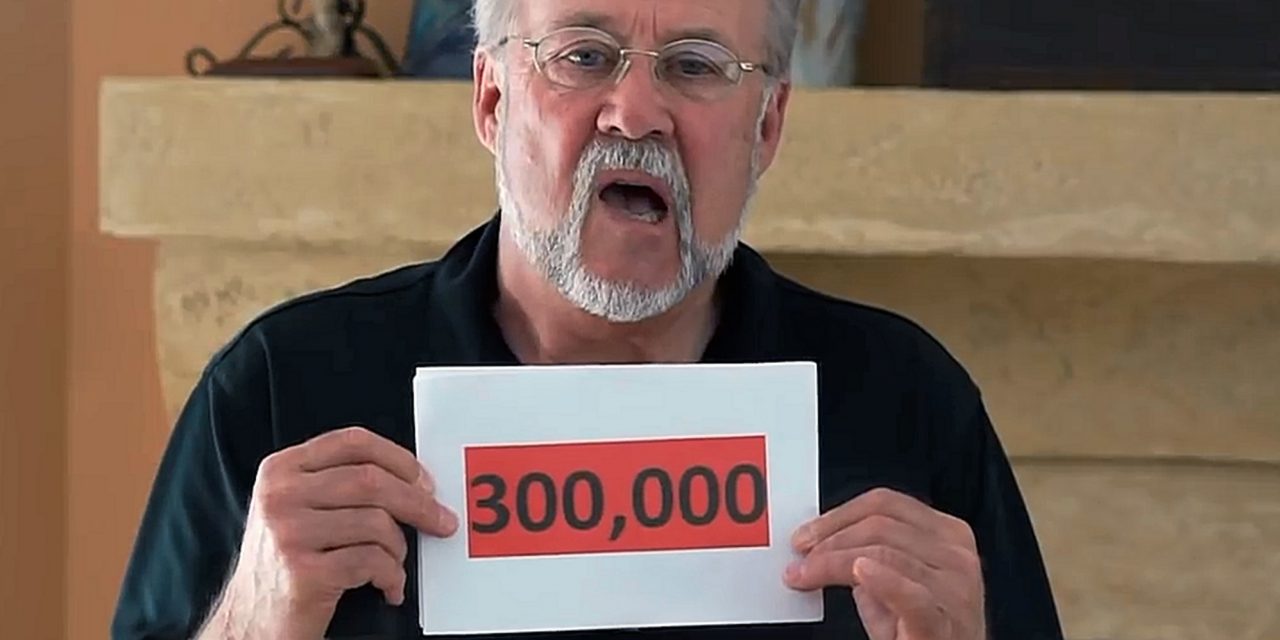

Brian Amos holds up a sign to show the number of annual visitors he expects to come to a South Okanagan national park reserve. (Screenshot from “No National Park Reserve”)
Ever since Oliver resident Brian Amos released an apocalyptic video in the spring about the proposed national park reserve, a figure cited in his video has become conventional wisdom among park opponents – 300,000 visitors a year.
To underline this staggering number, Amos even held up a sign with 300,000 written across it in large letters in his video that now has more than 2,000 views on YouTube.
As I’ll discuss in a moment, there are serious flaws with this prediction. But for now, it’s interesting to note that this is a significant change in strategy for the anti-park side, who previously insisted that few tourists would come because there was nothing to see.
That view was still expressed by a reader on the Oliver Chronicle’s Facebook page, who recently wrote: “You would be lucky to see 10K people a year from a desert park, and most wouldn’t be spending any time or money in the area.”
Actually, desert parks are very popular. Death Valley National Park in California draws more than 1.2 million people annually, despite temperatures sometimes exceeding 50 C, though that visitation figure is very unlikely here.
So, what about the 300,000 figure?
Amos claims in his video that it’s right there on Page 10 of the “feasibility study” in black and white.
He further amplifies the number by saying he reckons visitors will stay three days and therefore there will be three times the number of people on the roads. And he claims – incorrectly – that these are additional visitors to the area beyond the ones coming here anyway.
While I wouldn’t suggest Amos is intentionally misleading viewers, the entire 21-minute video, including the 300,000 claim, is riddled with errors and inaccuracies.
To begin with, the document he claims was the feasibility study was not. This is important, because the actual feasibility study was completed at the end of 2010 and reflects a national park reserve greatly reduced in size.
When the feasibility study was done, the proposed park was reduced in size to 284 square kilometres from an original 650 square kilometres – mostly by eliminating the Snowy Mountain Protected Area.
Amos appears to be unaware of that size reduction in 2010. Several places in his video he incorrectly insists the federal government still plans to include Snowy Mountain.
In fact, the document that Amos holds up as the “feasibility study” was an “Economic Benefits Study” produced in September 2005 for a pro-park group by a Vancouver consultant. The report states clearly that it was not sponsored or funded by Parks Canada. It has no official status and never did.
That report was written even before the original 650-km2 park concept was done in 2006, and it’s now 13 years out of date. Much has changed since then.
Aside from being based on a park more than double the size of anything considered since 2010, the 300,000 figure is also a 10-year forecast, with numbers only climbing gradually each year.
And, in his attempt to describe bumper-to-bumper traffic with a “fleet of helicopters” having to deal with all the accidents because ambulances can’t get through, Amos misrepresents what the 300,000-figure means.
Of that 300,000, almost a third – 90,000 – are same-day visits. This means the people visit the park without staying overnight in the area, but just stop on their way through.
The remaining 210,000 visits are counted each time a person enters the park. So, someone overnighting outside the park is already counted additional times if they visit the park on three consecutive days.
That means Amos is wrong to multiply the numbers by three to arrive at his inflated claim of 5,000 people a day between spring and fall.
I asked Parks Canada if they could provide a more recent estimate of anticipated visitors, given that the 300,000 figure is so out of date. They couldn’t, but they made the important point that only a small percentage of visitors who visit an area specifically come because of a national park.
“Parks Canada cannot speculate on the number of visitors that the proposed national park reserve in the South Okanagan-Similkameen would welcome,” the agency said in an emailed response.
A 2008 Social and Economic Impact Assessment, while dated, still provides valuable information, Parks Canada said.
“Visitation would be small and gradual and would likely increase once the park is fully developed with visitor amenities and broader levels of public awareness,” the statement continued. “Many visitors to the region would likely extend their stay to visit the proposed park and area.”
Some national parks such as Banff and Waterton Lakes are unique in that they provide a specific draw for tourists.
However, a national park here would be expected to reflect the experience of other parks in North America and Europe where it was found that only seven to 12 per cent of visitors come to the area specifically because of a national park, Parks Canada said.
So, what will the actual number be? Probably something well between the pessimistic prediction of the guy who suggested we’d be lucky to see 10,000 and the outdated and overly optimistic 300,000 figure.
And, with the possible exception of Banff, which gets more than 4 million visits a year, none of the more than 40 other national parks in Canada see the kind of chaos on the roads that Amos predicts.
RICHARD McGUIRE
Osoyoos Times




Many people support the National Park.
Many people oppose the National Park.
There is no right or wrong here . . . just different opinions.
Bob Parker
National Park Supporter