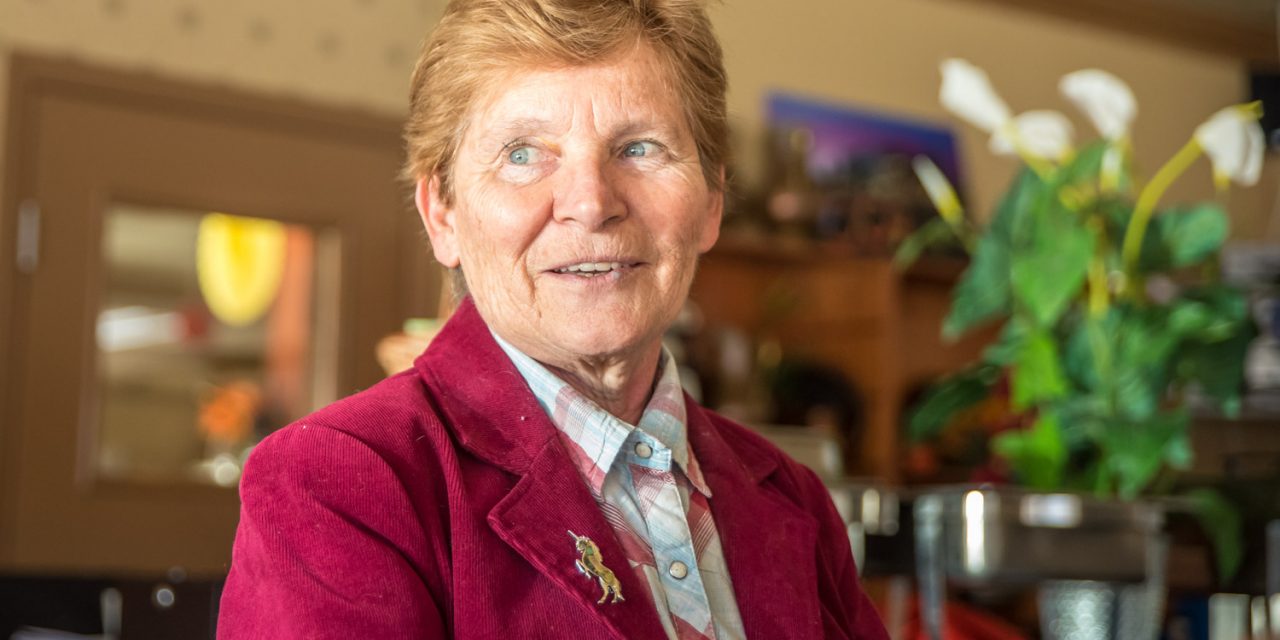
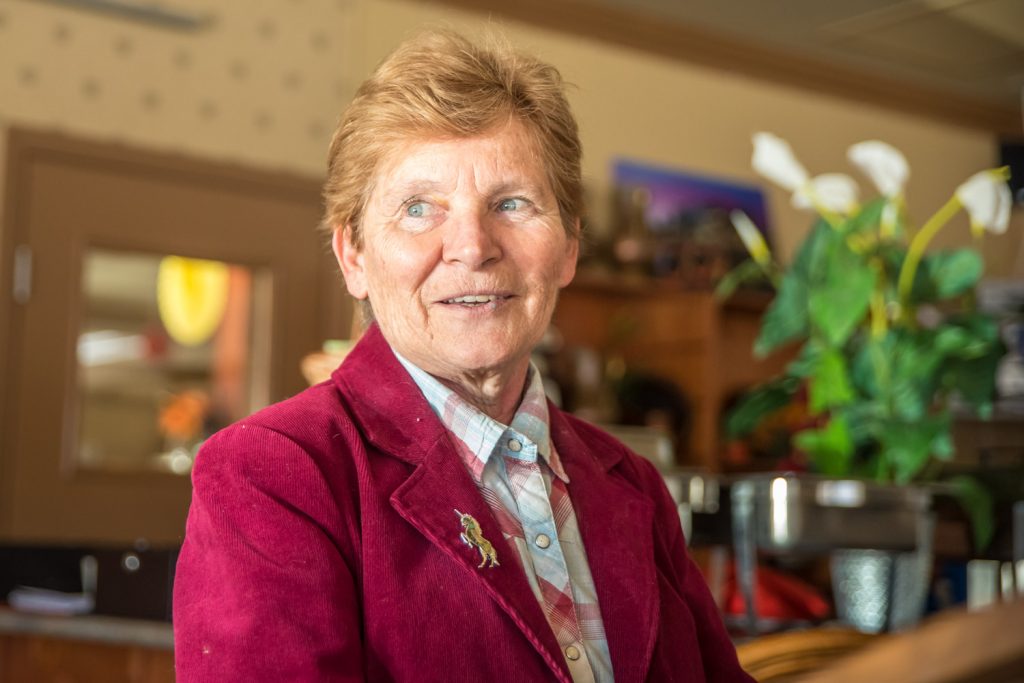
Paddy Head, vice president of the Desert Park Exhibition Society, was guest speaker last week at the Rotary Club of Osoyoos. She spoke about plans for Desert Park as well as her own career as a pioneer female jockey in the 1970s and 1980s. (Richard McGuire photo)
When Paddy Head was a young jockey in the 1970s, she was once offered a bribe to slow down her horse and lose.
She was the only female jockey in a career dominated by men and was the only one that day to refuse to participate in rigging the race.
In the end, her horse placed third, even though she admits it should never have done as well.
Head, who brings that same feisty determination to her volunteer job as vice president of the Desert Park Exhibition Society, last week outlined her plans for that facility in a presentation to the Rotary Club of Osoyoos.
Key among the plans is the return of the Lance and Tilt jousting event on the May long weekend.
“That is going to become, I believe, our big annual event,” Head told the Rotarians. “This year the planning has started.”
Because she was so busy with other tasks last year, there wasn’t time to sufficiently promote the event or to hold a medieval village, which was part of the original plan.
“We are getting it together for this year,” she said. “We already have some vendors signing up. We have entertainers. We’re going to have Celtic music.”
Despite only three weeks of advertising last year, the event drew an estimated 1,200 people over two days. This year Head hopes for 2,000.
“We’re definitely getting the news out right now,” she said. “It’s a very unique event. A lot of tourists were there.”
Horseracing has, of course, been the main event at Desert Park the past four years.
Head is hopeful it will return, but she admits there are challenges as it’s difficult to raise the roughly $25,000 needed for purse money.
“I’m keeping my fingers crossed that we’ll have racing again this year,” she said. “If we can get it going, we would have two [days], but more than likely it would be one.”
Horse racing, she admits, is in decline in North America. Osoyoos is the last community in B.C. to offer “B” circuit racing, which allows smaller stables with one or two horses to participate.
B circuit racing did extend around B.C. and Washington, but five years ago, it started to dry up, she said.
Less well known is that Desert Park is used for the training of race horses roughly from the beginning of February to the beginning of April.
Last year 158 horses trained at Desert Park, breaking previous records, but Head admits she “got a little bit enthusiastic” and it was a lot to handle. This year a more modest 80 horses are expected.
About three quarters of the horses come from Alberta, which is still deep in winter at that time of year. Others come from such places as Washington and Saskatchewan.
She plans to run several tours this year allowing the public to see the horses galloping and allow them to ask questions of the trainers and jockeys.
“I’ll probably start doing it towards the end of February because by then the horses will be doing some speed work and that’s always fun,” she said. “If you’ve never been there and seen them, they go pretty fast and it’s awesome.”
But while Head came to talk about the facility, she was also asked about her background. And she recounted some stories about her experiences as one of the first female jockeys in a male-dominated field.
Back in 1970, she was working in a stable, six and a half days a week for the grand sum of $50 a week.
“Horse people are a little bit crazy, but we’re passionate, I guess,” she said.
Then she read a newspaper story about a female jockey, Joan O’Shea, who became the first woman jockey in Ontario and the first to win at the Woodbine racetrack in Toronto.
“I remember looking at it and thinking hmmm. I don’t think I’m going too far cleaning stalls,” Head recalls.
Three years later, at the age of 23, she ran her first race at Blue Bonnets Raceway in Montreal where she was from.
“It was pretty rough,” she said. “Most of the trainers, a lot of the owners and some of the jockeys weren’t too thrilled to have women there.”
She recalls that often she would spend about a month galloping horses in the morning for little or no money. Then, when it came time to race the horse, she would be told by the trainer that the owner didn’t want to use her.
“The racetrack was very traditional, very patriarchal,” she said. “They would say women weren’t strong enough, women were too emotional. Oddly enough, it’s a known fact that horses get along with women generally than with men, so maybe there was a little bit of fear there.”
Sometimes jockeys would try to bully her by cutting her off when they passed and forcing her into the rails – something she thinks was often directed at all new jockeys and not just women.
One day, she told her trainer that she wanted to use the big black mare she was riding to send a message, even though she would probably get suspended. It would be worth it.
“He said great, go ahead,” she recalls. “So I did. I think of about 11 other jockeys, I got six of them. I shut them off, bounced them off the rail.”
To her surprise, she was not suspended. The steward merely suggested with a nudge and a wink that she should tell her trainer to put a little more training on the horse.
“I knew that he knew what was going on,” she said.
After that, the other jockeys treated her like another one of the boys.
Much of Head’s jockey career was spent in Boston where she was naively unaware of the Mafia involvement in the racing industry.
It was about three years into her career that a stranger approached her and offered her $300 “if I would hold my horse,” or slow it down.
“I said ‘absolutely not,’” she recalled.
When she told her trainer, he laughed and said she should have taken the money because her horse couldn’t win. Besides, there were eight other riders in the race and she was the only one who turned down the bribe.
Head asked him if the mobsters would shoot her if she rode out in front, but the trainer said they wouldn’t. Instead, they would probably try to get her in the starting gate, because the gate handlers were in on it too.
Her horse was very nervous and did require a handler at the gate. And sure enough, when the gate opened, the handler held onto the horse for a split second. The horse got upset and reared.
Head managed to hang on, though she was about six lengths behind the last horse. But her older horse was so angry that he ran all the way, finishing a surprising third.
“I had a wonderful career,” said Head. “Whether you’re male or female, being a jockey is a tough profession, but it’s one of those things that if you have a passion, you’re going to do it no matter what.”
RICHARD McGUIRE
Osoyoos Times