By Don Urquhart, Times Chronicle
The Okanagan has returned to Drought Level 2 as the ongoing heatwave has erased gains made in above average rainfall in May and June, with mounting concern over water for firefighting and fish survival.
The Okanagan Basin had begun 2024 at Drought Level 2 due, in part, to low snowpack, the Okanagan Basin Water Board (OBWB) said in an advisory.
After the rain events in May and June, the Okanagan was downgraded to Level 1 but the recent heatwave, low stream flows and increasing water temperatures have prompted the Province to move the Okanagan back to Drought Level 2.
“In consultation with Okanagan utilities and Okanagan Nation Alliance’s fisheries department staff, the Province has increased the drought level back to 2 (Very Dry). At this level, there is an emphasis on curtailing unauthorized water use and water suppliers may consider implementing water restrictions,” it said.
“Okanagan water purveyors should continue to monitor supplies and customer demand closely and communicate the importance of conservation with customers as we enter a low flow period,” the OBWB urged.
Low snowpack last winter and an early melt meant the Okanagan did not fully recover from the 2023 drought. Considering water supply conditions, the province moved on May 2 to set the Drought Level at 2.
The OBWB noted that thanks to some precipitation in May and an improvement in stream flows, the Okanagan was then downgraded to Drought Level 1 on May 30. June – typically the wettest month in the Okanagan – saw about normal precipitation; An improvement over the past few years when June was very dry.
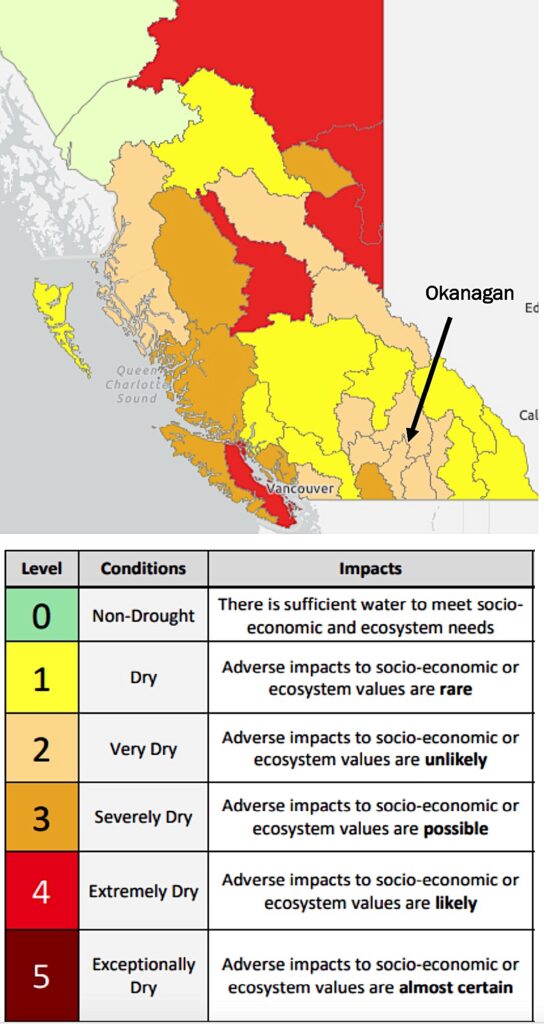
Provincial drought level map on July 18, 2024 Source: BC Drought Information Portal
“As temperatures rise and water supplies begin to drop in some areas, there is concern about ensuring enough water for the valley’s most important needs, including firefighting,” the OBWB said.
It was also noted that exterior wildfire sprinklers are increasingly being used by residents to help protect their property when wildfires break out nearby.
The problem however is that widespread use of these sprinklers when connected to shared water systems can impede the available water supply used by firefighters during a wildland-urban interface fire. This has already been an issue for some fire departments trying to respond to recent wildfires, the OBWB noted.
The current guidance from firefighting officials is to leave the sprinklers connected at the end of the driveway but left off for fire crews to turn on as needed.
The current heatwave has brought air temperatures over 35°C and water temperatures in some creeks reaching 27°C, which is concerning for fish mortality the water board said, adding that many creeks across the watershed are also seeing a rapid drop in flows.
The Okanagan basin is an extremely important region for fish, the OBWB said, pointing to Sockeye, Chinook, Steelhead and Coho (in small numbers) which use Okanagan tributaries for spawning and rearing. The Okanagan is also home to resident Kokanee, Rainbow Trout and Whitefish.
“These fish species are culturally important to the syilx nation, support a vibrant fishery, and are critical for healthy freshwater systems.”
Current temperatures in many streams are warm enough to cause a significant risk of fish fatalities as fish require cool water temperatures and likewise, low stream flows can impede fish migration and lead to fish getting stranded, according to the OBWB.
“Ensuring stream flows are meeting environmental flow thresholds helps prevent significant or irreversible harm to the stream’s aquatic ecosystem,” it added.
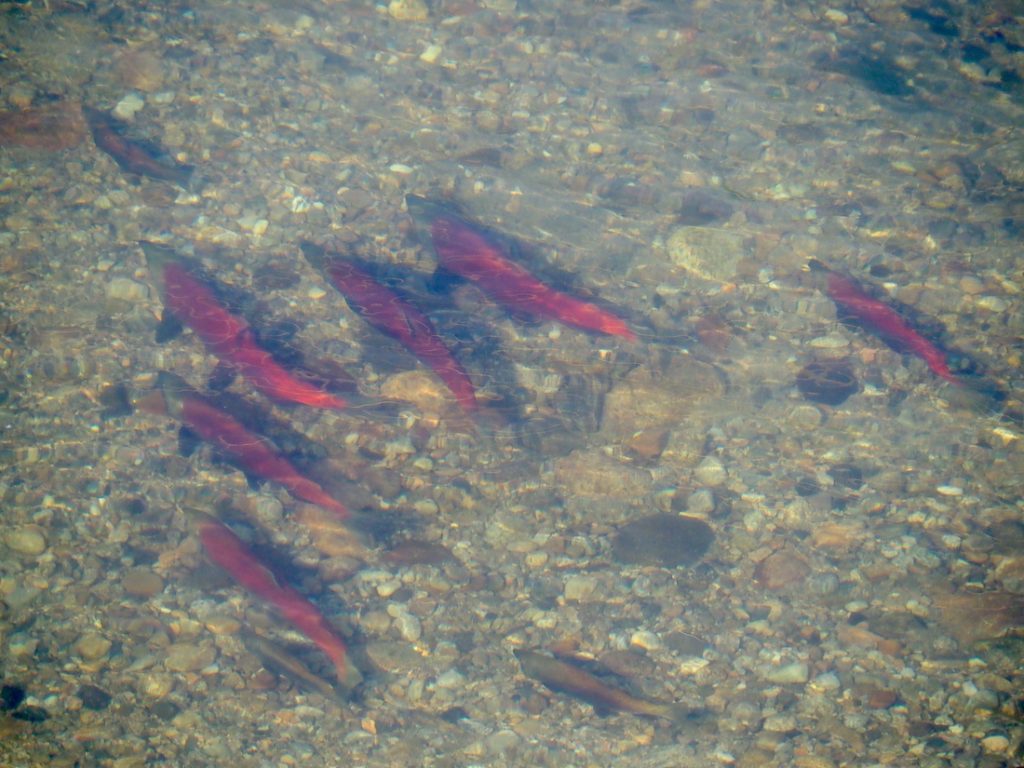
Spawning salmon in the fall with their distinctive colour on the Okanagan River just north of Oliver.
Don Urquhart photo
Local water restrictions (stages) are set using different indicators than provincial drought levels, and water supply conditions vary across the region. Whether a utility moves to a higher restriction stage depends on several factors, including customer demand, infrastructure capacity, and local water supply conditions.
Several Okanagan utilities have increased their water restrictions. These can be found at MakeWaterWork.ca. Water license holders on streams and wells who are not customers of local water utilities should adhere to conservation measures communicated by the Province, the OBWB said.
“Make Water Work” is an annual valley-wide residential outdoor water conservation campaign, delivered between spring and fall by the OBWB’s Okanagan WaterWise outreach and education program and with water utilities throughout the valley.
One aspect of this program is the promotion of the “Make Water Work Plant Collection” which is promoted and available at garden centres throughout the valley. New this year, the OBWB partnered with FireSmart BC to note the many plants on the list that are also FireSmart.