By Lyonel Doherty, Times Chronicle
For Clarence Louie, receiving an honorary doctorate last week paled in comparison to honouring the Mohawk warriors who defended their land during the Oka crisis in 1990.
The chief of the Osoyoos Indian Band (OIB) visited the famous site in Quebec during his trip to Ontario to receive the Queen’s University award on Oct. 14.
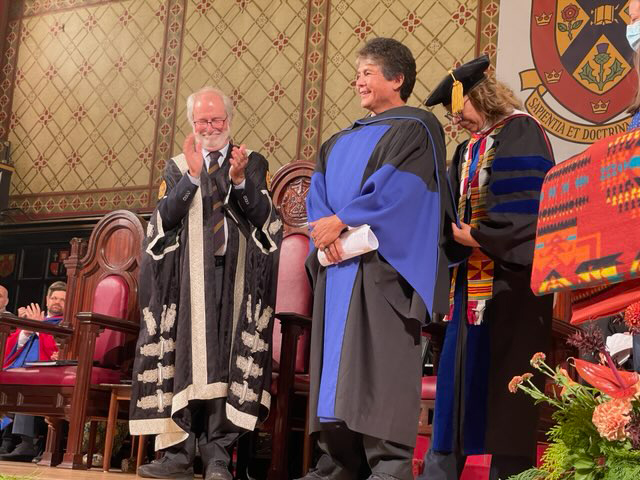
Louie was one of seven leaders who crossed the convocation stage for outstanding achievement in a wide range of fields, including law, music and engineering, as well as their immense contributions to local, national and global communities. Louie received the degree of “Doctor of Laws.”
In its presentation, Queen’s stated that the OIB Development Corporation (OIBDC) was formed in 1988 under Louie’s leadership. As CEO, he has developed more than 11 successful on-reserve, OIB-owned businesses and five joint ventures in pursuit of economic self-sufficiency for the community.
“For over 30 years, Chief Clarence Louie has been a champion for the Osoyoos Indian Band’s working culture, inspiring generations not only within the band but around the world with his message about self-empowerment through employment, hard work, and community building,” Queen’s said.
Louie is quoted widely in the media and is a highly sought-after speaker for his strong views on the link between economic development and First Nations self-reliance.
Queen’s stated that Louie wants to “build an Indigenous economy where First Nations business people and leaders not only participate in the mainstream of Canada’s business economy, but more and more, take a stronger leadership position to shape environmentally and socially responsible outcomes that still feed the bottom line.”
But Louie told the Times Chronicle the doctorate is recognition for the OIB, not him.
The chief said he always brings a group of band members, especially youth to witness these award ceremonies. He noted his surprise that Queen’s has 20,000 students, more than the population of Oliver and Osoyoos combined.
“It was nice to be on a campus; it reminded me of my ‘starving student’ university days.”
But Louie said the trip’s highlight was a visit to “The Pines,” where the Oka crisis conflict took place in the summer and fall of 1990. He stated this was the place where the Mohawk warriors defended ancestral burial grounds and stood up to the Canadian Army while doing it.
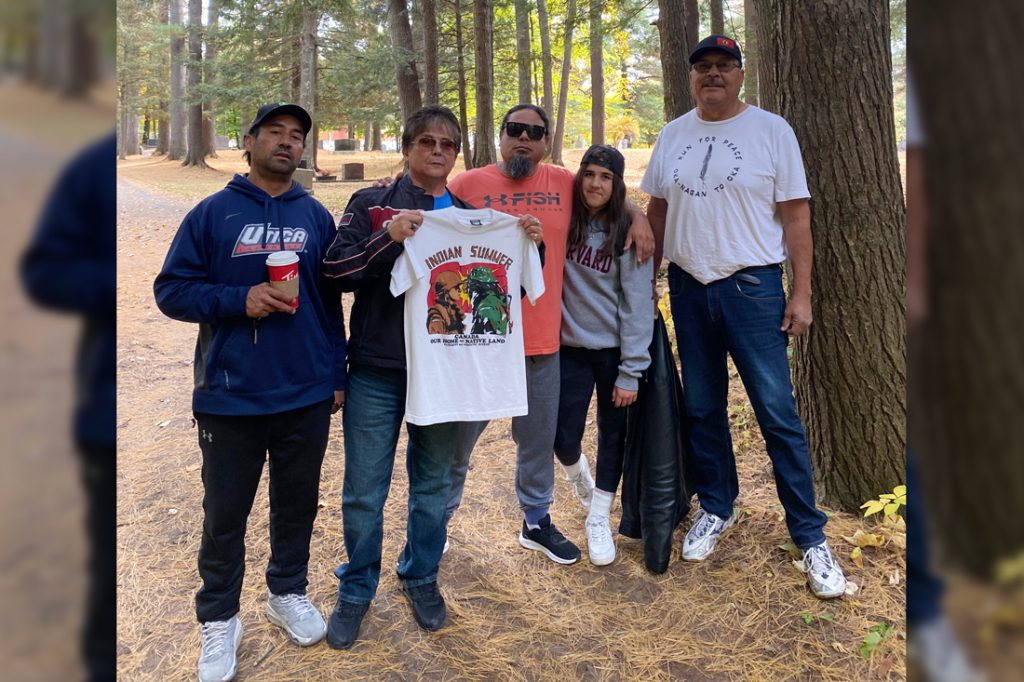
Chief Louie and members of the OIB gather at “The Pines” to honour the Mohawk warriors who defended their land during the violent Oka crisis in 1990.
Contributed photo
“I had always wanted to stop by and pay my respects to the Mohawk people and the actual site they protected,” Louie said.
The chief recalled how Okanagan Indian bands came together to send a group of runners carrying an eagle feather to Mohawk territory. It was called the “Run for Peace.” He noted the bands raised thousands of dollars to pay for all the expenses, adding that many members of the OIB participated in the run to “The Pines.”
The crisis, also known as the Kanesatake Resistance, was a 77-day standoff between a group of Mohawk people and the town of Oka, Quebec, which began on July 11, 1990.
The protest was against a court decision to allow a golf course expansion to proceed, resulting in Mohawk warriors erecting a barricade to block access. The ensuing clash with authorities led to a gun battle and the subsequent death of a police officer.
Negotiations reportedly ended the protest, but some argue the land dispute remains unresolved.
The crisis was known to have brought Indigenous issues to the forefront in Canada.