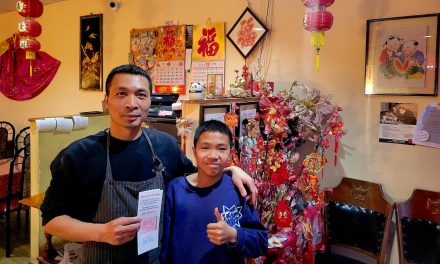

Giselle LeClair spoke to Osoyoos Rotarians last week about her trip to the north and south of India. (Richard McGuire photo)
When Giselle LeClair arrived in New Delhi, India after 23 hours of plane travel, the first thing that struck her was the noise.
“The noise was the thing that was most overwhelming for me,” LeClair said in a talk last week to the Rotary Club of Osoyoos. “The reason was anything that had wheels – a bicycle, a motorcycle, a tuk-tuk, a van or car of any kind had a horn.”
In India, the horn is the way drivers communicate as haphazard streams of traffic, as much as five a breast on lanes built for two, weave in and out treating traffic signals as “just a suggestion.”
“It was beep-beep I’m behind you, beep-beep I’m beside you, beep-beep I’m in front of you, beep-beep get out of my way, beep-beep I’m going to run you over,” she said.
“The traffic was incredible,” said LeClair. “It wasn’t just cars, bicycles and motorcycles. It was cows, pigs and goats and people walking with carts.”
It didn’t help with the noise that LeClair arrived during Diwali, India’s main holiday.
“For an entire week, 24-seven, they lit firecrackers,” she said. “I don’t just mean they lit them and stopped. I mean constantly. Like all night, all day, firecrackers.”
Other aspects of India such as the crowds didn’t overwhelm her nearly as much as the noise, she said.
But her 29-day trip through northern India, with a journey to the two southern states, wasn’t all in noisy places.
There were also excursions into the mountains, tea plantations and the idyllic backwaters of Kerala only accessible by boat.
Although the trip was LeClair’s first to India, she had previously spent a summer in Guyana teaching teachers to teach. With about 40 per cent of its population of East Indian origin, Guyana shares many cultural similarities.
Admitting that her husband is less adventurous than she is, LeClair said she travelled to India instead with a female friend who had always wanted to go.
“The question that came from anybody who I told that I was going to India was, ‘Why?’” she said. “Not, ‘well that sounds like a great place to go.’ It was like, ‘Why are you going to India?’”
The place that made the deepest impression in an unsettling way was Varanasi, the Hindu holy city on the Ganges River where the devout go to bathe in its holy waters or to die and be cremated.
“It’s an experience that you have to actually see, but it’s an amazing place,” said LeClair, describing how tens of thousands of people make their way down to the river banks every night or at sunrise as priests perform ceremonies.
“At one point it shook me so that I called it ‘holy hell’ because there were so many people and it was so intense,” she said.
But other parts of India impressed her in a more pleasurable way: Agra with the Taj Mahal and its semi-precious stones inlaid in marble; Udaipur, a city of white buildings on a lake; Pondicherry in the south with its remnants of French culture; and Cochin, a trading port in the south that has seen visitors from throughout the ancient world.
The two women always travelled with a guide and a driver, though these changed throughout the trip as they went from place to place, usually just spending only one to three nights.
LeClair offers two pieces of advice to those planning to visit India for the first time.
First, it’s not like the India we know in North America where restaurants serve one type of northern Indian food and women all wear saris. India is much more diverse.
Second, she advises visitors to talk to the local people as much as possible to learn about their country.
“As much as it’s wonderful to see all the sights, engage as much as you can with the people, because that’s the real India,” said LeClair. “Don’t be afraid.”
RICHARD McGUIRE
Osoyoos Times
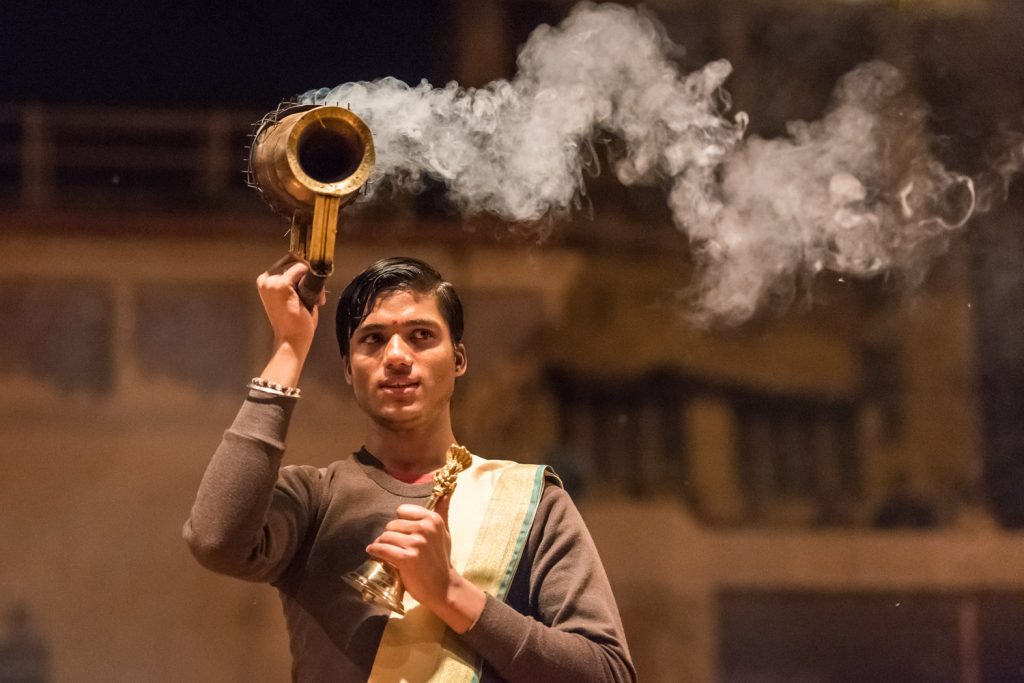
A Hindu priest performs during an evening ceremony by the Ganges River in Varanasi. (© Richard McGuire Photo)