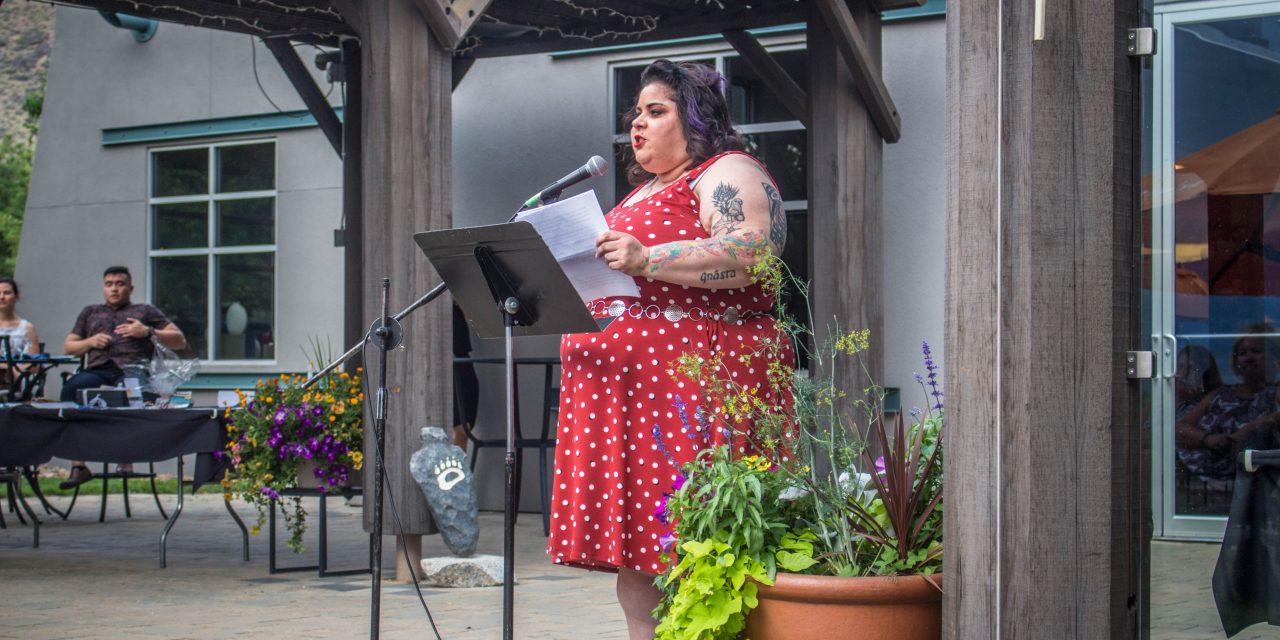
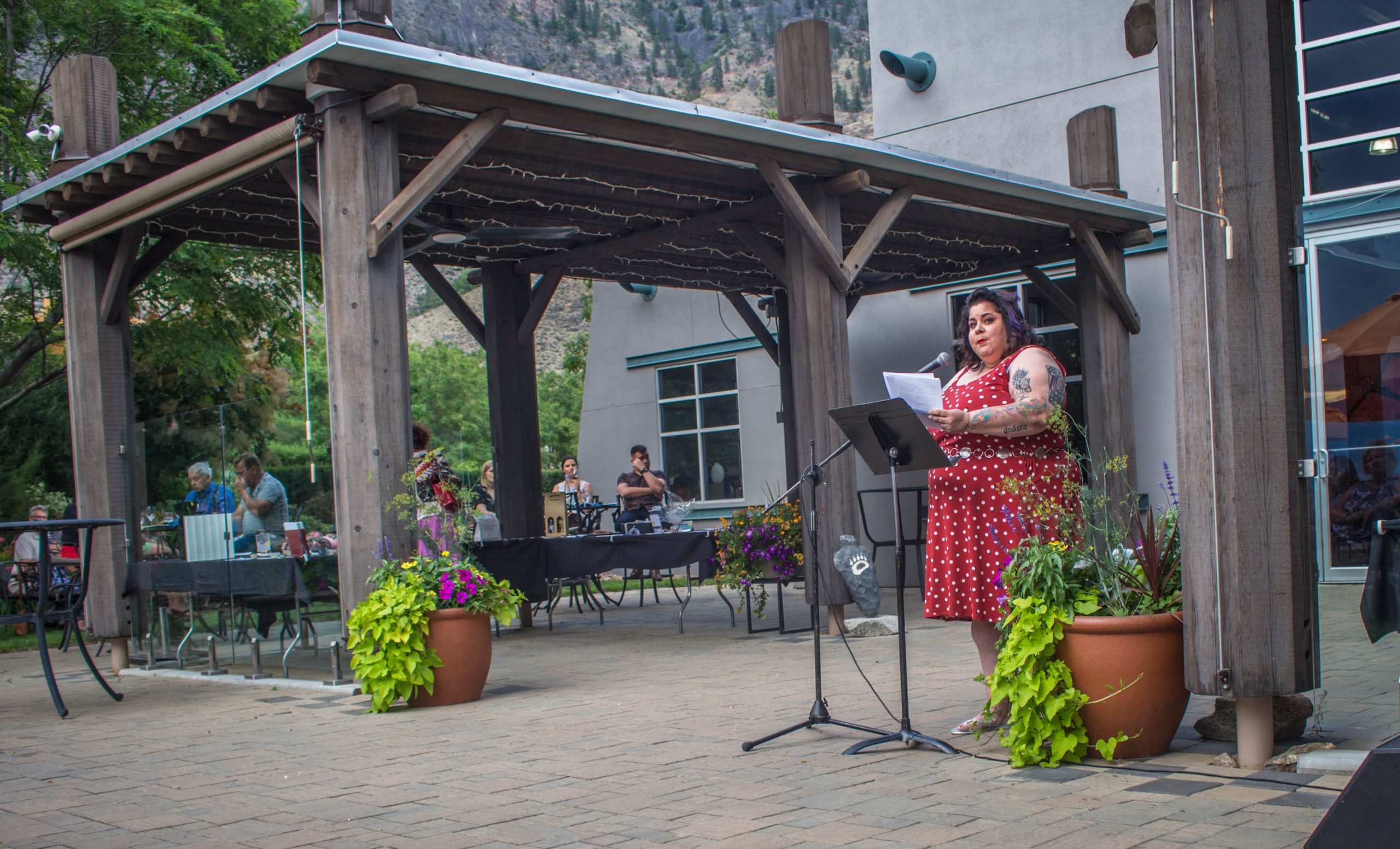
Former sex worker, now advocate against the industry Trisha Baptie spoke at a fundraiser for REED on July 13 at Nk’Mip Cellars. (Vanessa Broadbent / Osoyoos Times)
By Vanessa Broadbent
Osoyoos Times
The last time Trisha Baptie visited the Okanagan, she stayed in a lot of different hotel rooms between Osoyoos, Penticton and Kelowna, working in the sex industry.
Now a women’s advocate, the former prostituted woman spoke at a fundraiser patio reception to benefit REED (Resist Exploitation Embrace Dignity) at Nk’Mip Cellars on July 13.
“This is happening now, it’s happening here and we can ignore it or we can choose to be a part of making a difference and this is what this opportunity is tonight,” she told over 50 attendees.
Baptie shared her story, which started with entering the child welfare system before turning 13. While determining if she should live in a group home or foster care, she stayed in a “receiving home.”
“That home was a nightmare. It was a mixed-gendered home; it had all different ages, and as a 12-year-old girl, I was repeatedly sexually assaulted by one of the young men who lived there,” Baptie said.
Over 30 years later, Baptie says she can clearly remember telling her social worker, who responded with laughter and said: “boys will be boys, just stay out of his way.”
The comment pushed Baptie to instead live on the streets of Vancouver, where she felt safer.
“After being taken in and groomed by a predatory pedophile, I was raped and given money for the first time around my 13th birthday,” she said. “This would be the start of me being involved in the sex trade for the next 15 years.”
• Read more: Desert Centre Society thanks donors for pitching in for new building
Working in Vancouver’s East Side, Baptie’s friends, one by one, went missing, and their bodies were later found on the farm of Robert Pickton.
At the age of 28, Baptie left the sex industry and went on to cover the Pickton trials for online publication Orato, with a narrative that was “rooted in truth.”
Following the trial, she founded EVE (formerly exploited voices now educating), and advocates for the abolition of the sex industry alltogether. While Baptie, and REED, agree with decriminalizing prostitution for women in the industry, they advocate against the legalization of purchasing sex. Under Prime Minister Stephen Harper, the Conservative government passed similar legislation in 2014.
“When we talk about the sex industry, we’re not talking about a sector that wants highly-educated mature women,” she said. “It demands our youngest, our most vulnerable, marginalized and desperate girls and women.”
While some women may choose sex work, Baptie claims that women are funneled into the industry by issues including poverty, addiction, colonialization, mental health issues, abuse and threat of violence.
“If we then look at the men that are trying to purchase sex, we can see they have more power than these women and girls and are using their money to exploit women or girls to get their compliance,” she said.
• Read more: WW2 Veteran, 93, flies in American bomber
Baptie credits her leaving the sex industry to a support network of women.
“Exiting prostitution isn’t an easy, straight-forward process; it isn’t easy to disentangle your life, regardless of whether or not it was healthy,” she said.
“It’s the only life I knew, and you’re asking me to give that up? I have rent, I have kids to pay for, I have no education, I have nothing to put on a resume, and you’re asking me to leave?”
Women leaving the industry need access to finances, counselling, help with trauma and PTSD, a safe place to live, but most commonly: “a confidante, someone to rely on, someone standing beside them, encouraging them as they navigate a new life one situation at a time.”
“This is the gap that REED fills for women,” Baptie said.
“They help transition out of exploitation. They provide solidarity with the brave women who reach out of their exploitation and whether it is just a whisper of a different life, or a woman who is fully out and just needs an ear, REED is there.”
Through ticket sales, a silent auction, and a portion of wine sales the fundraiser brought in over $3,500 for REED. Donations can still be made at embracedignity.org.