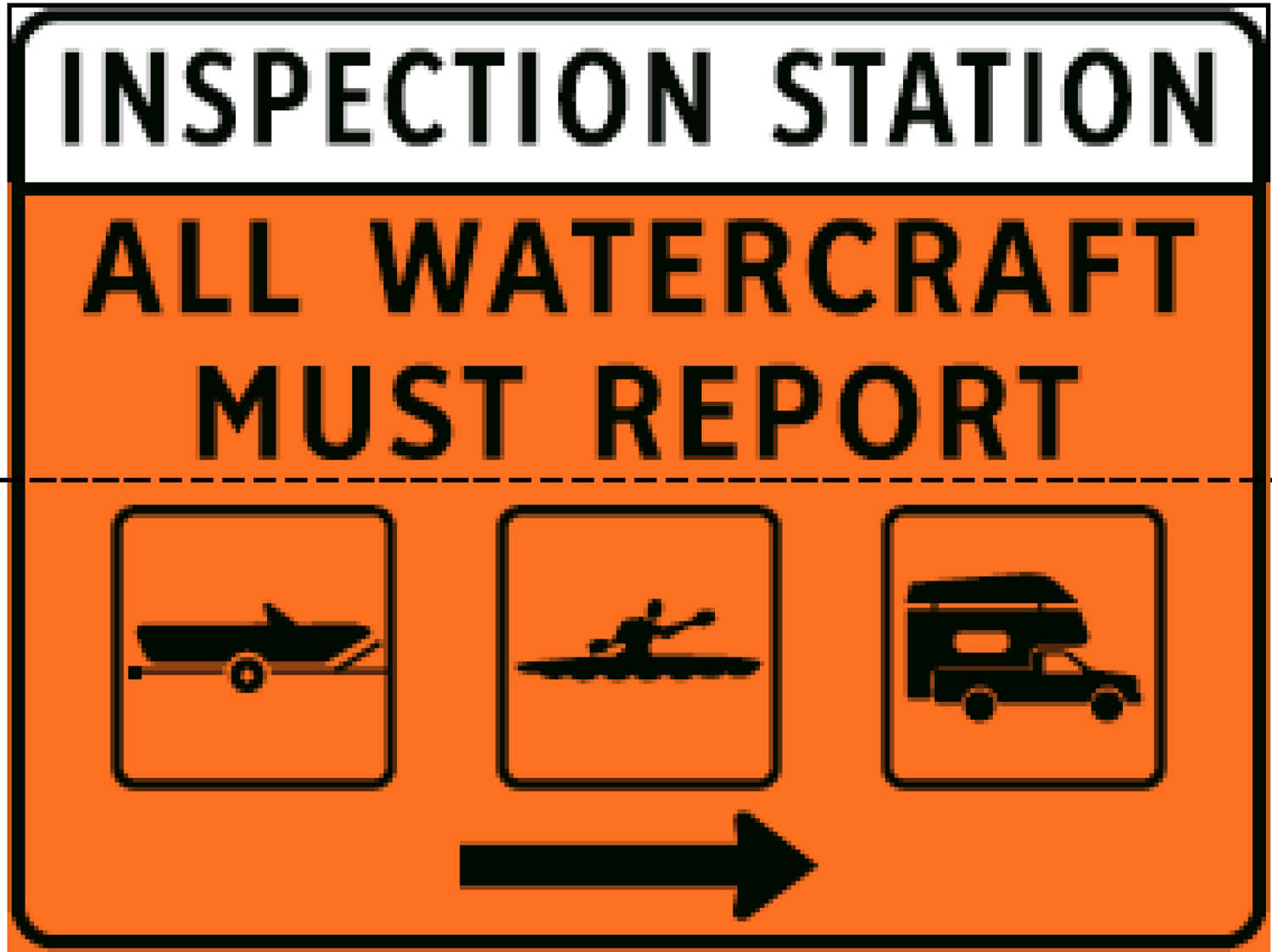
New signage aims to convey to motorists that they must stop at inspection stations if they have any kind of watercraft, whether motorized or not. This includes canoes or kayaks whether towed or on the roof. Invasive zebra and quagga mussels have been spread throughout North America mainly on watercraft that haven’t been sufficiently cleaned, drained and dried after being used in infested waterways, causing billions of dollars damage. (B.C. Ministry of Environment)
Provincial inspections for invasive mussels that started April 1 are finding a disturbing number of suspect and contaminated boats coming to the Okanagan.
This has prompted the Okanagan Basin Water Board (OBWB) to call for a stronger provincial program.
They are asking for an extension of opening hours for inspection stations beyond the current 10 hours a day and for mandatory reporting to an inspection station before a boat coming from outside B.C. is launched in B.C. waters.
As of June 6, the five inspection stations along the B.C.-Alberta border and three along the B.C.-Washington border had inspected 3,200 watercraft.
Of these, 124 were identified as being high risk for carrying invasive mussels. Six were found to be transporting adult invasive mussels, with a good chance they were still alive.
In total, 16 boats were quarantined in order to meet the required 30-day period from when a boat has been used in infested waters to when it is considered free of living mussels.
Anna Warwick Sears, OBWB executive director, said the numbers exceed what was expected.
“It’s deeply worrisome,” she said. “It’s pretty troubling.”
Zebra and quagga mussels are not native to North America, but since the 1980s they have spread to waterways across the continent, mainly by clinging to recreational boats that have not been properly cleaned, drained and dried.
They have caused billions of dollars in damage by encrusting themselves on water intakes, docks, boats, hydro facilities and other infrastructure, and they have destroyed beaches by covering them with the razor-sharp shells, impacting fisheries and tourism.
Although the provincial government estimates the annual cost to mitigate invasive mussels at $43 million, this cost doesn’t take into account the impact on fisheries, tourism and property values.
The OBWB, however, estimates the cost would be $43 million to the Okanagan alone.
“We’ve been calling for action since 2012, concerned that we were at risk for an infestation of zebra and/or quagga mussels,” said Doug Findlater, chair of the OBWB. “These stats demonstrate this is a real possibility. Remember, one mussel can reproduce a million. It only takes one to devastate our lakes, our drinking water, tourism, fishery, beaches and economy.”
In May, a driver hauling a boat failed to stop at an inspection station near Elko, B.C. in the Fernie area. The station was only manned by an auxiliary officer, who wasn’t empowered to pursue the vehicle.
When a law enforcement officer chased down the driver, the boat was found to be carrying invasive mussels and was decontaminated.
The OBWB says more fully empowered conservation officers would help to address this problem.
But the OBWB wants the province to revise its legislation to require reporting to an inspection station before a boat from outside the province can be launched in B.C. waters.
Currently, drivers with watercraft are only required to report for inspection when they pass an open inspection station.
A further issue is that many people transporting non-motorized boats, such as kayaks or canoes on their car roofs, aren’t aware they are also required to stop for inspection, said Barb Leslie, aquatic invasive species inspector with the B.C. Conservation Officer service.
Signage has been improved to make this clear, she said.
Leslie and Martina Beck, invasive mussel program co-ordinator, spoke to Osoyoos town council Monday about the threat posed by mussels and what the province is doing to try to stop them.
In addition to watercraft, Leslie pointed out that mussels can be spread on anchors, ropes, life jackets and wet suits and other objects that enter infested waters.
At the larvae stage, mussels are impossible to see, so inspectors look for signs of standing water on the boats, indicating they haven’t been properly cleaned, drained and dried, she said.
Not every boat is thoroughly inspected. Instead, inspectors try to identify high-risk boats by asking where the boat has been in the last 30 days and how long it has been out of water.
The highest risk boats are those that have been in contaminated states or provinces and have been out of water for less than 30 days.
Statistics from 2015 show that by far the main B.C. destination for high-risk watercraft is the Okanagan.
With the start of inspections in the Lower Mainland in 2016, that area is now coming close to matching the Okanagan as a destination for high-risk boats.
While the B.C. Conservation Officer service handles inspection stations along roads from the B.C.-Alberta border, the federal Canada Border Services Agency (CBSA) has jurisdiction at the Canada-U.S. border and provincial officials play a supportive role if inspection or decontamination is needed.
The OBWB is concerned, however, that not all points of entry (POEs) into Canada place the same priority on stopping a potential infestation of invasive mussels.
“We call on all POE chiefs of operations to require mandatory enforcement of the (federal) aquatic invasive species regulations through the use of the Uniform Minimum Protocols for Watercraft Interceptive Programs,” said Findlater, the OBWB chair. “The legislation is in place, but it needs to be enforced.”
The OBWB is also calling on the federal government to provide funding to the prairie provinces and B.C. to help contain the current infestations of zebra mussels in Manitoba’s Lake Winnipeg and Cedar Lake near the Saskatchewan border to stop their spread westward.
Leslie, from the Conservation Officer service, acknowledged that although the province talked about permanent inspection stations when it announced this year’s program at the end of March, the stations are in fact mobile, which she said makes practical sense.
James Littley, OBWB operations and grants manager, said there is a distinction between the mobile trailer-mounted units, which return to the same location each day near the Alberta border, and the past practice of “roving” or “pop-up” inspection stations.
In the south, the stations may be in different locations, or may be responding to calls from the CBSA at crossings like Osoyoos, he said.
Because most customs stations operate 24 hours a day, OBWB’s concern with these is only that some stations may not be performing inspections because customs officials are more concerned about border wait times, Littley said.
The concern at the eastern flank is that if inspections only operate during the peak 10-hour traffic periods, they may miss watercraft coming in at off hours.
“Ultimately, it will not matter how many boats they did inspect,” said Littley. “(What matters is) only those that are missed and get into our waters with invasive mussels.”
RICHARD McGUIRE
Osoyoos Times