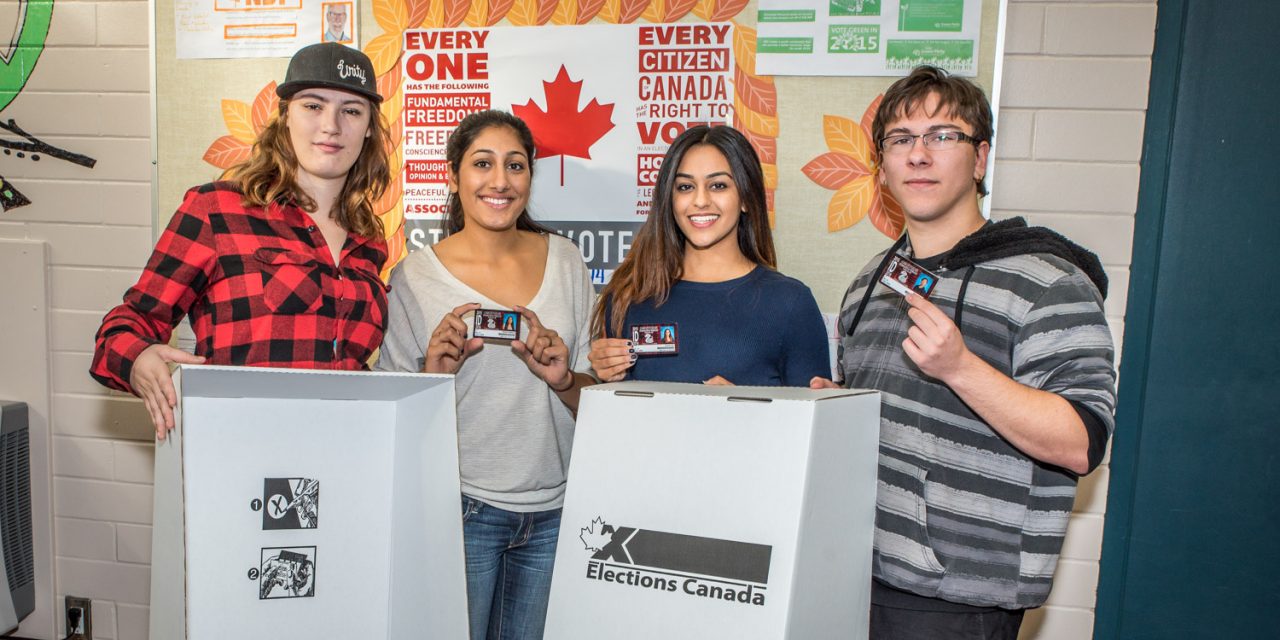
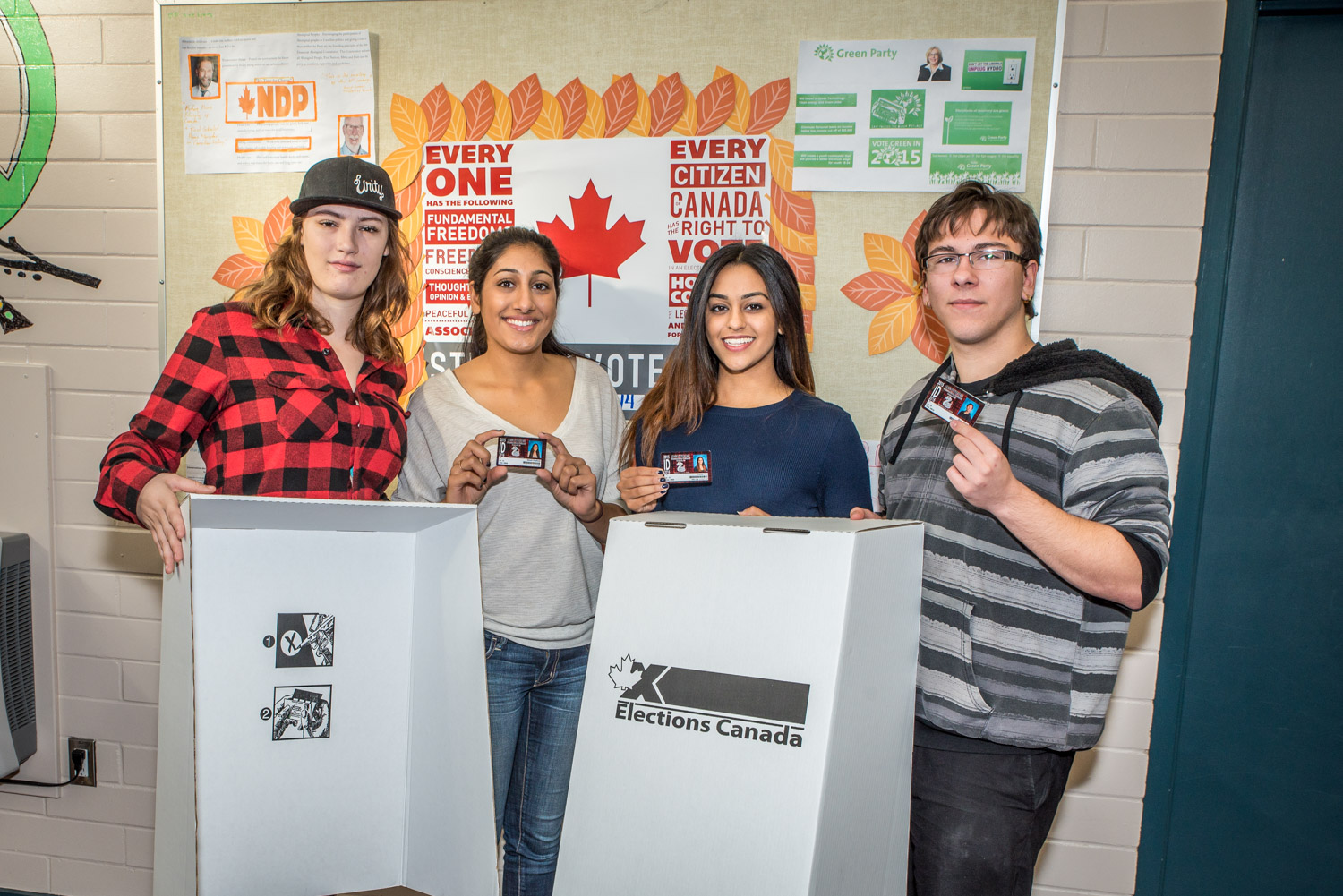
When adults go to the polls next Monday, students at Osoyoos Secondary School will already have voted. The students have been learning about the election process through a school-wide mock election that takes place Wednesday, Oct. 14. The school has integrated the Student Vote program from the non-profit group Civix into its teaching, using it for social studies, English and other subjects. From left are Grade 12 students Katrina Hahn, Nimrit Dhaliwal, Pawan Rai and Russ Hurst. Many students had almost no knowledge of politics before the exercise, but now they say they’re better informed. (Richard McGuire photo)
They’re still not old enough to vote in next week’s general election, but students at Osoyoos Secondary School (OSS) will be casting ballots for federal candidates on Wednesday.
It’s the first time in recent memory that the entire school has taken part in a mock election, said Catherine Scott, who has used it as a teaching opportunity in her English class by having students put together an election-related newspaper.
On the walls of OSS are posters for the four political parties designed and drawn by the students. Students from all grades will vote in the library behind voting screens provided by Elections Canada. Younger students will act as poll clerks, checking student ID cards. Vouching is allowed in cases where a student has forgotten to bring their ID.
The idea was hatched when teachers Natasha Schroeter and Doug Short attended a conference in Vancouver in February where they learned about a program organized by Civix, a non-profit charity dedicated to building citizenship skills and habits among young Canadians.
Civix has developed a program called Student Vote, which aims to introduce students to voting before they are old enough to vote officially.
The school program has been broken down into lessons that integrate different subject areas ranging from social studies to English.
Schroeter said when she and Short brought the idea back to OSS, the school embraced it.
She hopes to spark interest in having math teachers engage their students in analyzing the data after the vote.
“It’s great whenever we can do a cross-curricular kind of event, because it shows kids that learning isn’t just about what’s happening in one classroom, but that it overflows into other classrooms,” Schroeter said.
Before the program was introduced, many students had almost no idea about politics or current affairs.
Each class may have one student who watches news and talks with their parents about politics, but these are the exceptions, said Scott.
“Most of the time politics is not something we’re supposed to talk about, and so we don’t,” she said, adding that students do learn about government in Grade 11, so the older students have some knowledge.
Pawan Rai, a Grade 12 student, admits she knew very little about politics before the Student Vote program started. Now, she said, she’s much better informed.
Students were asked to pick a party and do a poster for that party.
“There was a couple of us that picked Conservative, but once we found out more about them, we ended up changing our minds,” said Rai. “I did more research on them and I switched to Liberals because I found out it was better.”
What did she learn about the Conservatives that she didn’t like?
“That Stephen Harper was Prime Minister,” said Rai, admitting she didn’t know this at the start of the exercise.
Her friend, Katrina Hahn, showed her instances where Harper made commitments he didn’t keep, she said.
“He wants to make all these changes, but why couldn’t he make them when he was in office?” asked Hahn.
Students also used Vote Compass, an online tool offered through the CBC’s website that asks people where they stand on different issues and then shows which parties align more closely with their views.
Rai said she learned from Vote Compass that hereviews more closely matched the Liberals.
Russ Hurst, another Grade 12 student, said he is among the small group of students that follows politics more closely.
“I think it was really good for our class, not only as an interesting piece of classwork, but it was also a very important step in people’s lives knowing how to vote and knowing who to vote for, and not just showing up at the poll and choosing a name because it looks nice,” said Hurst.
So who will win the student vote?
“Trudeau probably, because everybody likes his hair,” said Rai. “That’s all the girls talk about in our English class.”
Hurst said for some students Trudeau’s plan to legalize and regulate marijuana may also be a factor.
“Definitely since he’s younger, I think a lot of younger voters would vote for him,” said Hahn. “He’s got a new perspective and he can see it from our point of view, what we’re going to want for the future.”
As for who will win the real election, Hahn thinks it’s between the NDP and the Liberals, but she doesn’t rule out a comeback by the Conservatives.
“I personally think when it comes down to the nitty-gritty that there will be a coalition,” said Hurst. “That will be an interesting prospect, an NDP-Liberal coalition. I think it would do well for the country.”
Scott, the English teacher, rolled her eyes when told some students planned to vote Liberal because they like Trudeau’s hair.
“It’s interesting how they are influence by advertising,” she said. “That’s part of what we were trying to avoid. Media literacy is part of understanding what you are getting – being critical of what the advertising is. The Grade 12 are more astute obviously. They understand that better because of education.”
Schroeter emphasizes that teachers are not influencing students in their party selections.
“We are providing information for all parties and making sure we argue all points of view,” she said.
Students are told to consider where they fit on different issues and also what arguments someone on the other side would make.
“We’re getting them to look at everything,” she said.
RICHARD McGUIRE
Osoyoos Times