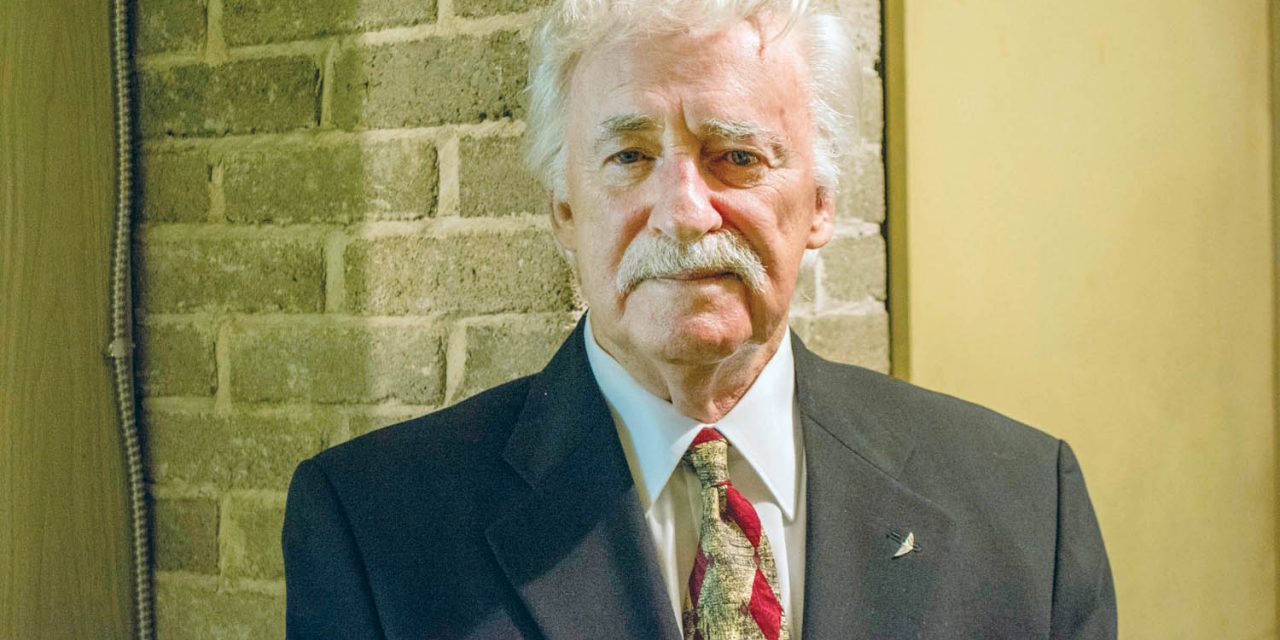
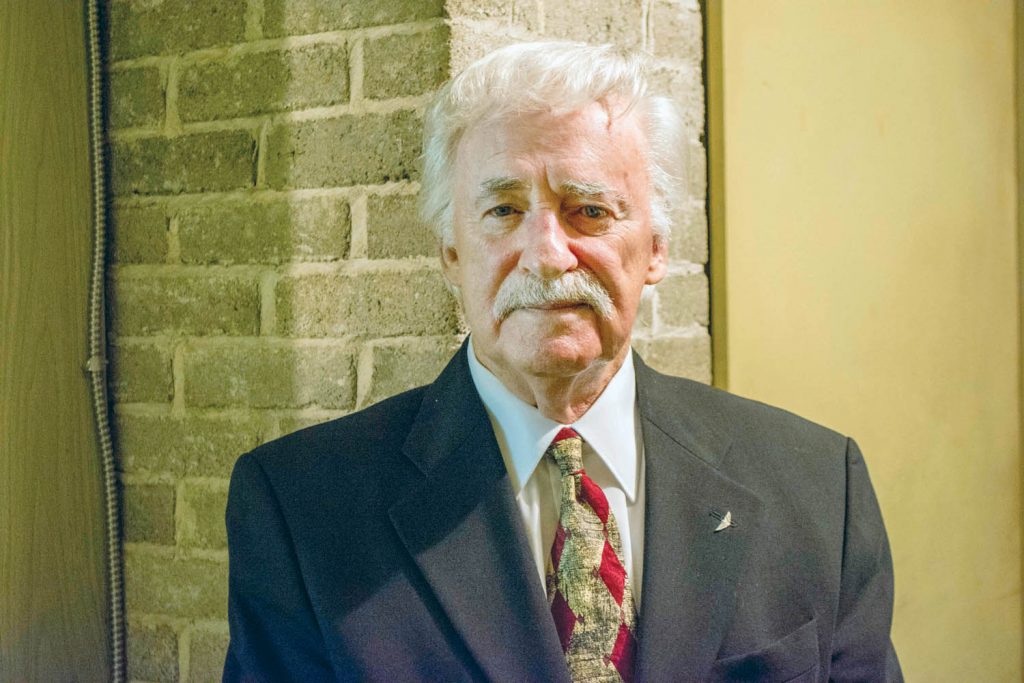
Hank O’Handley, who now calls Oliver home, joined the military as a raw 18-year-old and served six years in the Canadian army. He got to travel the world and enjoyed his military career very much before embraking on a long and rewarding career in corrections. O’Handley says it was a very tense time around the world when the Russians moved missiles into Cuba in the early 1960s. Remembrance Day ceremonies take place this Friday on Nov. 11. The Osoyoos Remembrance Day service in Osoyoos will once again take place in the main gymnasium at the Sonora Community Centre and is scheduled to begin at 10:45 a.m. Doors will open at 10 a.m. Anyone wishing to attend is asked to get there early. The ceremony is Oliver is downtown at the cenotaph. (Dan Walton photo)
Even though Canadian soldiers didn’t need to take up arms in the 1960s while Hank O’Handley from Oliver was serving the army, he still spent his career keeping law and order in check.
O’Handley’s military tenure happened during peacetime, but the idealogical rivalry between capitalism and communism brought tension between global superpowers to new heights.
As a member of NATO, Canada is committed to enter into war if one of its allies are attacked.
In 1962 when ballistic missiles were deployed to Cuba by the Soviet Union, it looked like the line in the sand might get crossed – that put O’Handley on standby for a full-scale war.
“After we did a parachute drop north of Edmonton we returned to barracks, and found out we were all grounded to the base and couldn’t leave,” he said. “We were to prepare for a war with Cuba. They had us getting all of our equipment. And this time it wasn’t blanks – it was live ammunition and shells.”
The crisis ended diplomatically, but for 13 days before its resolution, nobody knew how negotiations would turn out.
“Sitting there and you don’t know if a major weapon is going to be used with a nuclear end to it – it was scary,” he said. “But in any event, the President of the U.S., John F. Kennedy, forced them back. He put it in very strong terms – arm an island this close to the U.S. and there’s going to be some hardship suffered by the perpetrator.”
A sense of anxiety was constant at the base, but aside from a few apprehensive comrades, he said the soldiers were all well trained and ready to go. And even though the crisis was centred around Cuba, O’Handley was given no indication as to where he might be deployed.
“Even officers didn’t know where it would have been fought. It was highly secretive.”
O’Handley entered the army when he was 18 and was raised to have a disciplined mind. That helped him to get promoted constantly over six years of service.
“Whatever I do I put a lot of effort into it, and they recognized that.”
His new roles that brought him all around Canada and the U.S., and he was eventually offered the position of Staff Sargent, but that required a relocation to Germany, which was still divided by the Iron Curtain.
He said a sparse economy and the Wall of Berlin, which people were shot trying to cross, gave him no desire to live in Germany.
Before joining the army in 1960, O’Handley grew up in Nova Scotia, in a community where the most common career options weren’t very exciting.
“I was destined for the coal mines or steel plants and my father told me not to do that,” he said. “I decided to join the army, so my first stop was a recruit station in Sydney. I passed the exam and was sent to Halifax by train and spent about three or four months there training.”
After basic training, O’Handley was sent by train to barracks in Calgary, but that base had filled up, so he was relocated to Edmonton.
O’Handley enlisted in hopes of becoming part of a parachute division. He accomplished that when he was recruited by the Princess Patricia’s Canadian Light Infantry, which was Canada’s only airborne unit.
“The Patricians were the only group that dealt with severe areas – we trained in the Everglades in Florida and the cold weather in Alaska – exposing us to opposite ends of the spectrum.”
While training in Fairbanks, Alaska, O’Handley said Russian territory was so close it was visible from U.S. soil. But even though the Cold War was well underway, there was no provocative behaviour from that region.
“That’s a major part of my background, jumping out of airplanes – but the real work I got involved in was in prisons,” he said.
His military service carried over as valuable experience, but working in prisons brought about different kinds of hostility. He spent 32 years in corrections, served as warden in five prisons and was eventually promoted to the solicitor general’s department.
All the prisons he ran were very large, he said, and the conditions were “absolutely deplorable” when he took over.
One facility in Fort Saskatchewan was nicknamed ‘the sift,’ because it was so full of holes that breakouts were frequent.
“We put an end to that and we built a beautiful prison. If you can call prisons beautiful.”
But before O’Handley’s advocacy beefed up the prisons in Alberta and breakouts were common, the escapees would almost always get caught, he said. Nonetheless, they sometimes harmed the community while on the lamb.
“It’s not a great institution if people are escaping from time to time and robbing people and taking them hostage in order to get away. I needed to put an end to that,” he said, adding that he consulted with the various ministers involved with public safety.
“Alberta was very rich at the time. With oil and gas, people were making high wages and the dollars flowed pretty good towards prisons. The government recognized it would be good investment. Otherwise you’re deaa ling with people escaping all the time.”
In dealing with less severe incidents, prisoners sometimes demonstrated a lack of discipline, but he said it wasn’t difficult to straighten them out.
“They get the message very quickly – if they don’t adhere to the prison regulations then they’re going to be placed in segregation. They don’t like that.”
O’Handley didn’t rule over prisoners with an iron fist however.
“Our attitude was to ensure inmates gained something while they were there. We don’t want to see inmates locked up all the time because that’s going to cause worse problems.”
Under his thumb, the facilities launched prisoner educational programs.
“Vocational welding, carpentry, electricity and all those kinds off things. They were there to learn and change their behaviour.”
O’Handley retired in 2001 and founded a correctional consulting company, and said he managed to save the province $20 million in corrections spending.
“There was room to save money because when we started, we got rid of the old fashioned prisons that were not modern in any stretch of the word, let me tell you. We wanted better institutions, surveillance and training.”
He said he’s “absolutely happy” Oliver was chosen to house the new Okanagan Corrections Centre, as it’s an expensive piece of real estate that the province needed.
Some neighbours aren’t pleased to have a prison nearby, O’Handley said, but “It’s there, it’s not coming down.”
And the new prison is in good hands, he said. Warden Steve DiCastri “seems like a reasonable guy who’ll correct any problems.”
DAN WALTON
Regional Reporter