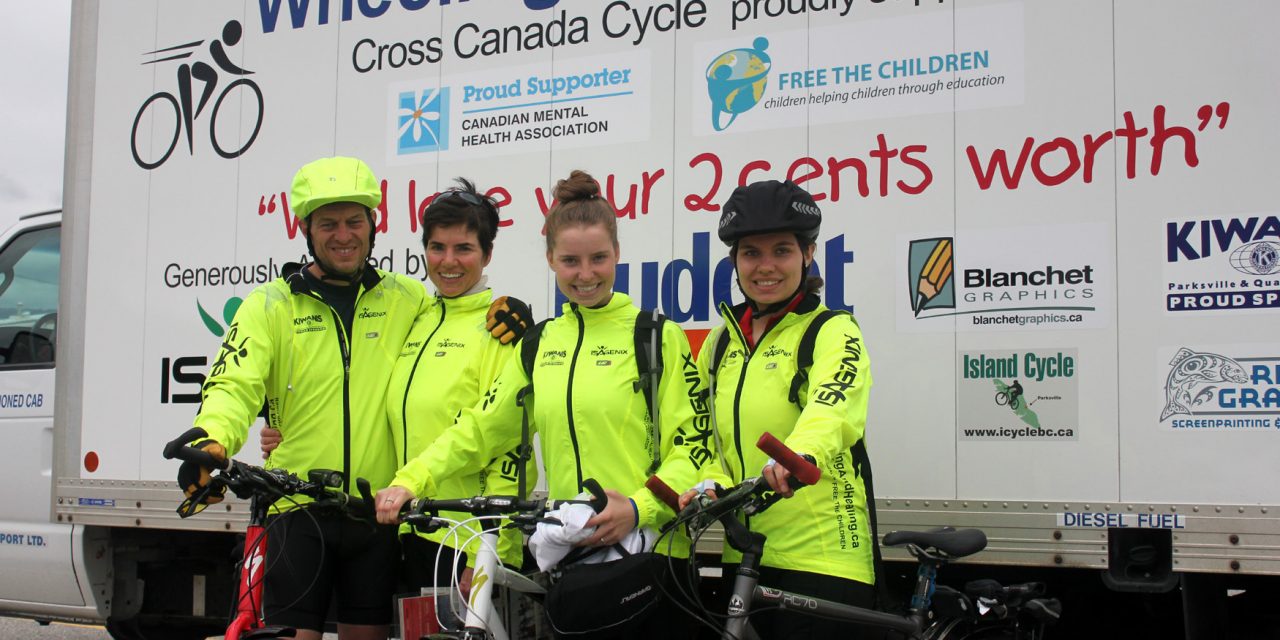
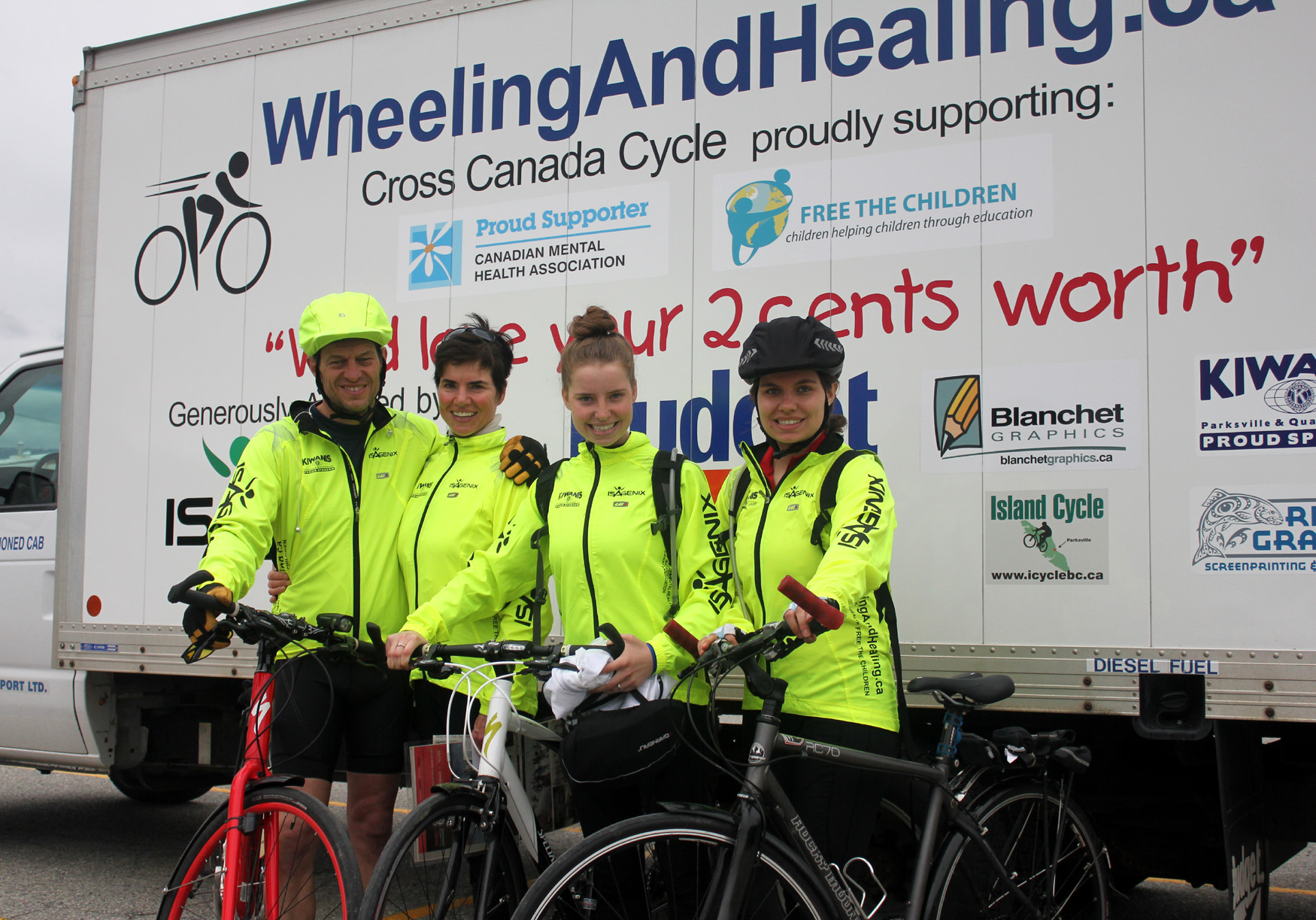
Marina Bakker-Ayers (centre-left), along with her husband Byron Ayers (left), and two daughters, Jessie (right), and Luschia, stand in front of their cube van while making a brief stop in Osoyoos during a cross-country tour on Wednesday, June 6. Bakker-Ayers and her family are biking from Nanaimo to Halifax in order to raise awareness and give a voice to mental health issues. Photo by Mathew White.
Marina Bakker-Ayers wants to bring a voice to the messier side of life, and to do it, she’s willing to go a long way, more than 6,000 kilometres in fact as she and her family cycle all the way from Nanaimo, B.C. to Halifax, Nova Scotia.
“We wanted to do something that would empower youth and children and we wanted to do something that would inspire other people working through mental health issues,” said Bakker-Ayers.
Bakker-Ayers, along with her husband of roughly 30 years, Byron Ayres, and two daughters, Jessie, 24, and Luschia, 19, left Nanaimo on June 1, but their journey actually started about six years ago. In 2006, after a neighbour reappeared in her life, Bakker-Ayers said she started to get flashbacks of a trauma that had occurred earlier in her life in that neighbour’s household.
“This trauma had been completely removed from my conscious memory,” said Bakker-Ayers. “I had no idea this stuff had happened to me.”
Bakker-Ayers suffered what she described as “childhood sexual abuse”, but stressed she has always had excellent parents and had a great family growing up.
This was someone outside of the household, she said.
“You can come from a really strong family and still things can happen to you,” said Bakker-Ayers.
“Someone gets their hooks into you,” added her husband.
The reappearance of this neighbour brought flashbacks of this traumatic event, which inevitably sent Bakker-Ayers into severe depression, and from there, a total mental breakdown.
She plummeted both emotionally and physically.
After seeing a doctor, she was diagnosed with post-traumatic stress disorder, obsessive-compulsive disorder, severe depression, panic attacks and anxiety disorder.
Metaphorically speaking, she was catatonic, spending her days by the window, simply staring all day long. As time passed, these symptoms only worsened and eventually suicide was contemplated on a regular basis.
“I did become suicidal, and at my worst, my life was trumped down to 12-hour sections, where my job was to be alive in 12 hours,” said Bakker-Ayers. “I’d wake up in the morning and it was, ‘be alive by bedtime.’ At bedtime it was ‘be alive in the morning.’ And that’s what got me through that time. I just kept getting from one day to the next.’
“I think the success for everybody is to never give up … and just keep moving forward.”
Through all this, it wasn’t just Bakker-Ayers’ remarkable courage and perseverance that allowed her to continue in life, but also her husband, who she said, in every sense of the word, is her hero.
“It was hard,” said Ayers. “It was really hard. Staying up all night long on suicide vigil and then trying to go to work. (I was) working seven days a week to try and pay the bills.”
Ayers said the family eventually had to sell their house due to the medical bills pilling up, mainly from alternative medical treatments that aren’t necessarily covered in Canada’s healthcare system. But when the treatments began to work, Ayers said that was all that mattered. What was lost in money, he said, was certainly made up for elsewhere.
“I tell people I got my newlywed back,” said Ayers. “It was amazing to get my vital, energetic, loving wife back. It was great and it’s been great ever since. That’s why we’re doing this. So we can play together and be together as a family and just do some really great things to give back to humanity.”
As she continued to heal mentally, Bakker-Ayers said she also started to heal physically (eventually losing close to 100 pounds) and riding her bike was something that helped physically and mentally.
“At one point my doctor said, ‘just get on your bike and ride,’ ” said Bakker-Ayers. “And so I thought ‘OK, I can ride my bike, and if I can ride my bike and make a difference, how can I combine the two and make a difference for others?’
“As we’ve been recovering, we’ve been talking about how great people have been and how kind and compassionate they are and how much support we’ve gotten from so many people, and we thought, this is our turn to give back, this is our turn to contribute.”
And while their journey is mainly about bringing awareness about mental health issues and removing much of the stigma that surrounds them, there is also a financial component to it. Before setting out, Bakker-Ayers said her family chose two charities they could support while making their way across Canada. Those two charities are Free the Children and the Canadian Mental Health Association – two non-profit organizations.
“We wanted to share our message that recovery is possible but people always say, ‘who can we donate to?’ said Bakker-Ayers. “And so that’s why we picked those two organizations.”
Bakker-Ayers said since then their campaign has become “we’d love your two cents” in the hopes that people will donate one cent to each charity. Bakker-Ayers said if one million of out the roughly 34 million people in Canada each donated two cents, it would reach $10,000.
“Our main priority is awareness and giving a voice to mental illness and mental health issues, and in the process, if people want to donate their two cents worth, great,” said Bakker-Ayers. “And if they want to donate more than two cents, we’re OK with that too.”
To follow along with Bakker-Ayers and her family while they travel across Canada or to donate to one of the two charities, visit www.wheelingandhealing.ca (which can also be found on Facebook and Twitter). Bakker-Ayers and her family plan to reach Halifax by August 5.