


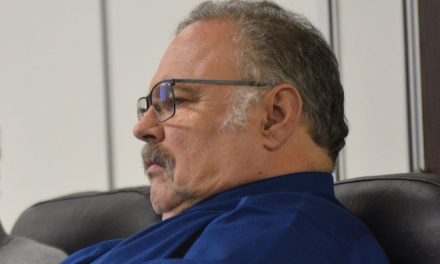
Osoyoos Mayor Sue McKortoff said in a video interview that the four-year term for council members has worked well. (Richard McGuire file photo)
One of the biggest challenges facing the next Osoyoos town council will be the impact of climate change and natural disasters such as wildfires and floods, says Mayor Sue McKortoff.
McKortoff made that comment in a video interview with the Osoyoos Times last Friday, which touched on numerous issues council has dealt with over the past four years and recently.
McKortoff, as well as councillors C.J. Rhodes and Jim King have said they plan to run again in the Oct. 20 municipal elections. Councillor Carol Youngberg has said she won’t announce a decision until September and Mike Campol has said he won’t run again.
After the last election, in November 2014, the term councils serve was extended in B.C. municipalities to four years from three previously. McKortoff believes it was a good change.
“I think that it gives you a little bit better chance to get things accomplished,” said the mayor, noting that there is “downtime” at the beginning and ending of the term, especially as councils defer some decisions for the next council. “I think having the four-year term actually allows us to get more things done. So, I like it.”
Asked what have been the most contentious and difficult issues for council over the past four years, McKortoff immediately pointed to the threatened closure of Osoyoos Secondary School (OSS) in 2016.
She also pointed to the town surpassing a 5,000 population in the 2016 census, which resulted in a much costlier police funding formula, as well as the ongoing challenge of ensuring the community has access to primary health care.
“That our school was threatened with closing caused a huge issue for all of council,” McKortoff said. “It took a great deal of time over about six months until we had it resolved on June 30 at 4 p.m. in 2016.”
The issue was resolved when the former B.C. Liberal government introduced a Rural Education Enhancement Fund, which convinced enough trustees in District 53 to outvote the two Oliver trustees who wanted to close OSS.
“I’m glad that we had wonderful support from businesses, from leaders in this town, and eventually we had good support from the Liberal government,” said McKortoff. “I think they were caught a bit off guard too by the whole thing, but I think it kind of tied us all together and made this whole town work really hard to fight for something that we wanted.”
The mayor added that “it’s absolutely essential” that Osoyoos have a school, and she warns, “We would fight again.”
On health care, she noted that the town received provincial funding to hire consultants looking at options for a community health centre. She also pointed to positive dialogue both with Interior Health and with others on a regional committee on which she sits.
Asked whether in hindsight there are any issues council could have handled better, McKortoff pointed to a couple recent issues where the town has responded to public concerns.
A new system of pre-paying for boat trailer parking at a machine was introduced this year, and some users have failed to buy a ticket, saying they’ve always paid afterwards in the past.
McKortoff said those issued with a ticket fining them for not paying in advance can now pay the fine on the spot if the bylaw officer is there. Previously, they had to wait until the next morning to pay the fine at town hall and get the boat released.
In another example, last week the town was able to get the contractor to do additional watering on the 62nd Avenue construction site to keep dust down in response to complaints from neighbours.
In a similar wide-ranging interview in January with the Osoyoos Times, McKortoff identified health care and a proposed aquatic centre as two major issues council faced.
Despite mentioning progress on health care, the mayor acknowledged that there has not been recent news on the aquatic centre. That facility was proposed as a joint project between the towns of Osoyoos and Oliver, the Osoyoos Indian Band (OIB), and Areas A and C of the regional district.
She noted that the municipalities applied for provincial funding for a feasibility study but were turned down. Also, things slow down over the summer, she said.
Asked whether the OIB was still on track to work with the other partners on this, McKortoff said there have been other issues OIB has been trying to accomplish.
“I can’t discuss that in detail, but it’s going to take some negotiating and it’s going to take some time to get this done,” she said.
The Osoyoos Times also asked the mayor to give short comments on several key issues from the past four years.
Osoyoos Airport:
The mayor said people assume that the airport will expand because of the recent presentation to council by the Osoyoos Airport Development Society of a report done for the group.
“That is not the case,” she said, noting it was just a study by the committee. “I’m not sure where the report is going. We have talked about this for a long time, we do have several other airports around and I’m not sure this is going to go ahead quickly.”
It’s a positive step that the group is looking at putting up fencing, lights and tiedowns, she added.
Cannabis retailing:
The issue is very confusing, she said, because there are three levels of government, growing facilities and retail outlets, and different provinces are taking different approaches.
“We’re going to take things slowly,” she said. “We’re looking at all of the issues and we have some good advice from staff. We don’t have to have everything open and up and running on Oct. 17 if we’re not ready.”
The town is not doing as some communities have done and allowed dispensaries to spring up quickly, without planning how to transition to a legal market, she said.
Police and crime:
The mayor noted that regional RCMP Superintendent Ted de Jager has suggested that people can greatly reduce crime by locking their vehicles and houses and not leaving valuables in plain view. Also, by recording serial numbers, it makes it easier for police to return stolen items to their owners.
McKortoff said she intends to attend a public crime forum in Oliver on Aug. 28 because she hopes constructive conversation and suggestions will come from it.
Affordable housing:
McKortoff said affordable housing is a “huge” issue. Houses behind the fire hall are not as low in price as originally thought, she said, noting that recently the town adjusted its policies on subsidized housing so that now subsidized buyers only need to hold it for five years instead of 20 before selling it at a profit.
“I think that we’re listening to people and we’re working to try and adjust things when needed,” she said.
Tourism:
The mayor referred to tourism as “the mainstay of our town” along with fruit, vegetables and wine. “We’re known as a tourism mecca,” she said.
In all issues, council has worked together and had a lively debate on many matters, she said.
“I think we’ve listened, we have compromised when we needed to, and we have worked with agencies that can help us in a positive manner,” she said. “I think that made a difference… We cannot solve everybody’s individual problems, but we can work at it.”
RICHARD McGUIRE
Osoyoos Times



“The View”?
I suppose that makes me Whoopie?