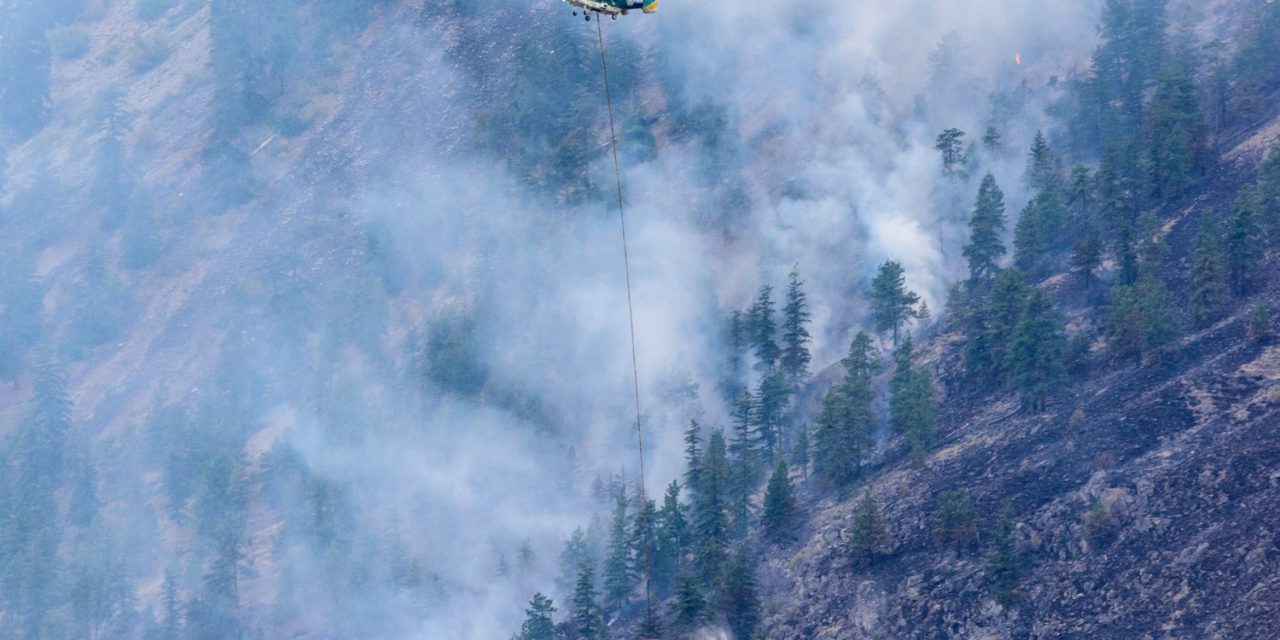

A helicopter carries a bucket of water to drop in an area where the fire is descending a creek bed into the valley. (© Richard McGuire photo)
The Snowy Mountain wildfire burning west of Osoyoos expanded over the long weekend and has now surpassed 12,039 hectares.
The fire is located in the Snowy Protected Area near Cawston, and depending on wind direction, it has at times been sending smoke over Osoyoos.
As of Tuesday morning, BC Wildfire Service reported that the fire was 40 per cent contained.
The fire is classed as an interface fire and evacuation alerts are in effect.
The Regional District of Okanagan-Similkameen (RDOS) on Monday rescinded an evacuation order for four properties near Cawston on Chopaka Road. That order came into effect on Friday.
The fire was most active Monday above the inversion, within a mountainous bowl and ravine on the northeast of the fire and on the west flank, BC Wildfire Service said in a bulletin.
On Monday night, crews continue to work on the east flank and crews worked to secure the north flank and tie it into rocky slopes in order to keep the fire from wrapping around towards Keremeos.
Other crews continued their work on the east flank to mop-up and patrol along Chopaka Road, and personnel worked to utilize an existing road system in the Roberts Creek area to the south of the fire to develop containment lines and take advantage of existing features, the bulletin continued.
The fire remained to the west of Chopaka Road, but is burning in a southward direction and the south flank is approximately three kilometres from the U.S. border.
The BC Wildfire Service incident management team assigned to the fire is working collaboratively with the U.S. Forest Service, U.S. Bureau of Land Management and Washington State Department of Natural Resources due to the fire’s proximity to the United States.
Early Saturday, two new fires were reported within the Lower Similkameen Indian Band jurisdiction. Those fires are now extinguished and were believed to be person-caused.
Because the steep terrain is inoperable in some areas and poses a safety risk to firefighting personnel, crews are being strategically placed where it is safe and where suppression objectives can be met.
Crews are supported by bucketing helicopters as they work south to conduct burn-offs as safe conditions allow to remove fuel from the slopes adjacent to properties in order to halt the forward progression of the fire.
SPECIAL TO THE TIMES
Osoyoos Times