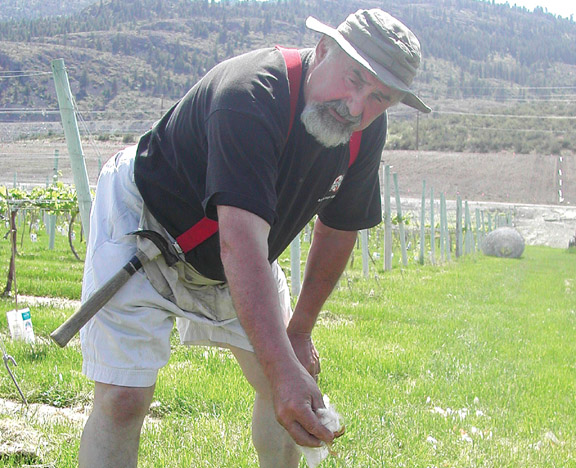
George Cimbala shows off chicken feathers on his property shortly after he shot Pepper, a St. Bernard, in the face. Photos by Paul Everest/ Osoyoos Times File - Click on picture for larger image
OSOYOOS TIMES-October 13, 2010
By Paul Everest – Osoyoos Times
Nearly two-and-a-half years after firing a shotgun point-blank at a dog’s face, 68-year-old George Cimbala of Osoyoos was found guilty of injuring an animal in Penticton provincial court.
Cimbala was convicted by Judge Anne Wallace on Oct. 5 on one count of injuring or endangering an animal in relation to a shooting incident on Cimbala’s 160th Avenue property in the spring of 2008.
On the evening of May 27, 2008, Pepper, a St. Bernard that was two years old at the time, wandered away from the property of her owner, Teya Coty, on 91st Street.
Pepper and Spryte, another dog belonging to Coty, wound up on Cimbala’s property after getting out of Coty’s house due to a front door that was not closing properly at the time.
A friend alerted Coty that the dogs were heading southwards along Hwy. 97 and Coty jumped in her car to retrieve them.
When she arrived at Cimbala’s property and saw the dogs, she called to them and Spryte came right away.
Pepper, however, lingered in a chicken coop in the northeast corner of the property.
Before Pepper could come to the car, Cimbala approached the dog carrying a 12-guage shotgun.
The 56-kilogram dog started barking at Cimbala as he approached and he blocked her path to the car, firing the shotgun.
It did not go off at first, but Cimbala pumped the shotgun a second time and fired into Pepper’s face.
The dog survived but required thousands of dollars of medical attention due to the wounds to her face and respiratory system.
Coty said Pepper still lives in constant pain to this day.
Cimbala said at the time that he felt threatened by Pepper and had gone out with his gun to defend his chickens because he had lost between 140 and 160 birds in the year prior to the shooting incident to dogs and coyotes.
He added that he had shot a dog in its backside the week before the incident with Pepper because the animal was trying to get at the chickens.
Crown council Alex Janse said Cimbala had testified during the trial that he shot the dog to protect his chickens and to defend himself.
Wallace, however, did not believe Cimbala’s version of events, Janse added.
She said the Crown was seeking four to six months of jail time, but in the end, Cimbala was handed a 30-day conditional sentence.
He must follow a curfew of 10 p.m. to 6 a.m., attend anger management counselling and not possess any firearms outside his residence.
Cimbala is also on six months of probation and was ordered to pay Coty $4,276 in restitution within five months.
Janse said the judge, while handing out the sentence, emphasized the need for deterrence when it comes to people shooting animals and wanted farmers to know they can’t simply shoot dogs on their land without good reason.
Const. Kathy Woodward, a senior animal protection officer with the B.C. SPCA, was cross-examined by defence counsel on Oct. 5 during the second of two trial dates on the matter.
She said she had interviewed Cimbala following the shooting incident and told the court what he had said during the interview.
Cimbala had admitted to shooting the dog, Woodward said, and explained he felt Pepper had killed his chickens.
Woodward said the Osoyoos RCMP had turned the matter over to the SPCA after the Mounties finished their investigation and it was the SPCA that had forwarded the charges of injuring or endangering an animal onto the Crown.
A second charge against Cimbala of injuring or endangering an animal was stayed by the judge.
Woodward said the judge took Cimbala’s age and the possibility of him reoffending into account when she issued the sentence.
But Woodward said she would have liked to have seen Cimbala receive a stiffer penalty since Pepper is going to suffer for the rest of her life.
While the B.C. Livestock Protection Act was brought up as part of Cimbala’s defence, a new version of the act states that a farmer can only protect livestock through the use of force if an animal is in the act of attacking the livestock, Woodward said.
She added that evidence presented at the trial from Pepper’s veterinarian showed the dog had not ingested any chickens, nor was any blood or feathers found on the dog.
Woodward also said it was pointed out that Coty also owns chickens and Pepper would have been used to the birds and would likely not attack them.
She said she hopes Cimbala’s conviction will send a message to people that there are other options when it comes to protecting livestock from dogs.
She also said this will show people that the courts do take cases seriously where animals are killed or injured by people.
Coty and Cimbala both declined to comment on the outcome of the trial.
[email protected]