By Don Urquhart, Times Chronicle
Water levels in Osoyoos Lake have reached historic lows as snow accumulation in the Okanagan Basin remains at below normal levels, but during the winter this has no impact on water quality according to the Osoyoos Lake Water Quality Society (OLWQS).
As of Feb. 15, the Okanagan Basin is averaging 78 per cent of normal snow accumulation for this time of the year, according to the province’s River Forecast Centre. This has led to a lake level of 909.12 feet, the lowest on record according to the International Osoyoos Lake Board of Control.
The board implements the provisions of the International Joint Commission (IJC) relative to the operation of the Zosel Dam, located in Washington State, 2.7 km south of the southerly tip of Osoyoos Lake.
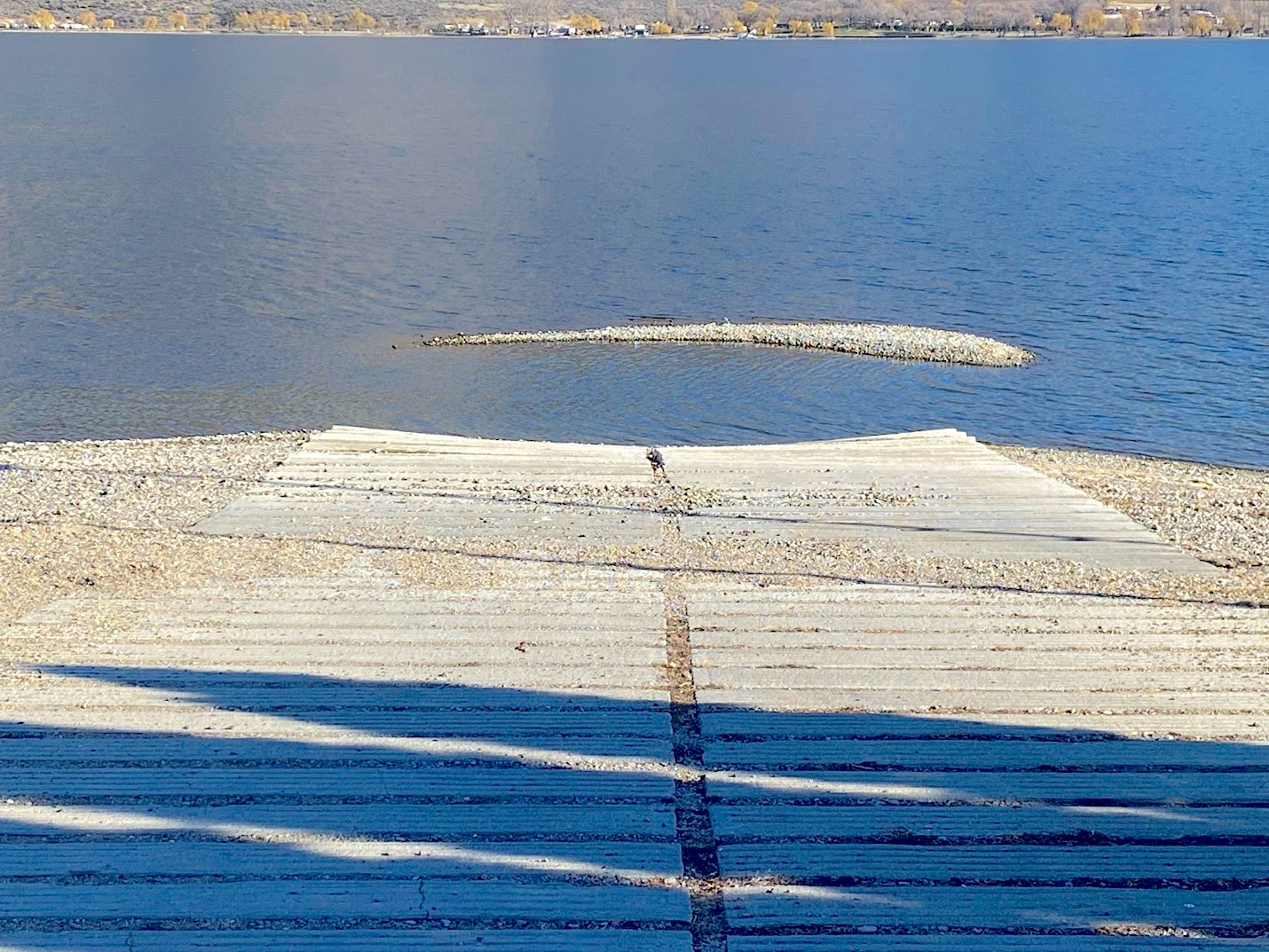
Osoyoos Marina boat ramp. Marg Coulson, Town of Osoyoos photo
In its winter update the Board of Control noted that water levels are likely to remain low until more water enters the Okanagan River system. “Osoyoos Lake operators are monitoring conditions closely and plan to maintain the current lake level at, or near, 909.1 ft. (277.06 metres).”
This level complies with the IJC’s Orders for Osoyoos Lake, which establish allowable lake levels, it noted.
“Residents should plan for lake levels to remain low for the foreseeable future . . . until more water begins entering the lake,” the Board said. “Historically, this occurs in late February; however, given this year’s low snowpack, more water may not be available until later in the spring.
The spring freshet typically occurs in April, when snowmelt and rainfall lead to increased runoff in the Okanagan River.
Much of the snowpack accumulated in December and early January before a period of warmer and drier weather led to snowmelt at lower elevations. As a result, flows in the Okanagan River are lower than normal, and models forecast a continued risk of reduced seasonal runoff.
And while the current sight of low water levels may be alarming, there is no real impact on the actual health of the lake, says former provincial fisheries biologist Dave Kumka, a volunteer with the Osoyoos Lake Water Quality Society (OLWQS). “From a water quality standpoint, there’s not a huge impact with the current low levels of the lake,” he said.
Kumka says the real impact to the lake would come if levels are low during the summer. A drop in lake level means a warmer lake, especially in summer and this has impacts on everything from plant growth, to salmon migration and even recreation.
And it could impact milfoil growth as well. “Milfoil can only grow in water three metres or less in depth, generally,” he says. “So the part of the lake that’s now three metres is the part where milfoil might not have grown. So it could establish vegetation in areas where it’s typically not a problem and that could be a bit of a cleanup that the Okanagan Water Board would have to address in the springtime,” he says.
Recreation could also take a hit. “Lower lake levels during the summer months are certainly going to affect recreation. They’re going to affect the quality of life for people who have cabins along the shore or live in facilities that are along the shore.”
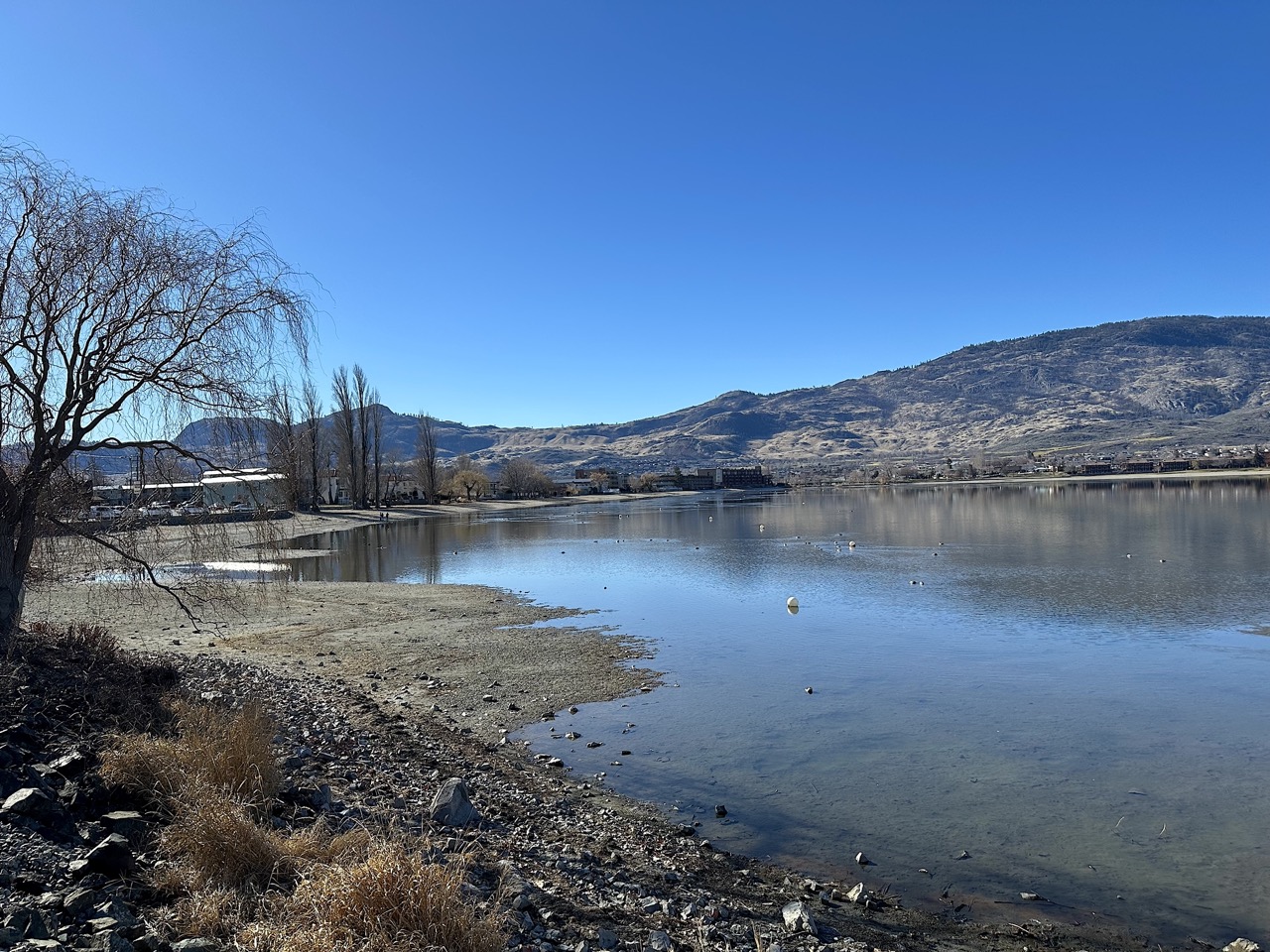
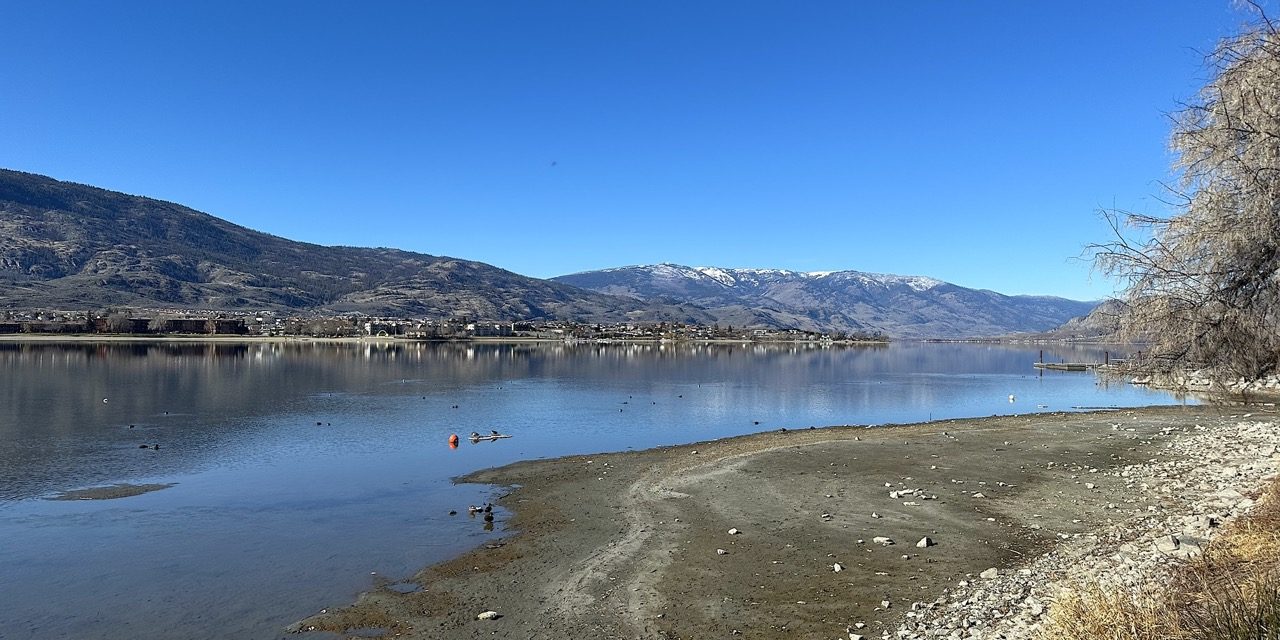
Osoyoos Lake operators are monitoring conditions closely and plan to maintain the current lake level at, or near, 909.1 ft. (277.06 metres).
Don Urquhart photo
Fish, salmon in particular, will also be impacted as they typically don’t like temperatures over about 18 or 19 degrees Celsius, “and from the data the Water Quality Society has been collecting, we’re seeing those temperatures and above in the surface waters of the lake in the later summer and early fall,” even without the significant drop in water levels.
This is why, he explains, the Board has been trying to keep the lake level “as high as possible, within the mandate of the Osoyoos Lake Board of Control.” He also notes that pulses of water have also been let go from Okanagan and Skaha Lakes to help cool the water for salmon migrating up through Osoyoos Lake.
He also noted the importance of maintaining water levels to support the work being done by the Okanagan Nation Alliance in terms of rearing juvenile Sockeye salmon. “So that also depends on using the lake as a nursery for the sockeye fry. A fuller Lake is a happier lake in the sense that it has more cooler areas and more water area for the fish to occupy.”
Going forward the remaining window to build up snowpack is narrowing and Kumka notes a key concern would be a “prolonged rain on snow event.” Essentially that would mean that the snow that’s in the Okanagan Basin “would melt at an accelerated rate and they want to have enough capacity in the basin to be able to handle that kind of surge,” he said.
Kumka said he understands the Board is currently in discussions around possibly broadening their criteria to include water quality as part of how they manage lake levels.
“Right now, it’s sort of a two pronged approach. They manage the high level for the summer, and they manage the low level in the winter, and perhaps over time that they will adopt a more granular approach,” which could include adjustments in spring and fall for instance.
“I know it’s just under discussion, but hopefully they will broaden their criteria to include water quality as part of what they use to manage lake levels.”
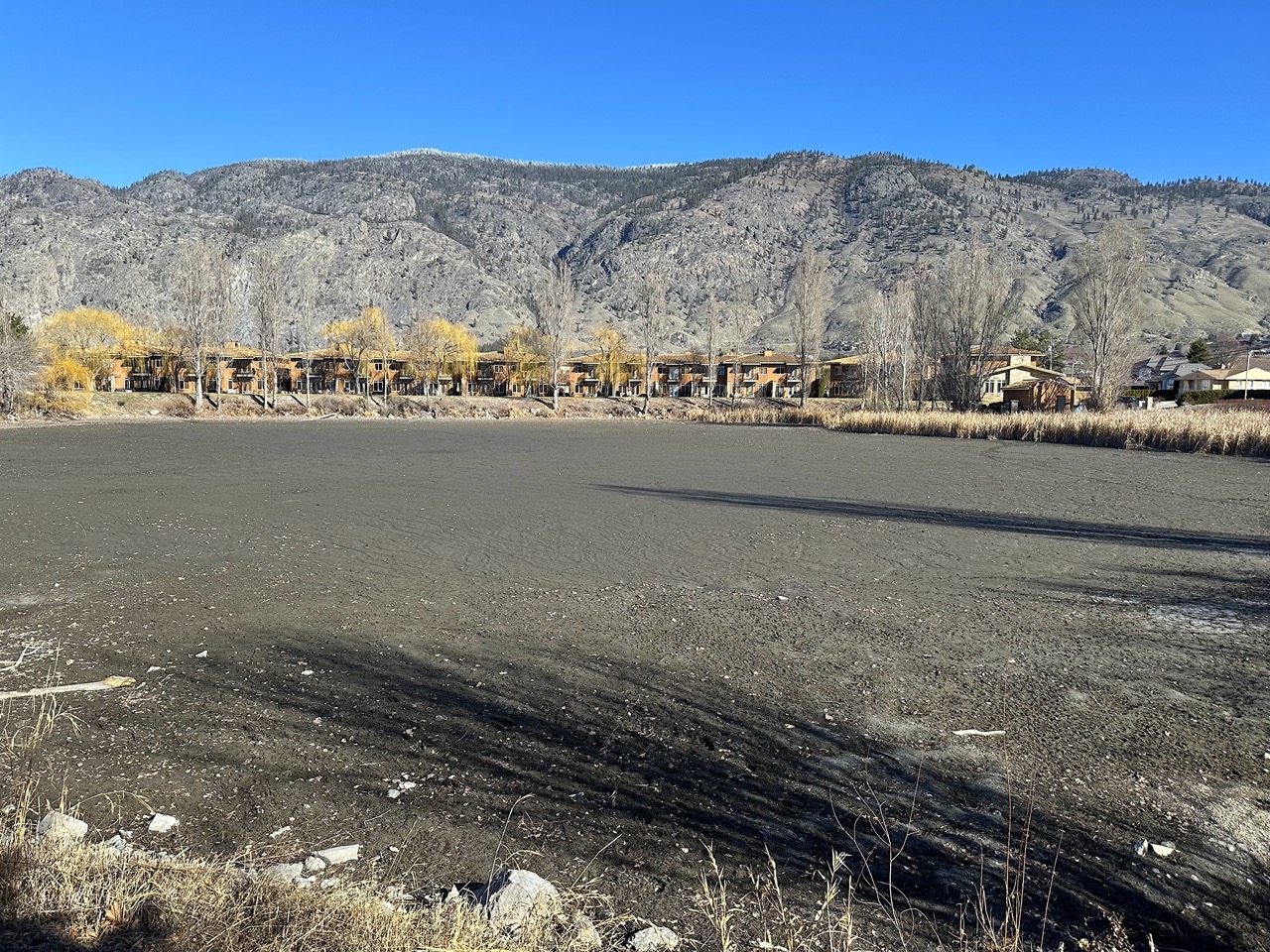
The lagoon at Cottonwood Park is completely devoid of surface water.
Don Urquhart photo
BC’s River Forecast Centre noted that during the first week of February, an atmospheric river impacted the North and Central Coasts, followed by a minor storm system impacting the South Coast. Snow accumulation was minor and limited to specific higher elevation locations along the coast, it said, adding that generally drier conditions occurred during the second week of February.
A colder pattern is expected to settle over the province this week, bringing a mix of cooler temperatures and increased chances of precipitation, including potential snowfall at lower elevations in some regions.
Currently the provincial average across all Automated Snow Weather Stations (ASWS) is 108 per cent of the median for this time of the year, up from 96 per cent of normal in the Feb. 1 snow survey. The Okanagan has risen to the current 78 per cent from 67 per cent of normal in that Feb. 1 update.
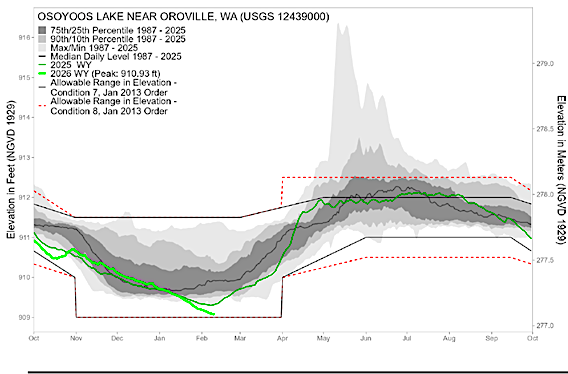
Water year 2026 (bright green) and water year 2025 (dark green) Osoyoos Lake Levels, along with allowable range under the normal rule curve defined by the International Joint Commission Orders of Approval for Osoyoos Lake (solid black). Expanded drought Conditions rule curve (red dashed). For the period of record from 1987-2025, the mean daily lake level is shown as a black line, and the historical gauged minimum, 10th, 25th, 75th, 90th, and historical gauged maximum lake levels are shaded grey.
USGS, IOLBC 2026 chart
Upstream of Osoyoos Lake, Okanagan Lake is at a lower-than-normal water level, noted the Board in its update. “Okanagan Lake serves as a major water storage location, and operators are actively balancing the need to hold water for summer use while serving downstream needs,” it noted.
The International Joint Commission’s Osoyoos Lake Board of Control said it will continue to monitor hydrologic conditions and communicate with lake operators and the public.