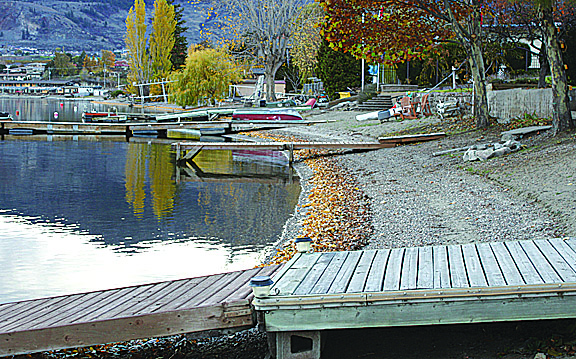
Brad Elenko, a lakefront property owner and a planning and development consultant, says the lake’s current natural boundary is too high and property owners are losing land when subdividing or losing development rights. Photo by Paul Everest - Click on picture for larger image
OSOYOOS TIMES-November 11, 2009
By Paul Everest – Osoyoos Times
Lakefront property owners in Osoyoos are having their rights eroded due to where Osoyoos Lake’s natural boundary is found, said a local planning and development consultant.
Brad Elenko, who is also a lakefront property owner, wants the natural boundary of the lake established at an elevation lower than where it is determined to be now.
A natural boundary for a lake is defined in the province’s Land Act as the “visible high water mark” where the “presence and action of the water are so common and usual, and so long continued in all ordinary years, as to mark on the soil of the bed of the body of water a character distinct from that of its banks, in vegetation, as well as in the nature of the soil itself.”
The boundary marks where a person’s private property ends and where Crown land begins and is used to determine setback lines to protect against flooding and property lines when lakefront properties are being developed or subdivided.
In the 1990s, Osoyoos Lake’s natural boundary was determined to be at an elevation of 278.28 metres above sea level to correspond to where the lake’s water levels are set during a drought year.
When the Osoyoos Lake Board of Control, an international body that regulates lake levels, declares a drought year in the spring, water is backed up into the lake for the summer by the actions of the Zosel Dam in Washington state to maintain a water level of roughly 278.28 metres to meet local water needs.
But Elenko said drought years have only been declared a small fraction of the time in the past two decades.
Data from the board of control shows that between 1987 and 2009, drought years were declared 11 times, including this year, and three of those declarations were rescinded.
There have also only been a small number of days when lake levels have exceeded 278.28 metres in the past 15 years, Elenko said.
According to board data, there have been 90 days between 1987 and October of 2009 when lake levels were above 278.28 metres.
Elenko said that since droughts have been declared less than 40 per cent of the time in the past two decades, drought years are not “common” or “usual” and the current boundary goes against the Land Act definition.
The elevation for where the lake’s natural boundary is determined should therefore be lowered to a height between 277.4 and 277.6 metres which corresponds more with natural water levels for the lake, he said.
By having such an “artificially high” current natural boundary for the lake, Elenko argues, lakefront property owners are losing land when subdividing or losing development rights.
“In some circumstances where the lake bed is quite steep, the difference between six inches or a foot in elevation of the lake has minimal effects on the establishment of (a) new property line or the establishment of (a) setback line,” Elenko wrote in a presentation to the board last month.
“But in numerous cases, the lake bed is very gradual and the horizontal effect in the difference between six inches or a foot in elevation of the lake is devastating and can have significant consequences on property ownership and the building envelope on the property.”
Brian Symonds, a director of regional operations with the B.C. Environment Ministry’s Water Stewardship Division, said natural boundaries for the province’s bodies of water are determined by the B.C.’s Surveyor General’s office with guidance from the ministry based on the Land Act’s natural boundary definition.
Symonds, who is also a member of the lake’s board of control, said he disagrees with Elenko’s suggestion of adjusting the determined natural boundary of the lake downwards.
He said Elenko has only taken the “static level” of the lake into consideration whereas the action of the water, including waves, also has to be factored into the equation.
If the boundary were to be determined at a lower elevation, waves from the lake during storms could cause flooding or erosion problems for lakefront properties and infrastructure, especially when the lake is kept at a higher level during drought years, Symonds said.
Even in a year when a drought wasn’t declared, he added, Elenko’s suggestion wouldn’t work because the lake is maintained at an elevation above 277.67 metres— an elevation above where Elenko wants the boundary to be— and wave action would be a threat to lakeshore properties.
Symonds also said that even though drought years have only been declared eight times in the past 21 years, drought years are still happening on average once every three years.
That frequency, he said, fits the “common” and “usual” criteria outlined in the Land Act’s boundary definition.
The current natural boundary for the lake also protects lakefront property from flood events in the Okanagan and Similkameen river systems, Symonds said.
Jeff Beddoes, the province’s senior deputy surveyor general, said the B.C. Surveyor General’s office could be called upon to make a determination of the current location of Osoyoos Lake’s natural boundary.
A surveyor would carefully investigate the effect the Zosel Dam has on lake water levels, he said, because, according to the Land Act’s definition, the boundary is determined based on the “natural action” of the water and dam operations would artificially adjust lake levels.
But Symonds said since the dam has controlled lake water levels for more than 80 years, the artificial control of lake levels is nothing new and can be considered common and usual.
“You could argue, ‘Does a natural boundary really apply on an artificially controlled lake?’ It probably doesn’t,” he said. “But it’s been controlled since the 1920s. So it’s not like this is something that’s new that’s come along. It’s been well established at that level.”
[email protected]