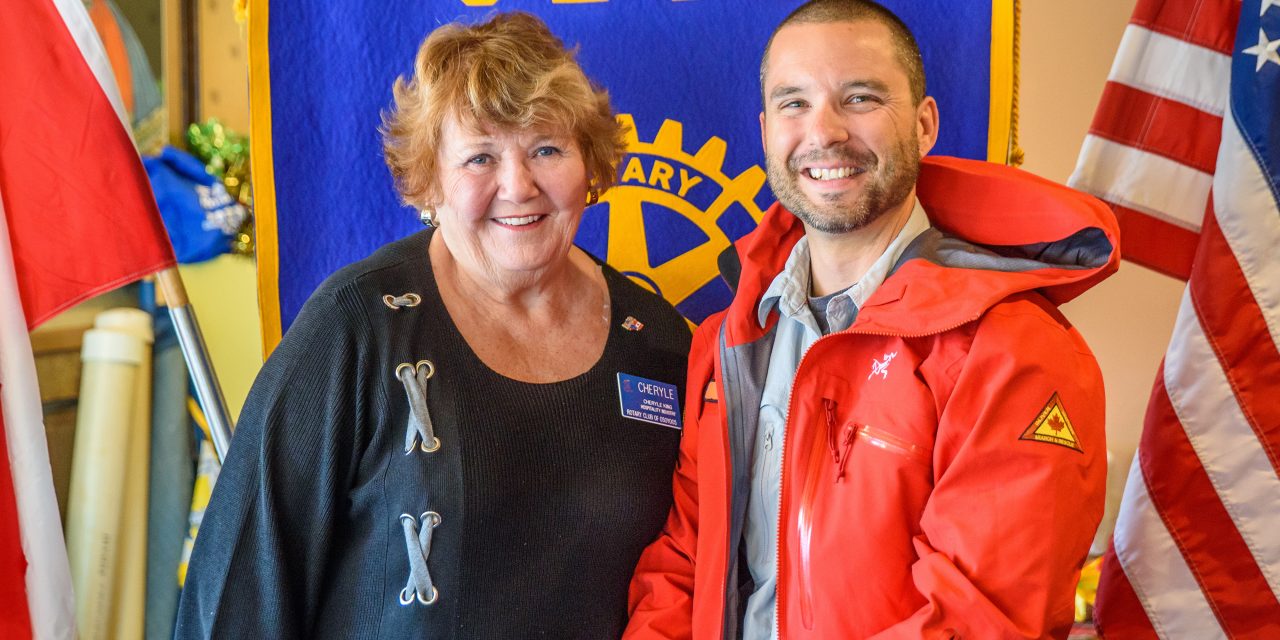

Jay Robinson (right) spoke to the Rotary Club of Osoyoos recently about Oliver-Osoyoos Search and Rescue. With him is Cheryle King, a former Rotary president, who chaired the meeting. (Richard McGuire photo)
By Richard McGuire
Osoyoos Times
When most people think of emergency services, they think of police, fire and ambulance.
But Oliver Osoyoos Search and Rescue (OOSAR) is also an essential emergency service in this region that fewer people know about, says Jay Robinson, an OOSAR member, who spoke about the volunteer service at a recent meeting of the Rotary Club of Osoyoos.
OOSAR has been serving the area since 1973 and is a registered non-profit organization.
Robinson recounted three very different incidents to illustrate the types of emergencies OOSAR members deal with: a fallen rock climber, a confused senior who wandered away from her care home, and a suicidal teenage girl.
The group of about 30 unpaid professional volunteers is normally contacted by police when their help is needed, often after police receive a 911 emergency call, Robinson said.
Indeed, the morning Robinson spoke to Rotary, Nov. 15, OOSAR volunteers were out scouring the river shores helping police in a search.
“Our pager, our cell phone goes off any time,” said Robinson, a former Edmonton police officer. “You never know when it’s going to go.”
In the first incident Robinson described, an organization in Okanagan Falls was hosting a thank you event for the group. But before the dinner, they got word from a senior member of the team that dinner was cancelled and members were told to get into their trucks.
They learned that a group of rock climbers had an accident and one of the climbers had a broken femur, a thighbone.
“A broken femur is not a good injury to have,” said Robinson. “That’s life threatening. There’s lots of internal bleeding and your bone marrow is in there.”
• Read more: Search and Rescue opens doors to new members
With dinner cancelled, the volunteers had to race to Penticton to pick up mountain climbing gear, get ropes, stretchers and arrange a helicopter. When the hastily assembled team reached the location of the accident, they were surprised to see the climber in his harness standing and talking on a phone.
It turned out that this climber had fallen, but his partner had saved his life by refusing to let go of the rope, while suffering injuries himself.
The climbers were ascending the mountain sideways instead of directly vertical and when the one climber lost his grip and fell, the other hung onto the rope.
“His partner realizes that if his friend falls from the height he’s at, it could kill him,” Robinson recounted.
Instead, with bloodied hands, he hung onto the rope, as he was dragged sideways about 100 feet through boulders and trees, breaking his femur. He still didn’t let go.
The injured man only had two questions, said Robinson. Was his friend OK? And did he really have to ride in a helicopter?
In the second incident Robinson recounted, a family event with pancakes and waffles was abruptly cancelled when an emergency call came in.
This time an elderly woman was missing from a care home. She apparently took a walk at 6 a.m. in her nighty and still hadn’t returned by close to 11 a.m.
The location was near a lake and waterfall with ravines.
“We were pretty worried about this lady,” said Robinson, describing how a team of about 30 people assembled to search for her with UTVs and ATVs.
“Our pager, our cell phone goes off any time. You never know when it’s going to go… We are 24, 365 and we are 100 per cent volunteer. We are not paid.”
A UTV is a side-by-side and stands for “utility terrain” or “utility task vehicle.” ATV stands for “all-terrain vehicle.”
They searched the bottom of the waterfall, along the shoreline and in areas too dense and rugged to bring in a helicopter. And they had to move rocks to get the vehicles in.
“About three hours later, we get a call on the radio that we might have found something,” said Robinson, describing how the volunteers anxiously held their breaths and headed to the spot.
“Sure enough, we find the lady in a nighty, frost-covered grass and not great in colour,” he said.
The first person on the scene was a paramedic. Before any other checks, the first thing the paramedic said to her was: “Honey, let’s put some socks on you.”
Soon after, there was a joyful, tear-filled reunion with family.
In the third incident, Robinson told how the group received a call around 10 p.m. about a teenage girl who had gone missing. The father was blasé about it, saying she’d gone out for a hike with the dog and would be fine.
But the mother, who was five or six hours away, was deeply worried, knowing that her daughter was depressed and had told her mother – unbeknownst to her father – that she planned to hang herself.
When the girl’s white face was spotted in the dark and the searchers approached her, she ran towards a cliff. A foot chase ensued and the girl was corralled and tackled and held until help arrived.
Only then did the father realize he should have listened to his wife because a couple minutes would have made all the difference in the world, Robinson said.
• Read more: 100 Women Who Care group supports local Search and Rescue
These types of incidents aren’t everyday occurrences, he said, but when they do happen, they are significant to people and the rescues change lives.
OOSAR has conducted search and rescue over a large area extending between Princeton in the west and Conkle Lake in the east, said Robinson. They’ve also helped out in the Kootenays.
Members receive special training in Ground Search and Rescue. They may undergo SAR medic training, which teaches such skills as taking a backpack apart to make a splint for a leg.
Members are on call 24 hours a day, 365 days a year, he said, and they are entirely unpaid volunteers.
They have to buy their own specialized clothing and they typically use their own vehicles without any compensation.
They do get provincial assistance up to a limited amount to replace the cost of equipment that gets broken.
They also receive grants to help with operating costs, typically from lottery and gaming.
The group doesn’t have a permanent home, but through a temporary agreement with the Town of Oliver, they have the use of a location next to the Air Cadet hangar.
Robinson said search and rescue training and meetings are every Tuesday evening at 7 p.m. and people are welcome to come out and meet the group.
For more information, visit: www.oosar.ca.