
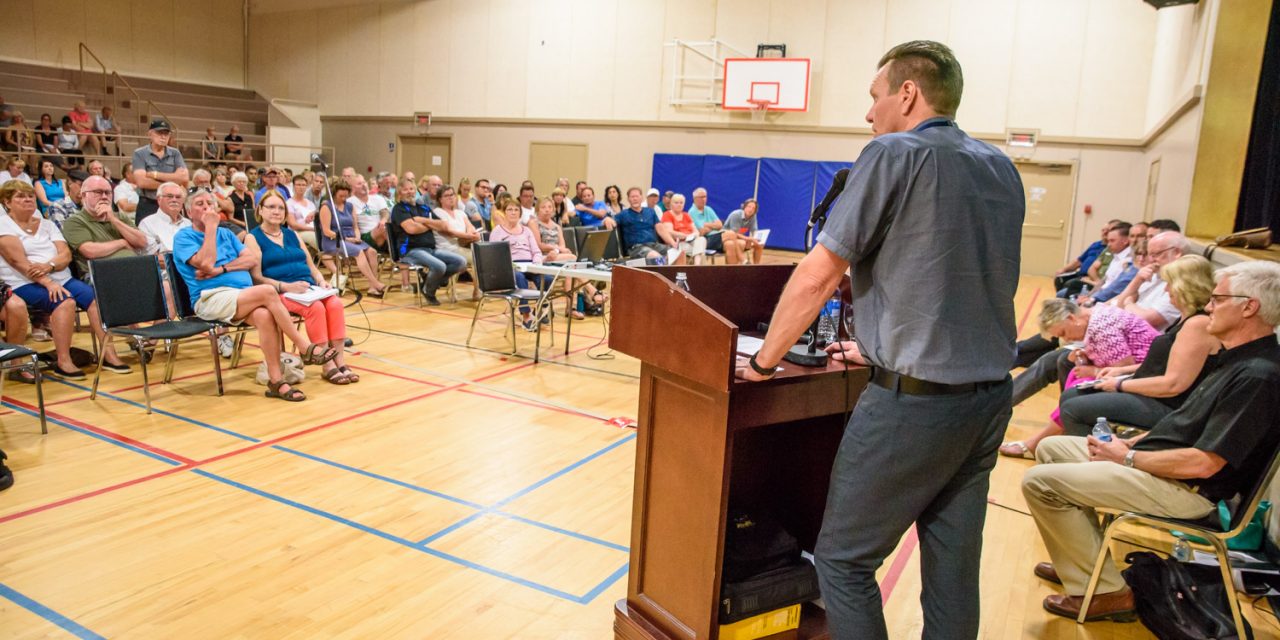

Mark Woods, community services manager with the Regional District of Okanagan-Similkameen, is in charge of the Emergency Operations Centre. He addresses the audience while elected politicians and officials sit under the stage to his right. (Richard McGuire photo)
RICHARD McGUIRE
Osoyoos Times
Osoyoos resident Doug Eisenhut last week accused water managers of flooding Osoyoos and causing millions of dollars in damage, choosing to benefit Kelowna over Osoyoos.
Eisenhut, the retired owner of Eisenhut Insurance, charged that officials should have started to lower Osoyoos Lake in January, as they were doing with Okanagan Lake.
The exchange at a public meeting on May 15 to discuss the flood situation was one of the more heated ones of the evening.
(Play audio: runs 11:00)
Most of the more than 100 people attending politely listened as officials from the Town of Osoyoos, the Regional District of Okanagan-Similkameen and the Government of B.C. explained the situation and answered questions.
Some audience members expressed frustrations with lack of information and with the inconvenience of evacuation, but the tone was mostly civil.
Eisenhut said officials should have known in January there would be flooding problems because of high snowpack levels.
“We knew that in January,” he said. “You lowered (Okanagan) Lake in January. Why didn’t you start lowering ours? That’s the question.”
The comment drew applause from some members of the audience, but it also highlighted the communication gap between some frustrated members of the public and the officials and experts.
“In January, February, March, we had an opportunity to at least keep our lake the level it was,” said Eisenhut. “You raised it, and now we get the flood, millions of dollars of damage. Did you sacrifice Osoyoos for Kelowna?”
Many of Eisenhut’s remarks in an 11-minute exchange were directed at Shaun Reimer, the B.C. official who oversees operation of dams on the Canadian side of the border, including the dam where water exits Okanagan Lake at Penticton.
Reimer explained that a high snowpack doesn’t necessarily translate into historic flooding on the scale of the 1972 floods. In other years, there have been high snowpacks, but no floods, he said, while acknowledging that the risk increases when snowpacks are high.
But much of the response to Eisenhut came from Brian Symonds, who sits on the International Osoyoos Lake Board of Control, a body under the Canada-U.S. International Joint Commission (IJC).
Armed with a slideshow of graphs and charts from government websites, Symonds tried to explain how the laws of physics affect rising and falling lake levels.
Symonds and Reimer at times appeared frustrated when their explanations seemed to fly over the heads of some audience members.
“I’m going to try to explain it again,” said Symonds when he stepped up to respond to Eisenhut. “Obviously I didn’t do a very good job last time and I hope this will make more sense.”
Symonds explained that the gates at Zosel Dam in Oroville, which regulate the outflow from Osoyoos Lake under normal conditions, have been “freeboarding” or wide open since March 26.
On that date, the level of Osoyoos Lake was at 910.32 feet above sea level.
The Zosel Dam is operated by the Washington State Department of Ecology based on rules established by the IJC.
“That was everything you could do possibly on Osoyoos Lake back on March 26,” said Symonds.
Even recently, flows from Okanagan Lake were fairly steady and Osoyoos Lake was within the comfort zone.
It was only when the Similkameen River started rising that the balance of inflows and outflows on Osoyoos Lake was upset, he said.
“We might like to be able to magically make the water disappear,” Symonds said. “The only way to get it out of the lake is to have the gates (at Zosel Dam) open and the elevation of the lake drive the water out.”
Officials let water out of Okanagan Lake in the winter months, lowering that lake’s level to provide capacity for anticipated snowmelts.
“If the water had not been let out of Okanagan Lake earlier, it would’ve been a lost opportunity with nothing gained by the people in this room,” said Symonds.
Eisenhut wasn’t persuaded.
“You lowered the big lake, you lowered Penticton’s Lake, and you raised ours,” he argued. “That was a man (made) decision and I think we are in an economic crisis year and your disaster fund only pays 80 per cent because you chose to obliviate Osoyoos. I think we should get 100 per cent of recovery, and not 80 per cent, because it was chosen to flood this area as opposed to hold the water back in Kelowna and flood there.”
Symonds tried to explain that with the nature of the channel at the outflow from Osoyoos Lake and the dam gates wide open, it would have been impossible to let more water out of the lake.
“You physically couldn’t do it,” said Symonds. “It’s fantasyland to think that it could’ve been down that low at (that) point in time.”

Doug Eisenhut, pictured when he retired, accused officials at a public meeting Tuesday of flooding Osoyoos to save Kelowna. (Richard McGuire file photo)




This was the most ignorant, immature, and self serving performance I’ve ever had the displeasure of witnessing.
You cannot change what happened, it’s not anyone else’s fault that you don’t understand science, water physics, or (apparently) the English language.
This outburst was and embarrassment to or town.
I may not have a home going forward.. However unlike some of the more ‘fortunate’ members of our town, I don’t have millions of dollars in the bank.. I have $7 and the coming months will be heartbreaking, tiresome, and endlessly humbling. But at least I have a high school education.. And mad respect for my sleepy little community.
For shame.
Maybe like teaching mathematics to cats. An exercise in futility that must be carried out regardless of success.
Aid should be for both those who live in and outside the community especially if they are in BC. 80% for those who have primary residences. Guess what, l am not a primary residence, l am not rich, l have a home l go to all the time that in hopes l can retire in. I sandbagged, l pumped, l was there and we tried our best. Cant blame anyone for water rising 2 feet or for me having an older home that is lower than most. But l will get no help even though l pay full tax. I will have to take out everything, cut drywall, tear out cabinets and carpets and get 0%. I live in BC, l give to Osoyoos, and the government aid says nope, we wont help you. I am sure l am not the only one in the same boat and even those who will get 80% will only get it after they fix their houses, go into debt and do their best to come back from this in hopes it doesn’t happen in years to come. I just hope Osoyoos invests in those bladder damns like Kelowna, who even put them around peoples houses and not just public land. I hope Osoyoos makes a plan for next year to be better in control and prepared. Yes the town and community came together to help, but we don’t want to be doing this yearly.
I agree with Doug Eisenhut, we knew the flood was coming. We just didn’t know how big it was going to be. Yes, it depends on snow pack, weather, rain fall etc. All this doesn’t change the fact that as Osoyoos Lake was raising rapidly in the last couple weeks no one closed the damn up the valley to hold some of the water in Okanagan Lake. With the size of Okanagan Lake all you would have to do is raise it a couple inches to give Osoyoos Lake a reprieve. I drove past Okanagan Lake last week and if anything it is low right now, Skaha is about normal. The only flooding you start to see is once you reach Vaseux Lake and it is a little high but they still have beaches. Then you get to Road 22 and there is Osoyoos Lake starting where a hay field should be. I do feel Osoyoos was sacrificed to keep Kelowna happy.
Frustrating and devastating. I accept and support the sentiments expressed on all fronts, however- Osoyoos should have been more prepared for a disaster after last year, and there should have been a discussion about the potential impact of the dam at Kelowna on our community long before we got to where we currently are. It’s called planning ahead. Most large organizations prepare for worst case scenarios, and have disaster plans- maybe take note? I am sad for my neighbourhood and the wonderful people who live in it- this is a huge loss to most of the residents on my street, and I am afraid that this will be impossible for some to overcome. And no- my family is not eligible for relief as we are not full time residents, but we do get the privilege of paying more tax. Just an awesome experience on all fronts.
As a former resident of Okanogan County near Oroville and living next to the Similkameen River, I witnessed the floods of 48 and 72 and this year is no different. With a greater than average snowpack, with high water content and then rain on snow or suddenly high temperatures severe flood conditions occur. When the Similkameen flows are high it backs up the flow of the Okanogan so water levels in Lake Osoyoos will rise, it has nothing to do with levels in Vaseux, Skaha, or Okanagan Lakes.
Sorry Jim but I have to disagree with you. You are correct that the river backs the water up in to Lake Osoyoos so the level of the lake increases. If we continue to put more in from the northern lakes than we can get out, the lake will overflow its banks quicker than it would if you slowed down the the flow from the north. When you fill a container up twice as fast as you can empty it, it fill in half the time. For some people a half inch of water is the difference between making through the flood and total destruction of thier most valuable asset.
It’s hard to feel compassion for wealthy lake front land owners who chose to live on the lake and know the risks associated with living near water. Trying to put blame on others to warrant another 20% in compensation from the government just doesn’t fly while residents in Grand forks are losing their homes.