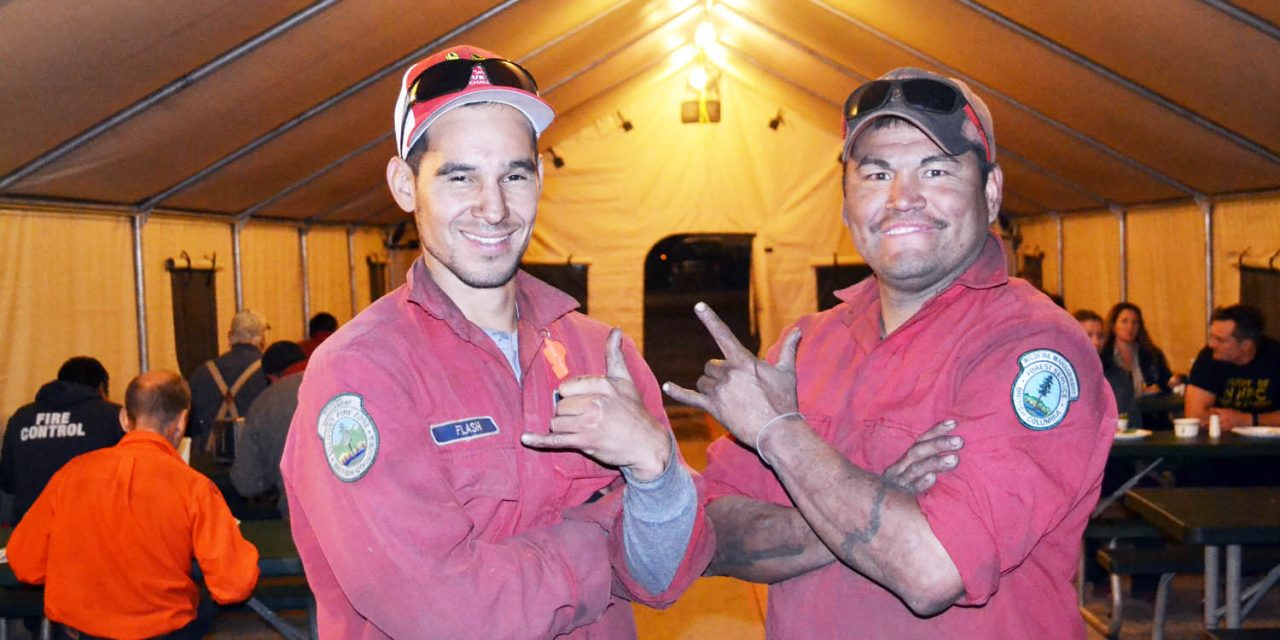
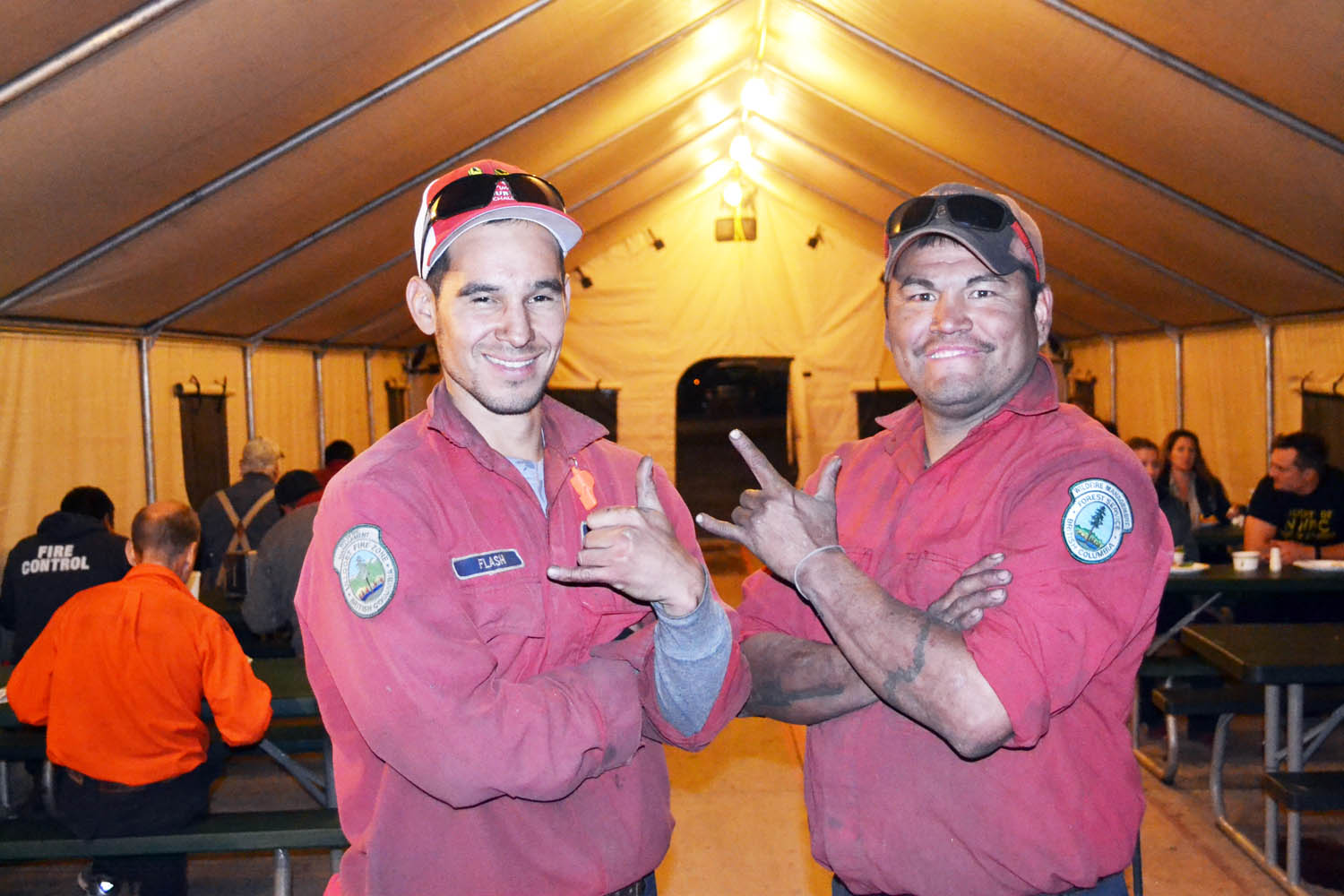
Dustin Ned (left) and Ray James stand in front of the cafeteria tent at the Testalinden Creek fire camp after another long day this past Sunday battling the stubborn blaze. (Trevor Nichols photo)
The Testalinden fire camp was relatively peaceful this past Sunday evening as helicopters flew in the distance and a small group of security guards conferred near the entrance as dishes clinked in the kitchen trailer.
The camp occupies a small lot of land southwest behind the Town of Oliver and its sprawl of tents and trailers is the nerve centre for the more than 200 people. They include firefighters, cooks, planners, safety experts, information officers, all who are working together to battle the Testalinden Creek wildfire.
It’s wasn’t until around 8 p.m. Sunday, when BC Wildfire crews started returning from another day of hot and hard work, that the purposeful quiet gave way to the hum of activity.
In the fading daylight, the returning crews trudged into the camp wearing rugged work boots and long, thick uniforms. Soot clung to their clothes and skin.
Most set out to fight the fire at 7 a.m., heading straight into the heart of the place no one else wants to be.
As veteran firefighter Ray James says, they are the “guardians of the fire.”
James and fellow firefighter Dustin Ned were two of dozens of weary firefighters who returned to the camp following another long shift battling the blaze.
James is a big guy, with gleaming eyes and a hearty smile. Ned is taller, slighter and dryer than his boisterous buddy, but both of the Lillooet natives carry themselves with the same combination of weariness and confidence unique to their trade.
Sitting at a picnic table outside the cafeteria tent, the pair explains what a typical day in the life of a B.C. Wildfire firefighter looks like.
That morning, like every morning at the camp, James had been up at “0-500” to eat breakfast, pack his lunch and prep his crew’s truck before the day’s work, loading it with tools, fuel, hoses and anything else they might need for the day.
By 7 a.m., after a brief meeting, he and his crewmates drove up to Osoyoos and turned onto a side road heading towards the burn area.
After about 90 minutes, they arrived at their safety zone, which Ned explained is a “fuel-free area” that has been cleared of any trees, grass or shrubbery that might burn.
Once on site, they hold another safety meeting, going over important on-the-ground safety information before setting out into the eerie landscape of burnt forest to begin their day’s work.
“It’s kind of like a scary movie. All you see is black trees … it kind of looks like winter on the ground and then the trees are just all black, kind of like a silhouette” James said, adding the whole forest floor looks like black charcoal.
According to Fire Information Officer Heather Rice, a lot of a wildfire firefighter’s work is creating “guards.” A guard is essentially a trench, dug deeply into the ground – right down to the mineral soil – to stop the spread of the fire.
The trenches can be as skinny as a few inches or as wide as a road. It all depends on the intensity of the fire. Bigger ones are dug with heavy machinery, but in places where the equipment can’t go firefighters do the digging.
The Testalinden Creek wildfire has been burning for weeks and some guards are as wide as roads, said Rice.
But burned-out trees present an enormous danger to firefighters in the area, so a large part of what they do is “danger tree assessment” and “danger tree falling.”
That is the first thing James and Ned did during their shift on Sunday. They scouted the area they would be working in for danger trees, so they could be felled later. After that, most of their work is digging guards and putting out hotspots.
Their squad, a 20-person team split into four smaller groups, was working the northern area of the fire.
Ned explained that crews would set up a pump in a lake or creek with a pipe leading into the burn area. Smaller hoses branch off from that pipe, allowing firefighters to hose down hotspots.
Firefighters will dig guards and lay hose behind them, allowing them to get to the hotspots and take care of them. A hotspot is a place where the fire is still smouldering underground.
Firefighters look for signs of the spot (Ned said that one method is to feel the ground with your hand), dig them out and hose them down.
Rice explained there’s actually not that much water used in fighting the actual flames from forest fires. Usually they are so hot that any water evaporates before it can do much good, so water bomber and helicopters are used primarily to cool things down for the firefighters or to put out small spot fires.
The two looked beat, but James still wore a big smile. He said that fighting fires is one of the best jobs he’s ever had.
Ned agreed. He said he tried for years to get on a crew before finally managing a decade ago.
At one of the first fires he ever responded to, he was struck by lightning. He was “mopping up” by a large tree that was struck. The current travelled from it through the nozzle of his hose into his arm.
“It sent me like 20 feet down the hill,” he recalled with a chuckle. “I couldn’t feel my arm for like 24 hours and my hand I couldn’t feel for a long while.”
But he loved the job so much, that didn’t scare him away.
“I was off for five days and back to work,” he said. “The camaraderie, the brotherhood of the reds and blues. You probably won’t get a greater bunch of people anywhere. With all the fear and everything else that is out there, it just brings us closer together, like a tight family. It doesn’t matter if you’re from the south; the east; the coast; South Africa; anywhere. We’re just one big, happy family.”
TREVOR NICHOLS
Regional Reporter