The provincial government is still speaking in generalities about how it plans to ward off an infestation of invasive mussels in the Okanagan lakes, but there are signs it is moving forward.
Elected representatives and staff from the three Okanagan regional districts met recently with Steve Thomson, minister of Forests Lands and Natural Resource Operations (FLNRO) at the Union of B.C. Municipalities (UBCM) convention in Whistler.
“I wouldn’t say that he gave us a whole bunch of new information,” said Mark Pendergraft, board chair of the Regional District of Okanagan-Similkameen (RDOS). “He basically assured us that they are working on it and are proposing to come up with something in the near future, but no real details were given.”
Pendergraft said he was not completely satisfied with the meeting, but he is encouraged to hear the province is working to address the threat.
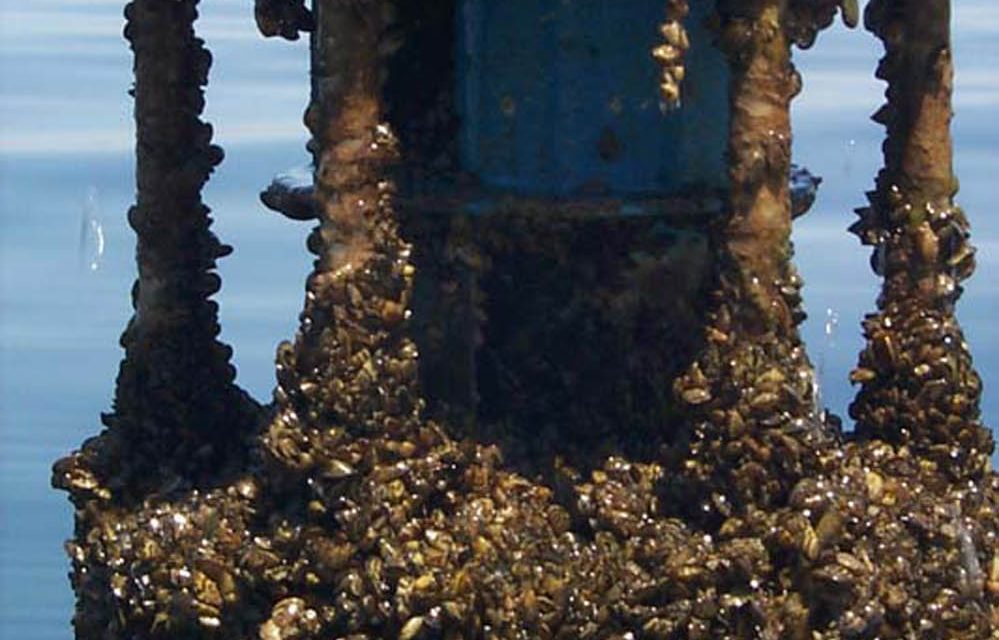
Zebra and quagga mussels have spread to lakes and rivers throughout eastern North America and they have recently made inroads into the U.S. Southwest.
They encrust themselves on docks, boats, water intakes, bridges and other infrastructure.
The Okanagan Basin Water Board (OBWB) estimates it would cost the region $43 million a year just to mitigate the damage caused by a mussel invasion.
Mussels are usually spread between water basins by recreational boaters who fail to properly clean, drain and dry their boats after using them in an infected lake.
Despite the lack of concrete information from the minister, a small victory was achieved at UBCM with the passage of a resolution from the Town of Osoyoos calling on the provincial government to allocate resources for boat inspections at interprovincial entry points into B.C. as well as within the province.
The resolution, which is not binding, also called on the province to push the federal government to move forward on Fisheries Act regulations that would allow border officials to inspect and stop contaminated vessels coming into Canada from the U.S.
Meanwhile, the OBWB was expected to discuss on Tuesday an update report on the mussel threat prepared by James Littley, OBWB office and project manager.
Littley outlined a conversation with Dr. Matthias Herborg, aquatic invasive species co-ordinator with the B.C. Ministry of Environment.
Littley said he contacted Herborg to press for details on the province’s mussel strategy because there have been few details from either the provincial or federal government in response to the OBWB’s written correspondence.
Among the steps being taken, Littley said Herborg noted the following:
•The province has offered training about invasive species to officials from the federal Canadian Border Services Agency (CBSA). Nonetheless, only about 15-20 federal officials have taken the training because they are required to do it on their own time and the federal government hasn’t yet put in place regulations allowing CBSA officials to inspect and detain infected boats.
•There is discussion of a perimeter defence strategy for zebra and quagga mussels in which provinces like B.C. and Alberta would fund inspection stations between contaminated and uncontaminated provinces and states elsewhere. Neither province currently borders on states or provinces with invasive mussels.
•The province’s early detection and rapid response plan has been delayed because it is part of a larger provincial plan for all invasive species, which has not yet been finalized. In a June letter to the OBWB, Environment Minister Mary Polak said the plan would be “completed over the next several weeks.”
Littley said details of a perimeter plan are still in early stages, but meetings between officials from affected provinces and states are taking place.
Although it is common practice to require boats to be decontaminated when leaving infected lakes in the U.S., Littley said Herborg told him this isn’t happening in Manitoba.
Lake Winnipeg is the westernmost lake in Canada known to be contaminated by invasive mussels.
Although OBWB has been lobbying hard to have the province set up inspection stations for boats entering B.C., Littley said he was told the province has no plans to do this, although there are some roving inspections that took place during the summer.
RICHARD McGUIRE
Osoyoos Times