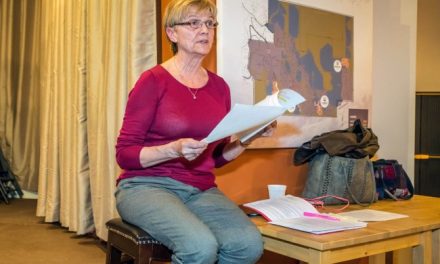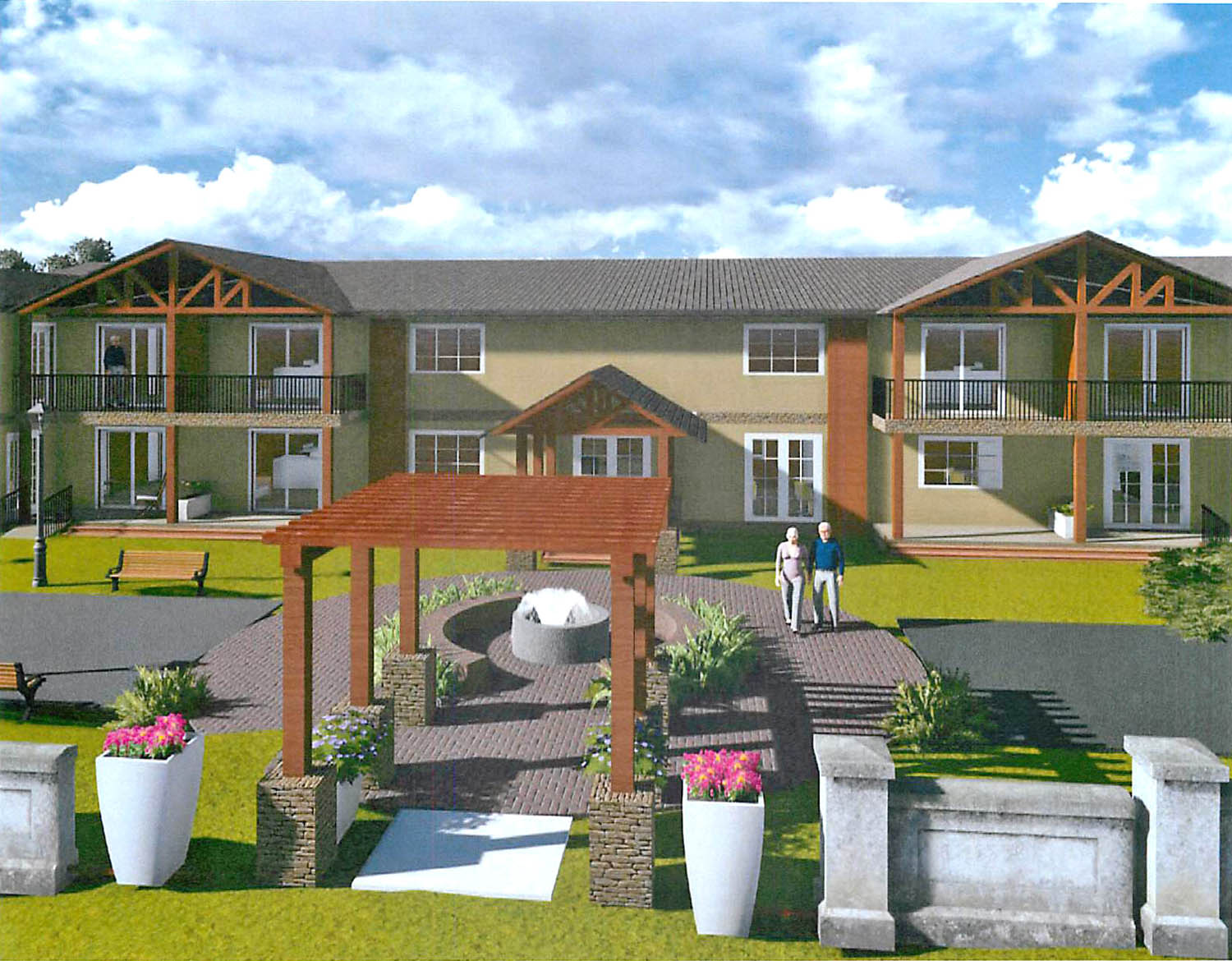
Financial planner Stephen Hill showed council this image of what affordable seniors housing could look like.
With 800 Canadians now turning age 65 every single day, the need for affordable housing in communities like Osoyoos will grow exponentially as baby boomers reach retirement age.
That’s the message brought to town council’s committee of the whole last week by Stephen Hill, a financial planner and president of Septen Financial Ltd.
“Right now we have four million seniors over the age of 65 in Canada,” said Hill. “And 80 per cent of them collect guaranteed income supplement (GIS), which means they’re living on almost $1,300 a month.”
Hill told council that he wants to start a discussion about affordable housing because so many of his clients in their 70s to 90s find themselves trapped – unable to sell their homes for enough to move into affordable senior-friendly housing.
“I’m not a developer,” he said. “If you can find a local developer to take this off my shoulders, that would be great. I’d be happy to work with them. My job and experience is bringing qualified people together to a particular problem and bring it to a successful conclusion.”
Hill acknowledged to council that he has never developed a housing project of the kind he suggested, however, he did play a key role in restarting the sawmill at Midway, which brought much-needed economic stimulus to that community.
Hill has also run unsuccessfully as a federal Conservative candidate in B.C. Southern Interior.
While council was non-committal to Hill’s proposal, which involves using town-owned land and pre-fabricated multi-unit housing, the need for low-cost housing is something council is already discussing.
Recently Destination Osoyoos decided to launch a task force to look into affordable housing in order to provide accommodation for employees working in the hospitality industry.
Osoyoos has a median age of 60.3, based on the 2011 census, making it one of the oldest communities in Canada, though not the very oldest, as Hill suggested to council.
Qualicum Beach has a median age of 63.9.
The problem, said Hill, is that many seniors are trying to sell a house for an average price of $250,000, but many of the available condominiums in communities such as Kelowna are in the $400,000 to $600,000 range.
“The markets being served are the upper 20 per cent,” he said. “It’s not being served at the bottom 80 per cent. So we need to look at unique private-public partnerships.”
The answer he proposed is multi-unit developments using manufactured housing built in Kelowna to reduce costs and maintain quality control.
“We can build it in parts of 14 to 18 units in 10 to 12 weeks, and every 10 to 12 weeks we could deliver another 14 to 18 units,” he said.
The problem, however, is that costs of producing this kind of housing in Canada are about double what it costs in the U.S., due to various municipal requirements and the cost of the land.
These costs, he said, include municipal bylaws, provincial and federal codes, parking requirements and municipal development cost charges (DCCs) that developers pay.
“Some municipalities create all those things and then they wonder why nobody develops,” Hill said in an interview.
Hill suggested that if the municipality could take land costs out of the equation by a long-term lease or strata mortgage arrangement, it could be possible to lower the cost of a unit to $200,000.
Mayor Sue McKortoff told Hill that the issue of affordable housing “is on our radar and it’s in our long-range plans.”
Alain Cunningham, director of planning and development services with the town, said Osoyoos has an affordable housing policy developed years ago that identifies a number of priority needs. These include moderate-income working households, short-stay workers, low-income and special-needs households and elderly seniors on fixed incomes.
“At that particular time, we did not envision the municipality getting involved in a major way as a partner, but the policy does say that we will monitor the situation very carefully,” said Cunningham.
He noted that the provincial government has the lead on housing policy.
Hill, however, suggested that municipalities have the land and they are able to innovate on a small scale and then go to the provincial and federal governments with ideas that work.
Coun. Carol Youngberg, whose background is in real estate, expressed an interest in following up on Hill’s idea.
“I thought it was really good,” she said, adding that she wanted to do an inventory of vacant properties and rental housing to see what is available. She also wanted to talk to builders and others familiar with this concept.
“It very easily could be a viable project for our Meadowlark subdivision,” she said. “It’s a matter of how we’re going to work the numbers out.”
Youngberg agreed with Hill that municipalities should be more responsible for affordable housing.
“Housing forms part of the economic drivers of the benefit for the community,” she said. “If we can’t find affordable housing, we don’t have workers, so we don’t have younger people moving into this area. So somebody has to help.”
Youngberg also agrees that manufactured buildings can help to bring costs down to the level where this kind of project becomes possible.
She questioned Hill’s suggestion of two-level accommodation for seniors, because many can’t use stairs, but she acknowledged that three- or four-storey buildings with elevators could be a solution if the cost numbers can be made to work.
Hill said the high number of seniors collecting the GIS and living on less than $1,300 a month is because only 40 per cent of Canadians have a pension and of those, only half have an indexed one.
“It’s very, very difficult and if you’re not saving the money and you’re taking your money and putting it into cigarettes and alcohol and other costs and not saving it, then you wake up one day and all you’ve got is 1,300 bucks to live on,” he said.
Older people are migrating from the east to communities like Osoyoos, Hill said. They’re not going from west to east.
“This stream turns into a river and the river turns into a torrent and all of a sudden you’ve got a raging problem on your hands if we don’t address it early enough,” said Hill. “I’m just trying to bring it to people’s attention. This thing is just starting and 15 to 20 years from now it could be colossal.”
RICHARD McGUIRE
Osoyoos Times