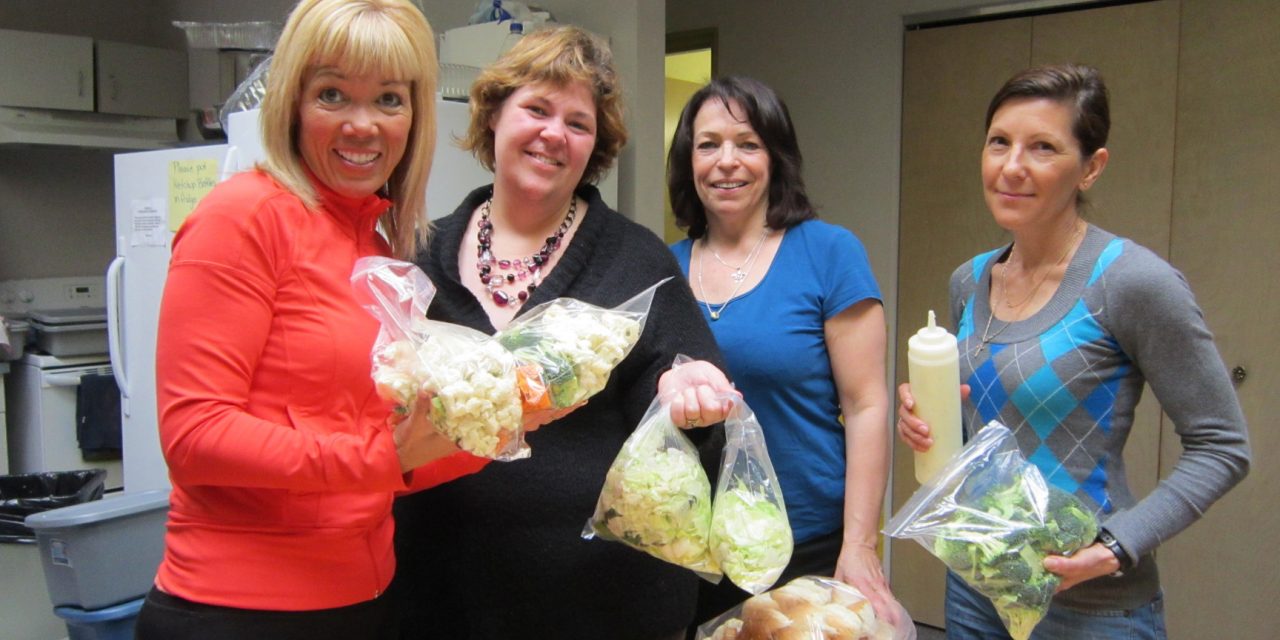

Farm-to-School advocates Marji Basso (left), Cory-Lee Mills, Claire Schwartzenberger and Louise Szalay promote healthy eating for students at Oliver Elementary School.
The women behind the Farm-to-School program in Oliver are hoping to see more children making healthy food choices in School District 53.
Marji Basso and Claire Schwartzenberger recently updated the Education Committee on the salad bar program.
Basso began the presentation by saying Canada imported a total of $15.8 billion in food products in 1997. She also noted an average of 32 pounds of waste is produced for every pound of goods that is produced, and a third of all waste comes from food packaging.
Basso said the only business growing faster than fast food is food banks, with women and children being the primary recipients.
Sadly, children are consuming more soft drinks and potato chips than ever, and obesity is a big problem, she pointed out.
“We are trying to get a handle on addressing obesity, but unfortunately it’s really a hard battle to fight,” Basso said.
Statistics show that one in four children in BC live in poverty.
The Farm-to-School program at Oliver Elementary began in 2008. The students quickly learned about salad bar etiquette and developed a good understanding of why healthy food is important, Basso said.
But teachers are still seeing a lot of children eating potato chips and pre-packaged junk food, she pointed out.
The good news is that 67 per cent of Oliver Elementary students are participating in the salad bar program.
Schwartzenberger said it’s amazing to see kindergarten pupils getting involved, adding they love choosing food from the salad bar.
Basso recognized the organizations that sponsor the program, including the Kiwanis Club, Valley First Credit Union and Hester Creek Estate Winery.
“We’re not looking for handouts, but business partnerships,” Basso said.
The Kiwanis Club now sponsors all kindergarten children at Oliver Elementary and Tuc-el-Nuit Elementary. The belief is that every child deserves a nutritious start to their education.
Basso noted the program is now being offered in five district schools. She said Osoyoos Elementary has its own garden on site, which makes her “very envious.”
ity kitchen, and staff have trained Grade 6 and 7 students in the safe handling of food.
Similkameen Elementary involves its home economics class that prepares the food for the program.
Basso said students are also taken out of the classroom and into the fields to see where and how their food grows. Some sites they have visited include Oliver Super Market and the Okanagan Gleaners facilities.
Despite all of the healthy benefits, Basso raised a concern about a “conflicting” situation in local schools. She referred to the type of food being served during the week, such as hot dogs and pizza, which are not full meals.
Basso said offering these meals five days a week negates the opportunity for students to shop for healthy foods with their parents.
“We really believe we have to foster and develop powerful consumers,” she said, noting that three dollars (for a slice of pizza) can buy you a bag of apples which will last a week).
Basso said she fully understands why parents advisory councils offer weekly meal programs to schools; to raise money for playground equipment. But she hopes there will be dialogue to address this conflict.
Lyonel Doherty
Oliver Chronicle