By Don Urquhart, Times Chronicle
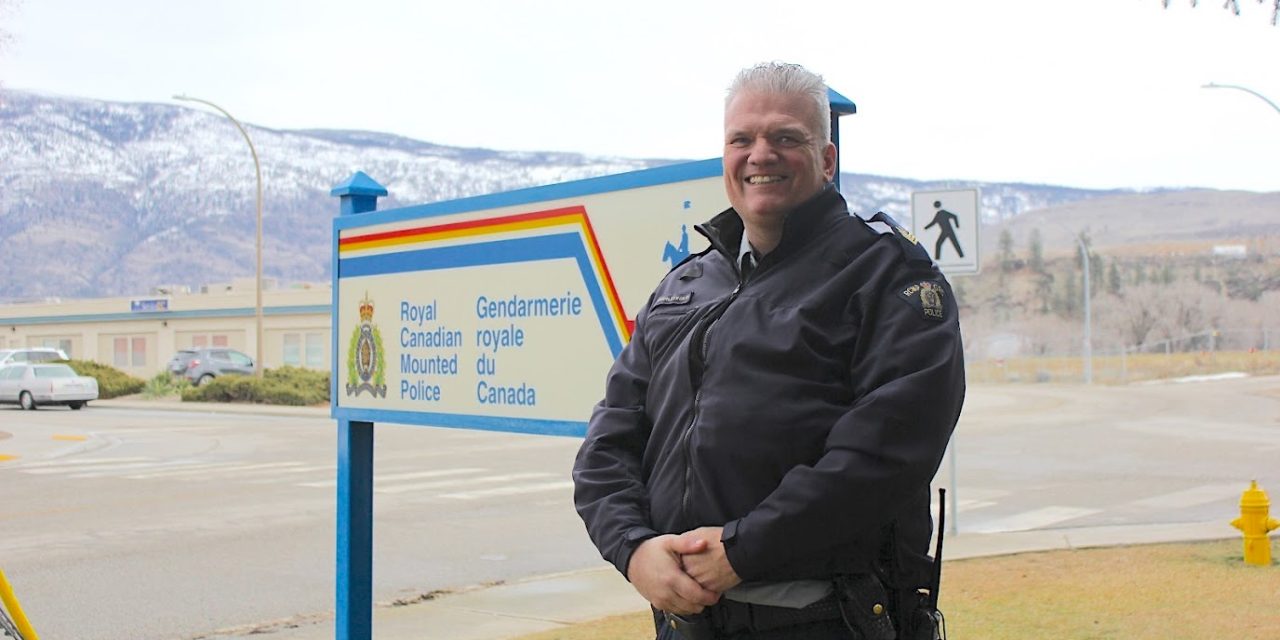
Oliver residents will be seeing less of the very recognizable former detachment commander, Sgt. Don Wrigglesworth who retired effective late last month after nearly a decade of policing in town both as a constable and then again later as the officer in charge.
On the day we sat down to talk about his many years on the force he had just returned from paying a visit to Okanagan syilx elder Jane Stelkia to introduce his replacement.
With her birthday coming up in April it means her annual ride around the community on horseback and she didn’t waste the opportunity of the visit to get a commitment from him to join her on the ride. His reply, “ok, as long as it’s a Clydesdale!” he said laughing. For those that don’t know Wrigglesworth, he’s a very big man and hence the reference to a strong heavy draft horse.
Certainly many in the community will miss his sense of humour, although he does fully admit sometimes he says things he shouldn’t. When this journalist first met him it was the Ides of March and he had brought lunch for the detachment staff . . . complete with Caesar Salad of course.
Wrigglesworth says he hadn’t any plans as a youth to get into policing but rather saw an advertisement while in his hometown of Toronto, and saw an opportunity, not to chase criminals, but to see more of the country.
After training in Regina he was posted to BC in New Hazelton between Terrace and Smithers to get some small town experience and learn about community policing. “And I sure did,” he says. It also turned out to be serendipitous on the personal side as well because he met his wife who was also with the RCMP, but posted to Burns Lake. Not quite a long distance relationship but still a couple hundred kilometres of bush in between he notes wryly.
“We did our time up there and then she transferred to the Penticton Detachment and I transferred to Oliver, which was 2003.” The pair married and had two kids and then in 2008 they were both promoted to a corporal position – his wife to Smithers and he went back to New Hazelton.
This time up in the north they had their two young kids with them which made it a whole new experience. “We totally loved the community he says, adding local residents were very surprised to see him again because normally small remote towns don’t get repeat officers.
“It was a really good time and I still go back every couple of years, I’ve got friends up there,” and of course he loves the beauty of nature there, doing all the things he didn’t have the chance to growing up in the big city like “wading into the river, looking at snow capped peaks and catching giant salmon.”.
In 2011 they both transferred back to Penticton where they were both working as watch commanders while their kids were in their young years at school. Wrigglesworth did some community policing work in Penticton working a lot with volunteer groups, something he enjoyed very much.
“Then back on the watch, and I was able to get the promotion to Oliver.” This saw him return here in 2020.
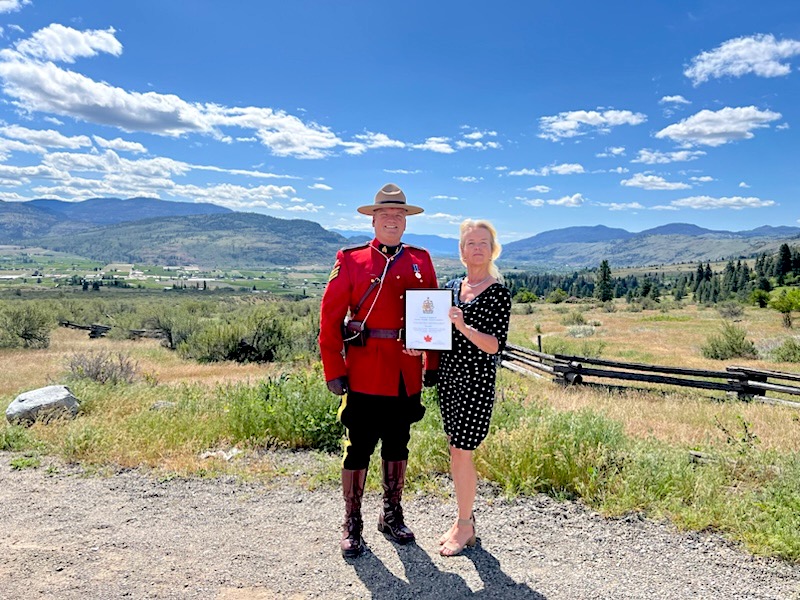
A favourite part of the job – Oliver RCMP Detachment Commander Sgt. Don Wrigglesworth in red serge, standing next to new Canadian citizen, Anke Galardo, in Oliver.
RCMP photo.
He highlights that he’s not fully retiring as the RCMP has what’s called a Reservist Constable Program (RCP) which enables him to work and fill in as needed – “kind of like a substitute teacher” he chuckles. He’ll be based out of Penticton and quite likely Oliverites just might see him in a patrol car on occasion.”
The top priority however will be to travel. His wife retired a few years ago and now that he’s retiring, there’s time for more leisurely pursuits. And he’s got it all figured out – he can leverage the RCMP at different locations around the country.
“There’s a lot of places to travel to and it also provides an opportunity to travel and work as a constable in different communities in the country,” he says. This could be for a month at a time for instance, he says, adding that the Okanagan will always be home.
The reservist constable program has also been used at the Oliver detachment he notes, when someone is going on vacation or when they simple need some backfill. The retired officers “bring a wealth of experience with them that’s hopefully a positive influence on the younger officers that are coming up.”
One of the highlights of the job for Wrigglesworth was the ceremonial aspect, in particular the Canadian citizenship ceremonies. “New citizens getting their Canadian Citizenship and being invited to be there in Red Serge [the traditional red ceremonial uniform] and to experience that and see those 100-odd new citizens from 40 or 50 different countries around the world that have come to Canada and to feel that pride they have on that special day,” is priceless.
He notes it’s something that Canadians who are born here don’t necessarily acknowledge or realize. “But when you’re in that room, and feel that energy and you see the tears of joy of people, and then being the person that they want to have a picture with, is very special, and I didn’t take that lightly,” he says.
He adds it was always an honour to be invited to participate, whether high school graduations, leading parades, marching . . . in short “getting to be that guy”, he chuckles.
He laughs as he recalls one particular occasion during 2010 when the Olympic Torch Relay was passing through Hazleton.
A stop was planned on account of Hazelton native Carol Huynh who was at the time an Olympic gold medalist from the Beijing 2008 games (she later added a bronze medal from London 2012).
While pausing the run to sign autographs for the hundreds of people that had gathered in old Hazelton, she passed the torch to Wrigglesworth to hold for her and without missing a beat he held it aloft over his head evoking cheers from the assembled crowd. “It was a pretty neat reaction,” he says laughing that he might have gotten a better reception than the actual torch bearer.
While these are some of the “perks” of the job if you will, there is of course the reality of the job and all its facets. In general, he points out, “People don’t call the police when things are going great, they call when there’s a tragedy and awful things have happened to them or their loved ones,” Wrigglesworth says soberly.
But there is a positive to this he explains. “To be able to be there and to be the person to calm and help them through that, and to have those skills and to communicate and help them through that,” is a good feeling he says, noting there is no textbook way to deal with every situation.
When asked about the changing role of policing and changes in public attitudes over the course of his career Wrigglesworth says he’s always operated by his own personal mantra of “trying to win the public’s opinion back one person at a time”.
One of the things he’s most proud of in the RCMP was the change in 1989 introducing turbans as part of the uniform to accommodate and honour the rights of Sikh members.
“I think it was fantastic,” he said, noting the history of the turban goes further back than that of the stetson which has changed its form over the years.
“We live in a country where we value someone’s religious beliefs more than just what a military uniform is,” he said adding it would be a shame if there’s people that want to join but can’t because of something valued from a religious or cultural perspective.
“I think it shows how wonderful Canada is that we are willing to change and adapt to allow one of our citizens to be part of an iconic tradition.”
One of the challenges of policing in the modern age is social media. And while it doesn’t necessarily impact policing directly, it has wider implications for society at large and it does require having a thick skin, he notes.
“It’s an echo chamber where people are able to express an opinion in caps lock with exclamation points without having to have a conversation face to face,” he observes. “You can be a loudmouth bigot or whatever you want on social media because you don’t see the reaction of a person’s feelings eye to eye.”
He notes that if something offensive is said in a normal face-to-face conversation there is often the realization that one has gone too far leading to correct or backtrack. “We lose a lot of that face-to-face communication.” Quoting Voltaire, via Peter Parker, he observes, “With great power comes great responsibility”.
And then of course there is social media’s problem with mis- and dis-information. “People throw in little gems that have zero truth to them, and that gets people rolling,” he says.
There are also people who report things on social media instead of actually calling the police. “So we don’t know. We do want the reports and we do want the calls with information,” he says.
“I think it’s important for the public to not give up and not throw their hands up and say, ‘What’s the point?’ because society works based on citizens doing their part,” and that includes reporting things to the police.
But on the bright side (Wrigglesworth is without a doubt a glass-half-full type) he notes “There are a lot of positive interactions that can be had given our role. I think it’s important to embrace those opportunities too, and not just always look at the negative.”
“I love the idea of being out in the community, and there’s a lot of people out there that like to have positive conversations with police officers.”
“Unfortunately,” he says, “sometimes people don’t know how to start that conversation. It’s often some sort of joke about donuts,” he chuckles.
Part of the problem he says is that most people have never had interactions with police, other than maybe a speeding ticket to which he adds, “I got one of those too.”
He feels it’s important to connect with the community, particularly with the negativity that can fester, fueled by social media, as a sort of balance. “I think it’s important, there is a lot of negativity, there’s a lot of challenging things that you see throughout your career, but the balance has always been very important for me to also be involved in the community.”
For him, this has meant a keen involvement with the Special Olympics in the South Okanagan. “It brings me a lot of joy and puts things in perspective,” he says.
On the topic of negativity, he adds, “not everybody out there in the community is stealing bikes, right? There’s a lot to a community and what I’ve learned about Oliver is there are so many people here that are proud of Oliver and love this community.”
“And I’m leaving it in good hands,” he adds, in reference to Sergeant Laurie Rock, who is taking over as detachment commander after transferring from Penticton. “We have a great group here and it’s a good time to leave on a high note, I’m not leaving like an angry bear, “ he says adding that he’s had a succession plan in place for a while now.
The detachment is also at full staffing, something that had been an issue in previous years. Recruitment has largely recovered from the hit it took due to the COVID-19 pandemic and all the negativity that was rampant during that time.
“It was frustrating to watch . . . We had a number of things happening at the same time that led many to ask why would anyone want to become a police officer when everything out there was very negative. We have such an exposure to what’s happening in the United States that everyone thinks that what goes on there is exactly the same situation in Canada and it’s very different in a number of ways.”
One thing he says he won’t miss is the high level of stress that can come with aspects of the job. “There’s healthy stress, the adrenaline rush, those sorts of things, but the negative things the continuing stress, I won’t miss that,” and the “incredible amount of emails,” he adds.
Part of this stress is being responsible for his members. “As a supervisor, you worry about what your members are dealing with at night, you’re home sleeping, but I don’t know if you necessarily sleep well,” he says.