By Madeline Baker, Times Chronicle
This is part two in a series on the Okanagan Nation Alliance Water Forum. Part one can be found here.
The land and water rehabilitation projects presented at Okanagan Nation Alliance’s water forum in March of this year may be focused on very specific areas, but their positive impact on the overall habitat of the southern Okanagan River has the potential to touch everyone along its path.
Maryssa Bonneau spoke about the Floodplain Re-Engagement Project, a multi-year, multi-stage land rehabilitation project by the Penticton Indian Band that will undo the canalization of the Okanagan River at the Penticton channel.
Bonneau’s presentation opened with a breakdown of conditions in the area they seek to repair: “the Okanagan River system is heavily impacted by human activities,” she said.
“Channelization and isolated floodplains have contributed to the loss of 85 per cent of low elevation wetlands, 15 per cent of river length, and 93 per cent of riparian habitat.”
“The Penticton channel section of the Okanagan River is particularly degraded, with native fish populations negatively affected and the adjacent water table lowered by up to three metres.”
One of the natural stages of every river’s lifecycle, its old age, involves outward erosion of its banks which then fills in on one side or the other, creating large loops called meanders. This stage also widens the overall floodplain, which means a wider swath of riverside ecosystem in which certain plants and animals thrive.
At this stage of life, city planners may choose to redirect the river on a straighter path by building canals to cut past the looping meanders. This process, called canalization, is often done to “reclaim” developable land from floodplains in service of urban sprawl.
A portion of the Penticton channel on reserve land was identified in 2015 as an area where human interference has severely impacted the river ecosystem, and plans to reconnect the river to its floodplain began to take shape. Nearly six years later, construction would finally begin.
With the Floodplain Re-Engagement Project, the band hopes to reconnect 8800 square metres of the river’s floodplain with fish-friendly culverts, thereby rebuilding an aquatic habitat that supports rainbow trout, chinook and kokanee salmon, and several other endangered salmonoid species of fish.
The curving culverts will also extend the river’s riparian zone – the name for transitional land between a river and dryer upland areas – which will bring back wetland that was lost in the canalization process.
Bonneau presented an impressive list of benefits to the land and water as a result of their project, many of which could have a positive impact for the entire South Okanagan. She said that their work has the potential to improve the river’s water quality and filter the spring runoff more thoroughly, both of which have become problems for local communities.
Restoring the river’s former conditions will also cool the water and land by stabilizing the river’s temperature, which should help to moderate drought conditions and flooding as well as providing a natural fire break in a region prone to wildfires.
On an interpersonal level, the project will bring members of local government and stakeholders together with the public in a rare opportunity to problem-solve for the benefit of everyone. These connections, along with the experiential lessons learned during the process, will help future projects in the Okanagan basin.
For Indigenous communities along the southern stretch of the river, de-canalization will provide an increase in culturally significant food sources, plants used in medicine, and other natural tools used to retain spiritual knowledge and practices between generations.
As of 2021, the land earmarked for the Floodplain Re-Engagement Project has been cleared of invasive plant species and recultured to its original flora and excavation, and insulation of the fish-friendly culverts has been completed, a berm has been built, and new habitat features have been installed.
All that remains for members of the project is to observe and monitor the response of specific animal species and plant communities, adapting the project’s work to support any species that do not flourish in the new conditions.
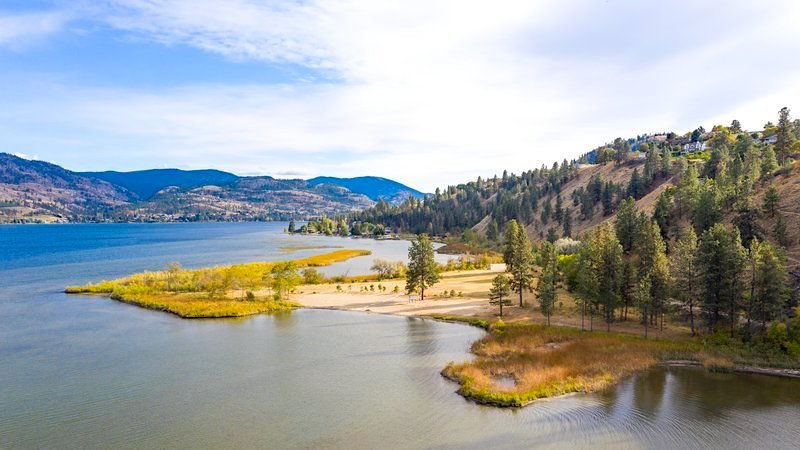
A few kilometres south of Penticton, another project has busied members of Syilx nation on a five acre patch of land on Skaha Lake known as Sickle Point. Wendy Hawkes spoke about the revitalization of this millenia-old camping place for Syilx peoples, who once used the waterways of the province as their roads and highways.
A 2008 study commissioned by the Regional District of Okanagan Similkameen (RDOS) found that 51 per cent of the Skaha Lake shoreline had been denuded and developed, which had stripped Sickle Point of the vast majority of its plant life. In addition, several at-risk species of plant and the severely endangered rocky mountain ridged mussel were found clinging to life at the ravaged site.
Scenes like the one at Sickle Point are all too common, according to Hawkes. “Today, wetlands account for only a small percentage of the earth’s land base, yet these incredibly biodiverse places are being degraded or polluted daily and we’re losing them. It’s estimated that at least one acre of wetland is destroyed per minute in North America alone.”
The RDOS study inspired a collective of locals to form Save Sickle Point, an association that raised $300,000 through online fundraisers to purchase the parcel of land when it was repossessed in 2020. An appeal to Penticton Indian Band’s chief and council led to the formation of a larger group to begin Sickle Point’s true reclamation.
“We did what our elders and knowledge keepers taught us to do,” said Hawkes of their initial visits to the site: “we went and we listened to the land. We began to look and see – what did the land have to say to us? It allowed us to envision what was possible.”
Before those possibilities could become a reality, the group needed to remove a massive amount of organic and non-organic garbage from the lakefront, as Sickle Point had become a party destination for humans and invasive plant species alike.
Once they had sent 670 kilograms of invasive plant life to the landfill, native plant species donated by En’owkin and Sagebrush Nurseries were planted in “communities” that mimicked what they saw on the land.
They also harvested seeds and stalks from the few native plants that had survived to supplement the new potted plants and, as Hawkes shared with a twist of emotion in her voice, added their own nurturing touch to encourage the fragile new ecosystem they had begun to piece together.
“As any good gardener knows, your plants are really happy if you can sing to them,” said Hawkes, “and I caught our guys singing to our plants. They’re awesome.”
Like the Floodplain Re-engagement Project, the Save Sickle Point initiative is now in its most exciting – and most vulnerable – stage. The improvements they have made will either take hold and flourish or require further attention, but Hawkes has seen a positive sign.
Not long before she spoke to the water forum, Hawkes visited Sickle Point and found fresh buds on all of the plant life.
In the third part of this ongoing feature about the Okanagan Nation Alliance Water Forum, the goals and strategies of the multi-disciplinary team behind the Okanagan Lake Responsibility Planning Initiative will be spotlighted.
Part three (of three) to follow.