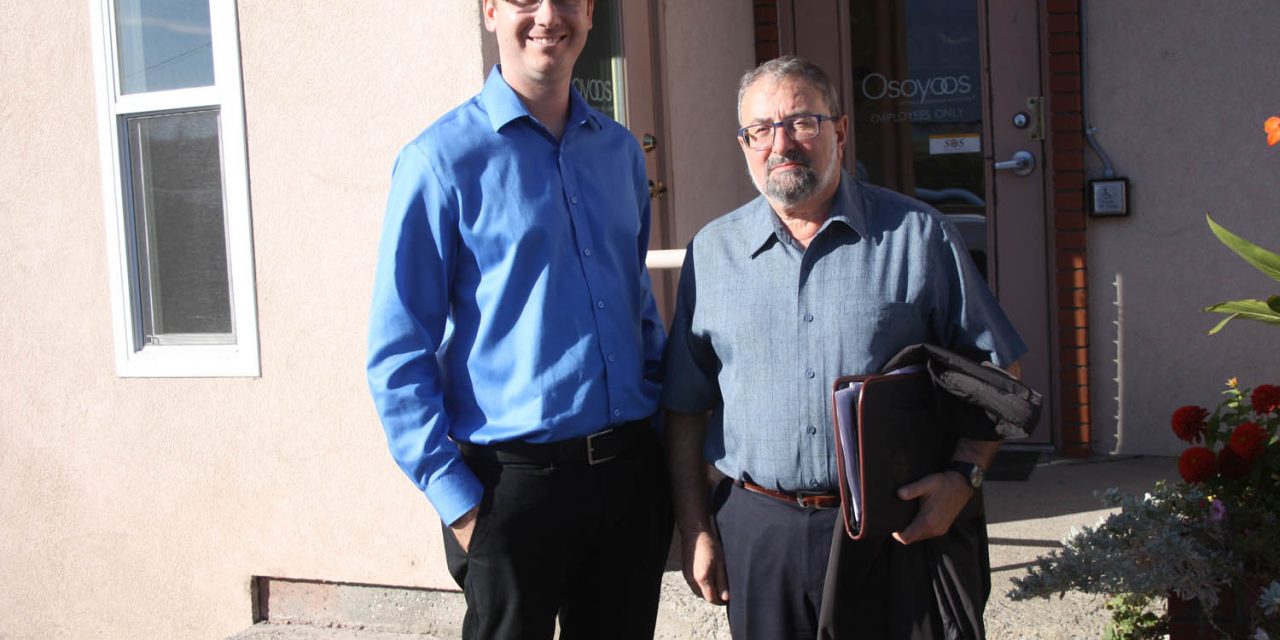
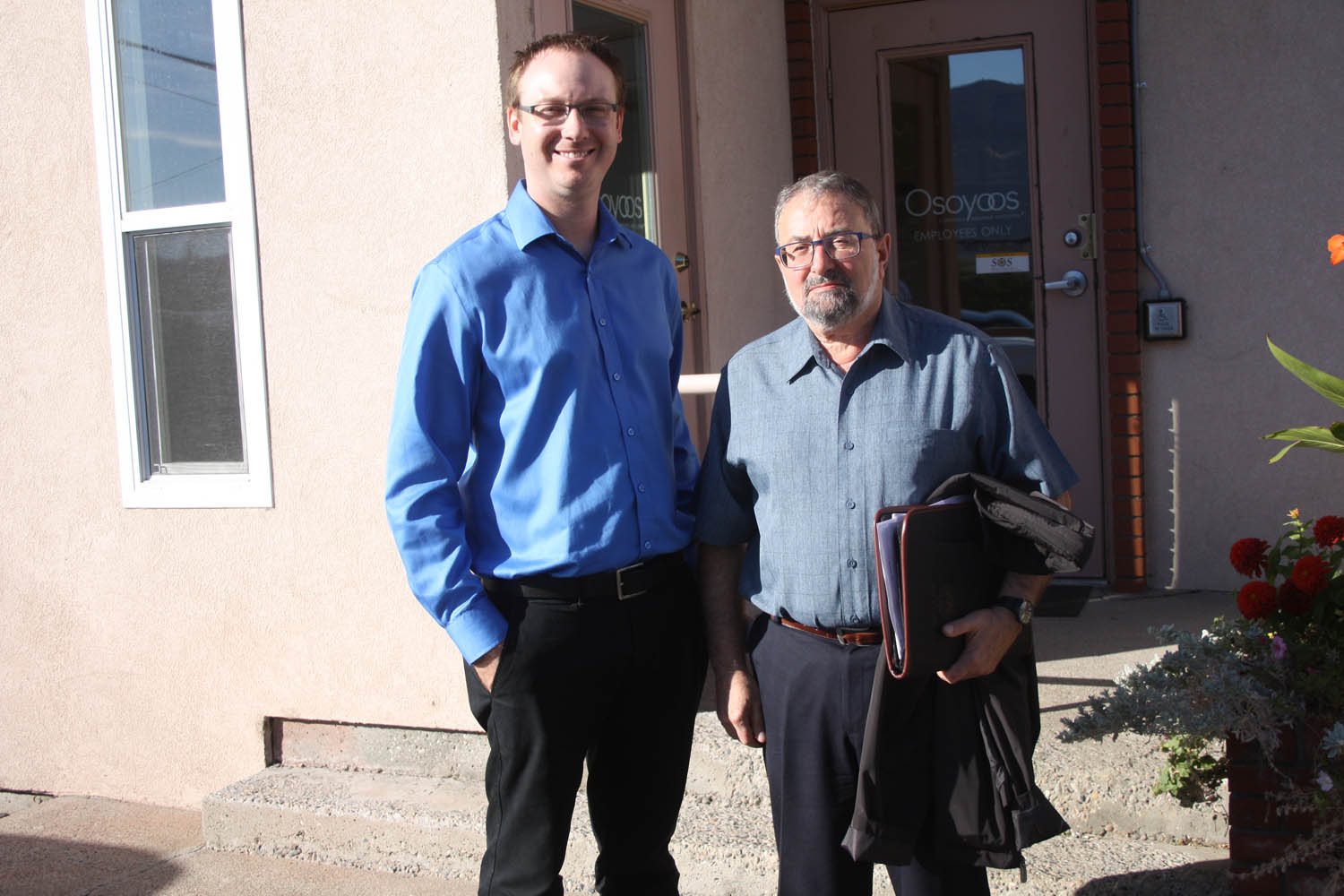
Jacob Scissons (left) and Peter Gigliotti, who work for the Kelowna consulting firm Urban Systems, detailed the highlights of their consulting report which looks at all options for council to implement a water metering program. (Keith Lacey photo)
Town of Osoyoos council heard Monday that water-metering programs in other Okanagan Valley communities have been successful in reducing the amount of water being used by more than 20 per cent.
Mayor Sue McKortoff and members of Town of Osoyoos council will now review a comprehensive consultant’s report before deciding whether or not they will approve spending $1.9 million to install water meters on all local homes, apartment complexes and commercial businesses.
Jacob Scissons and Peter Gigliotti, who work for the Kelowna-based consulting firm Urban Systems, made a presentation to town council Monday detailing the highlights of a report they have prepared on behalf of town council relating to a possible universal water metering program in our community.
“We are here to evaluate various water conservation strategies, including water metering, and recommend an approach for the Town of Osoyoos to achieve its water conservation goals,” said Scissons.
When it comes to adopting a water metering program, it has been proven that universal programs are the most effective and voluntary programs aren’t effective, he said.
The technology currently being used would be well-suited for Osoyoos, he said.
The benefits of a water metering program stretch beyond simple conservation as they allow municipalities to closely monitor peak periods, which sectors are using what amounts and determine a fair and equitable rate system in the long term, he said.
The estimated $1.9 million price tag for Osoyoos would pay for a smart meter being installed on every home, business, multi-family dwelling and institution in the town, said Scissons.
While meters can be installed inside homes and buildings, it’s recommended they be installed buried inside a small box at each property line as the meters are more effective in the long term, he said.
“That allows for better data collection and to come up with a more adequate rate structure,” he said.
Metering programs instituted in other Okanagan Valley communities, including Kelowna, have resulted in more than a 20 per cent increase in water conservation, he said.
Water meters inform users daily about their water usage and eventually result in behavioural change, he said.
“At the end of the day, meters are just tools … it’s people who save water, not the water meters,” he said.
If council does move ahead with a water metering program, it must also plan an effective and consistent communications strategy that details the benefits of water meters in the short and long term, said Gigliotti.
Spending close to $2 million is a significant investment for a town of this size, but the data is clear that metering programs save taxpayer dollars in the long run, do attain the goal of dramatically reducing water usage and encourage individuals to think about this issue every single day, he said.
Any transition to metered rates doesn’t have to take place immediately and can be phased in over two, three or four years, he said.
There are numerous programs where utility companies and provincial governments will share the costs for rigorous fixture retrofit programs, said Gigliotti.
The provincial government has announced its BC Living Water Smart Initiative, which details a goal for communities across British Columbia to be 33 per cent more water efficient by 2020 and to provide 50 per cent of water demands for new development from water conservation initiatives, said Scissons.
Their report details to town council options to try and minimize operational and maintenance costs related to water, defer capital investment for major infrastructure by initiating water conservation programs and the importance of increasing public awareness of the importance of water conservation, he said.
During the preparation of their report, they studied several owners of single-family dwellings in Osoyoos and it was determined the water usage went up 400 per cent, or quadruple, during the summer months compared to winter months, said Scissons.
However, one homeowner who used xeriscaping to virtually eliminate outdoor water usage during the summer, had no significant increase in water use throughout the year, he said.
“The impact from lawn irrigation appears to be one of the major factors (of water use) at single-family residences,” he said. “This was similar to results obtained from 2014.”
Any water conservation strategy adopted by the town should include a program to encourage and perhaps help pay for fixture retrofits inside homes and apartment complexes, said Scissons.
The town’s water restriction program implemented this past June did reduce average water consumption in the short term, but did not have any significant long-term impact, he said.
Programs like this only work if the majority of citizens abide by the water restrictions and it’s clear that was not the case this past summer in Osoyoos, he said.
You also have to have strict enforcement for any water restriction program to be effective, he said.
“There are also others who simply won’t follow the program and are willing to pay the fines” in order to have a green lawn, he said.
Mayor Sue McKortoff thanked Gigliotti and Scissons for their presentation and report, saying the report will provide valuable information for members of council in coming to a decision on the possible implementation of a water metering program.
Coun. C. J. Rhodes said Statistics Canada reports clearly indicate that communities with water metering programs have been successful in attaining their goal of dramatically reducing the per capita water usage of citizens.
Other statistics indicate the per capita water usage of residents in Osoyoos and across the Okanagan Valley are the highest in the country, he said.
“Those numbers are staggering and beyond belief,” he said.
Victoria has amongst the lowest per capita water usage in the country and was one of the first cities in Canada to introduce water meters many decades ago, said Scissons.
Barry Romanko, the town’s chief administrative officer, said Osoyoos is fortunate to have an extensive water reservoir system in place because the prolonged drought over the past few months would have resulted in potential water shortages across the community otherwise.
Council is expected to discuss the water metering program during upcoming 2016 budget deliberations.
KEITH LACEY
Osoyoos Times