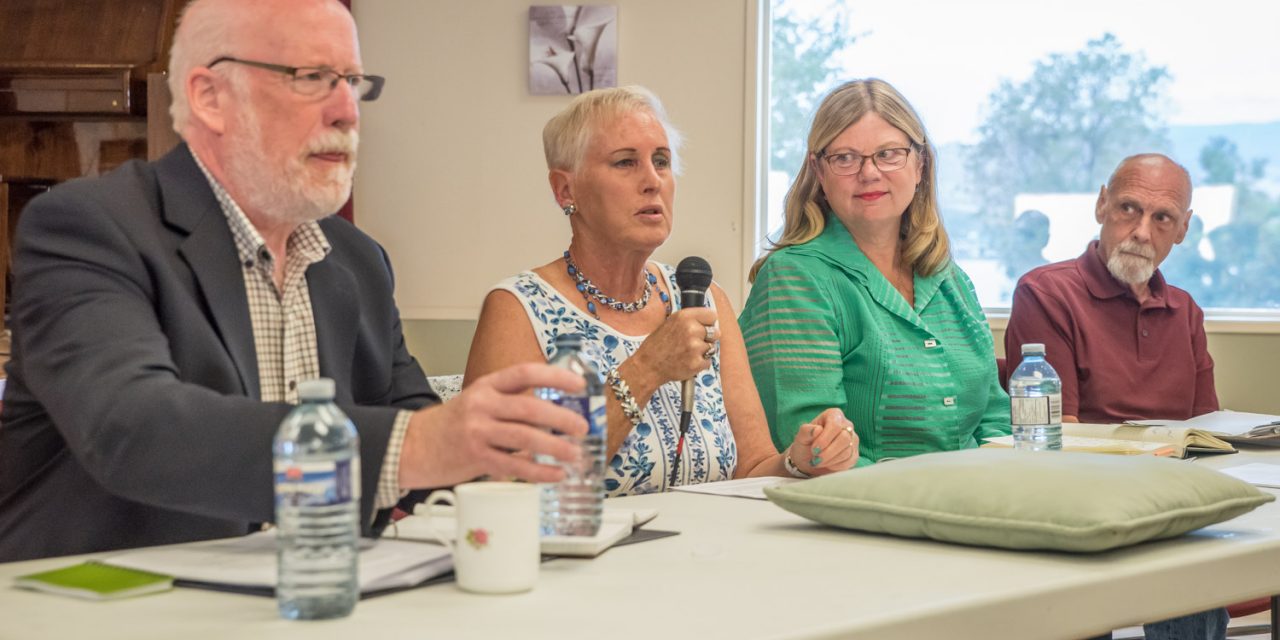
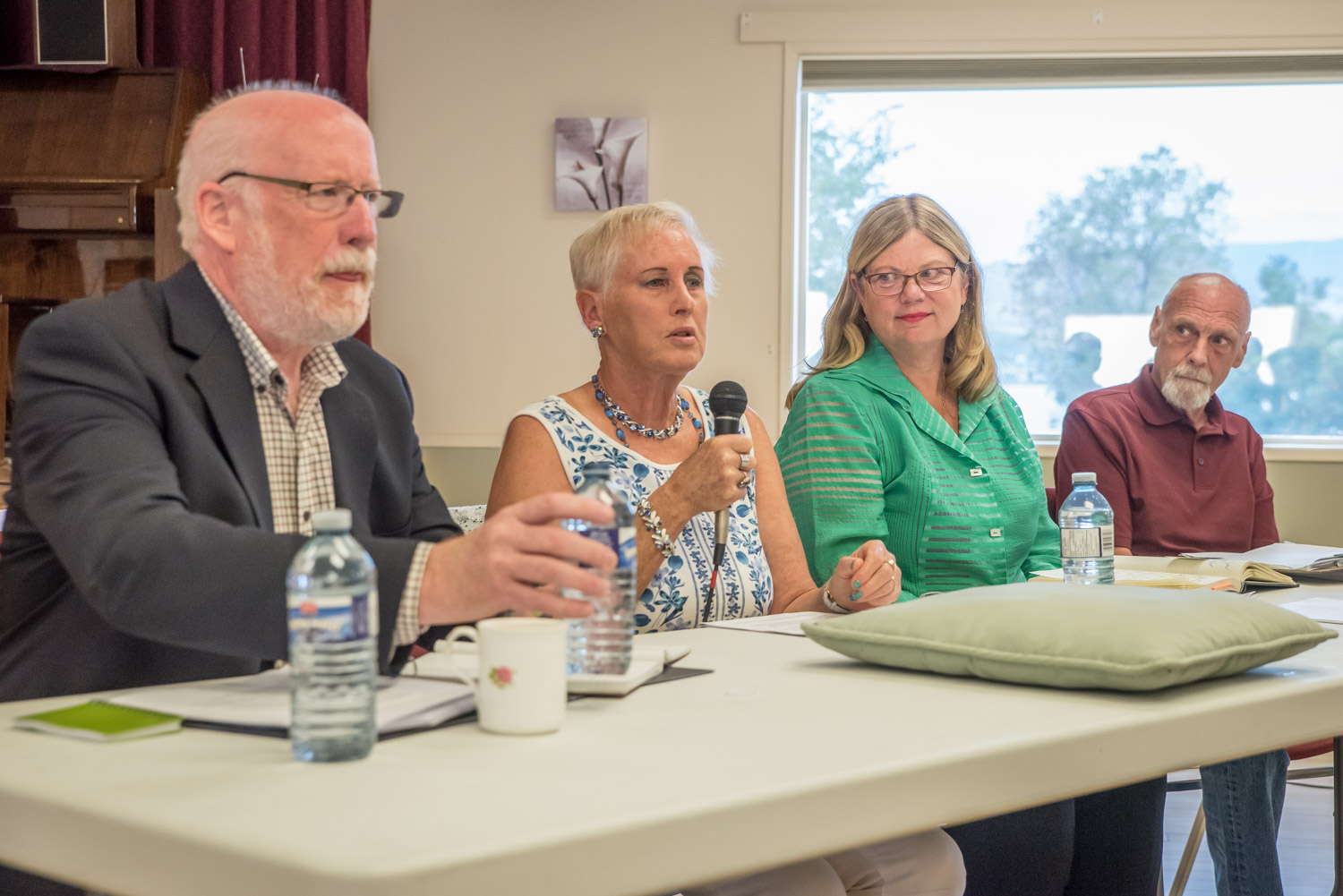
Federal election candidates participated in a candidates’ forum in Oliver last Wedesday evening. From left are Richard Cannings (NDP), Marshall Neufeld (Conservative), Connie Denesiuk (Liberal) and Samantha Troy (Green). (Richard McGuire photo)
The national park issue led off the questions posed to federal election candidates in Oliver last Wednesday, but it was the government’s muzzling of federal scientists that drew the testiest exchange.
The forum in front of about 250 spectators at the Frank Venables Theatre in Oliver was the only one in the Oliver-Osoyoos area attended by all the candidates, though only the four representing political parties were invited onto the stage.
The presence of independent candidate Brian Gray was acknowledged by moderator Carol Sheridan of the Oliver Community Theatre Association, but Gray had to be content with speaking to people in the foyer.
Besides the theatre group, other sponsors of the event were the South Okanagan Real Estate Board and the South Okanagan Chamber of Commerce.
Conservative Marshall Neufeld, who didn’t attend previous local forums organized by the Wine Country Retired Teachers Association, often found himself isolated as the other three candidates were critical of the Conservative government led by Prime Minister Stephen Harper.
On the national park issue, Neufeld was again the odd man out, offering only tepid support contingent on the rights of hunters and other recreational users, as well as existing commercial operators, being respected.
“We need to keep in mind the lifestyle of people that live here,” Neufeld said.
When she introduced the park question, moderator Sheridan said it was “by far the number one question” that forum organizers received from the public.
Parks Canada has said that ranching tenures would be continued and a helicopter training company’s operations would be grandfathered, but hunting would be phased out in a national park and off-road vehicle operation would be prohibited.
Liberal Connie Denesiuk, NDP candidate Richard Cannings and Samantha Troy of the Greens all spoke in favour of a national park reserve in the South Okanagan-Lower Similkameen.
“What I wonder is why it’s not a park already,” said Denesiuk. “We know that it’s an ecosystem that’s unique and is not currently protected through a park. We also know that it will employ a number of people.”
Cannings, a biologist, said he’s been involved in the park issue since his first contract in 1979 after graduating from university when Parks Canada hired him to look into creating a national park in the dry interior of B.C.
“It still hasn’t happened,” he said. “We live in such a special place and I think we all know that it’s one of the most endangered ecosystems in Canada. It’s the last eco-region in southern Canada without a national park.”
Troy agreed with the other candidates about the need to protect the ecosystem and also pointed out that having a national park would bring millions of dollars in federal investment.
While the candidates were mostly civil and even friendly to each other, Cannings took strong exception to a statement by Neufeld that federal government scientists are free to speak to the media about their research.
Neufeld said federal scientists publish 4,000 research papers most years.
“They do provide regular media interviews if it’s on their own paper,” Neufeld said. “In fact the government’s official communications policy, which applies to all bureaucrats, including federal scientists, directs federal scientists and agencies to promptly address media inquiries.”
“What Marshall said is just not true,” said Cannings, earning some of the strongest applause of the evening.
Cannings said he’s read the government’s communications policy, which in fact directs scientists to contact media relations to get permission to speak and to receive lines on what they can say.
The NDP candidate said he often participates with government scientists in webinars where media are on the line and scientists from Environment Canada must defer media questions to him because they are not allowed to respond to the press themselves.
“The NDP would end the muzzling of scientists and we would stop ignoring evidence,” said Cannings. “We want to have a government that’s based on fact-based decision making instead of decision-based fact making.”
Both Cannings and Denesiuk said they would bring back the long-form census, which Denesiuk said provides data for decision-making.
A question about funding for the CBC also pitted the three centre-left candidates against Neufeld. Cannings, Denesiuk and Troy all said their parties would restore $115 million in funding to CBC cut by the Conservatives in 2012.
Neufeld, however, defended the cut saying that instead of cutting from transfers to provinces and individuals, the Conservative government sought to reduce its deficits after the 2008-09 recession by cutting federal department budgets by five or 10 per cent over five years. CBC received a 10 per cent cut, he said.
He noted that CBC still has advertising revenue, while private networks rely entirely on advertising revenue and still turn a profit.
Despite the cuts, CBC still receives more than $900 million a year, Neufeld said.
“Once again, $900 million is more than enough,” Neufeld concluded, earning him loud applause from supporters.
Other questions submitted to organizers by the public and addressed by the candidates were:
- Would candidates vote as an MP according to party line or constituents’ wishes if there were a conflict between the two?
- How would they hold corporations accountable and make them pay their fair share?
- Would their parties support electoral reforms to replace the first-past-the-post voting system with preferential voting or mixed member proportional representation?
- Why should the voters of tomorrow (youth) vote for you?
- What would they do for food security and farmer success?
All four agreed they should represent their constituents, but they pointed to factors that could also affect their votes.
Neufeld said his conscience would also be a factor.
Denesiuk said Liberal Leader Justin Trudeau has committed to open votes except on the budget, positions the party put forward in its election platform and on human rights and freedoms.
Cannings said he would fight for the concerns of his constituents, but would vote in support of his party’s platform. If the party were to change from its platform drastically, he would vote with his conscience, he said.
Troy said the Green Party has always had a policy of not whipping its votes, however, she acknowledged this wasn’t hard to do when the party only had two MPs in the last parliament.
On corporations, Neufeld used the question to claim the other parties believe higher taxes are the answer to every problem.
The NDP plans to increase corporate taxes by two per cent to 17 per cent, which Cannings noted is where the Conservatives set them in 2009 and is well below the U.S. corporate tax rates and below the G7 average.
Neufeld said the NDP is also planning to raise payroll taxes by $1,500, while the Conservatives would cut them by $200 per employee.
He said Calgary economist Jack Mintz predicts there would be 250,000 in lost jobs by 2017 if the NDP tax increases were put into effect.
Denesiuk said the Liberals would close tax loopholes, while leaving corporate taxes at their present level. They would increase income taxes for the wealthiest one per cent of Canadians, while reducing taxes for the middle class.
On the electoral system, all three centre-left candidates called for a change away from first-past-the-post, although they differed in what they would replace it with.
Cannings said the NDP wants a mixed-member proportional representation system.
Denesiuk said Trudeau is committed to making this the last election under the first-past-the-post system. The Liberals would bring together an all-party committee to look at alternatives.
Troy said a Green government would introduce a form of proportional representation in its first year after public consultation.
Neufeld defended the existing system pointing out that past efforts to change it were unsuccessful and in referendums the public voted to keep the old system.
“I am open to having change, but would insist that we do the same thing and have a referendum on any proposed change,” he said.
In his concluding remarks, Neufeld said only a Conservative government can protect Canada’s fragile economy for the next four years.
Denesiuk said the Liberals would invest in infrastructure immediately to kick-start the economy, including investing in environmental infrastructure and green energy.
Cannings said an NDP government would listen to Canadians instead of insulting them and would bring democracy back to Parliament Hill.
Troy said Green MPs would work tirelessly for their constituents, would not abuse the trust placed in them by the public and would conduct themselves with integrity.
RICHARD McGUIRE
Osoyoos Times
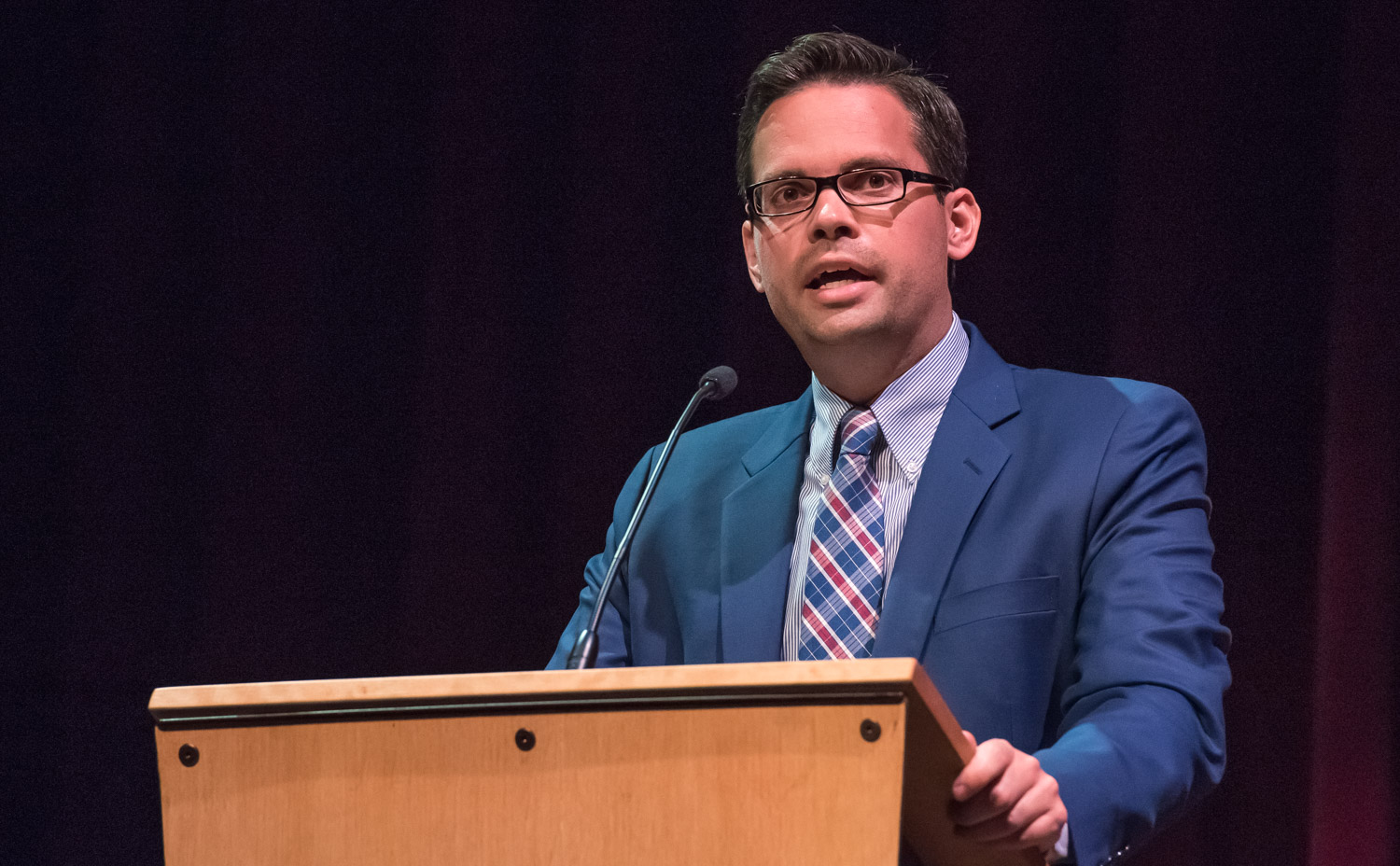
Marshall Neufeld, Conservative Party candidate (Richard McGuire photo)
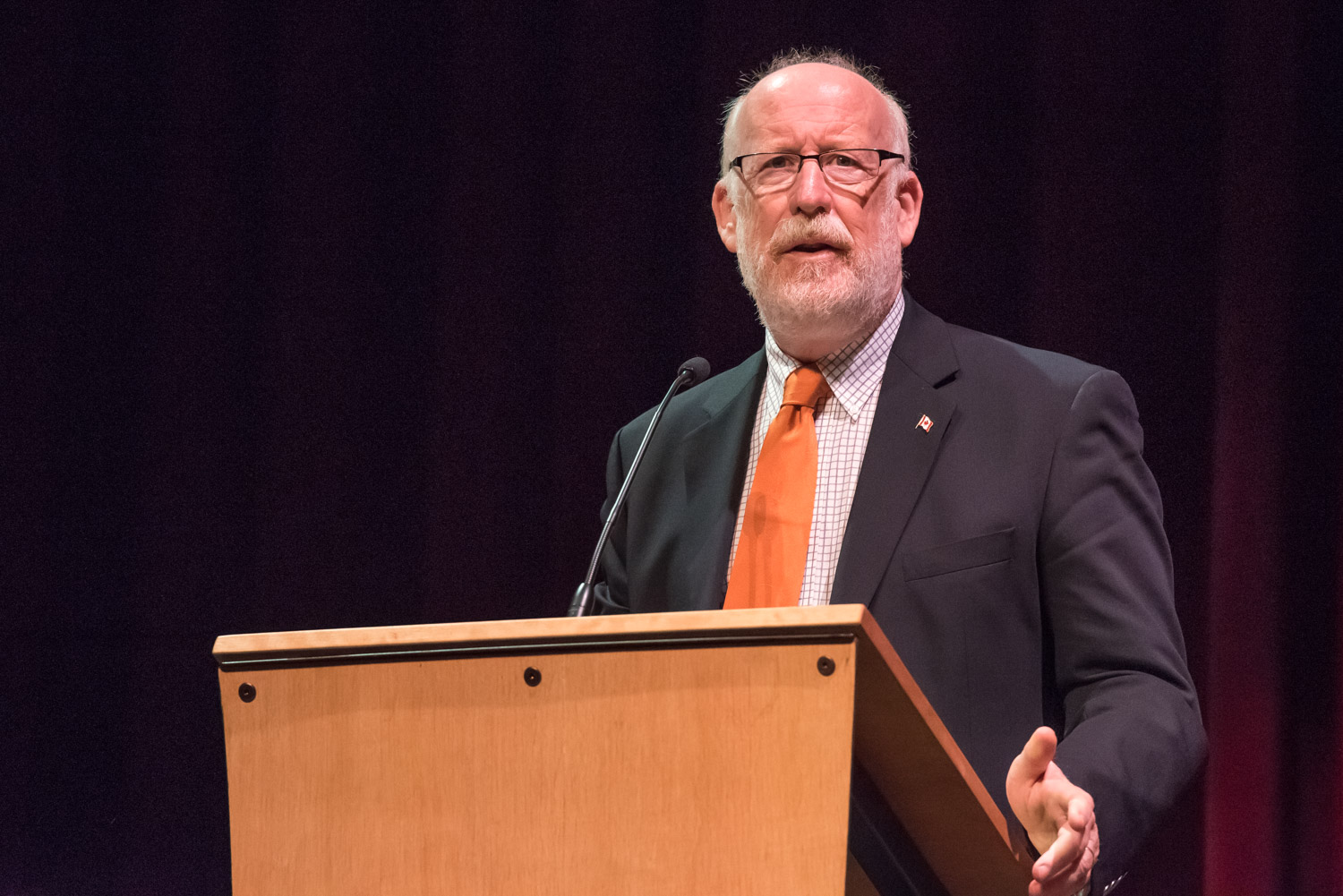
Richard Cannings, NDP candidate (Richard McGuire photo)
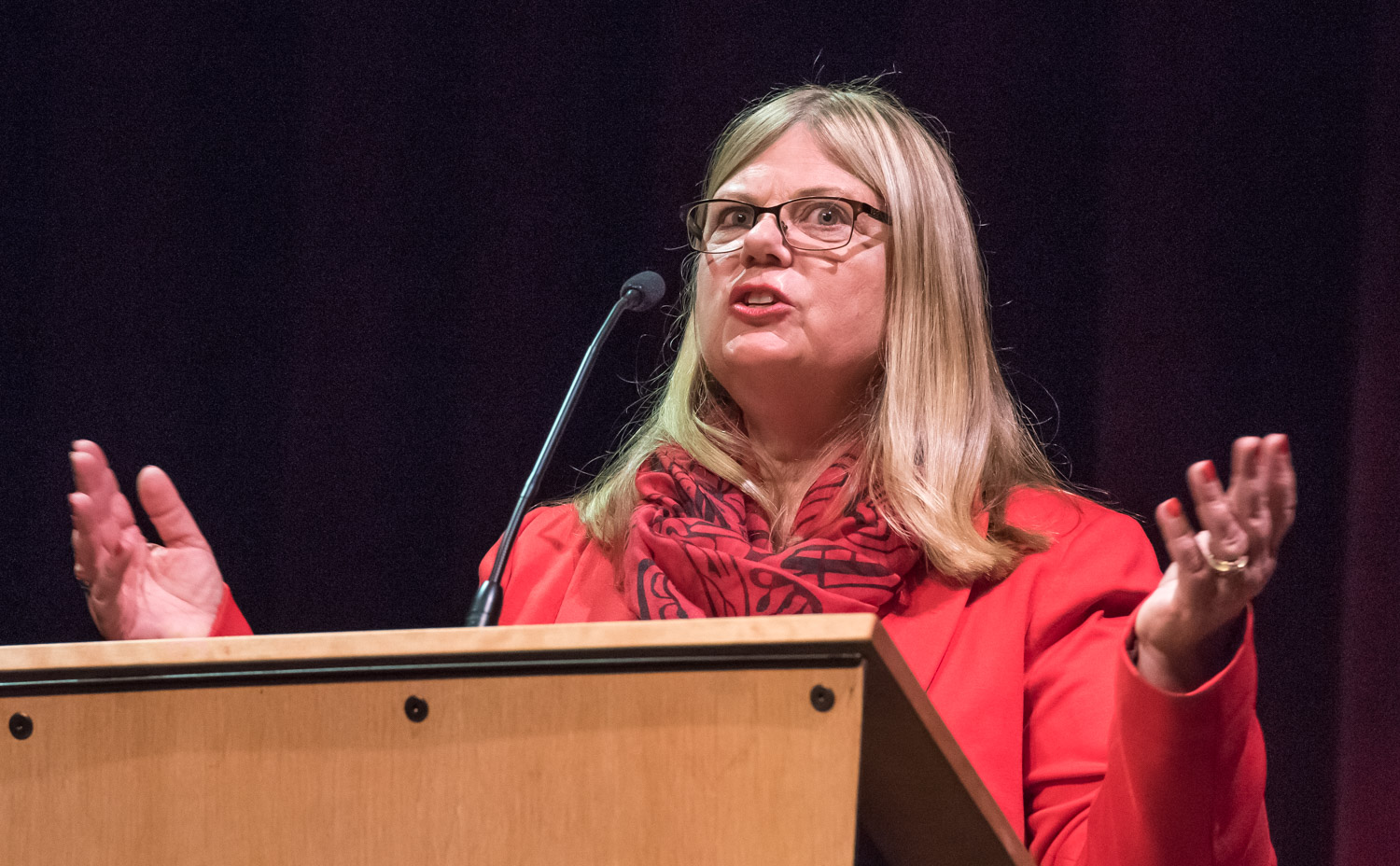
Connie Denesiuk, Liberal Party candidate (Richard McGuire photo)
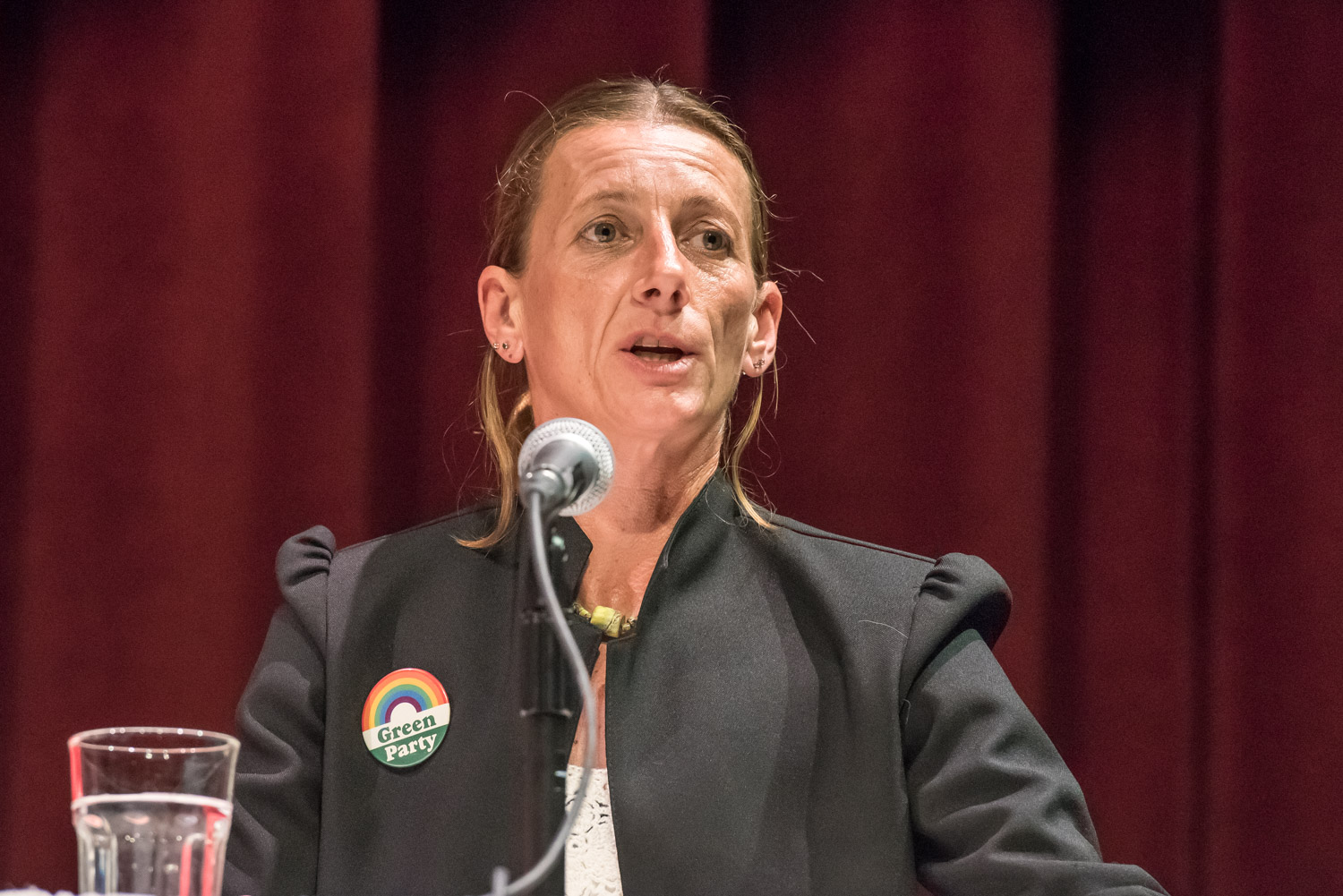
Samantha Troy, Green Party candidate (Richard McGuire photo)