Don Urquhart
Times Chronicle
It was a tough slog of long days and nights fighting a fire intent on climbing the craggy ravines and hillsides of Anarchist Mountain, but after nearly three weeks all is now quiet on the western front.
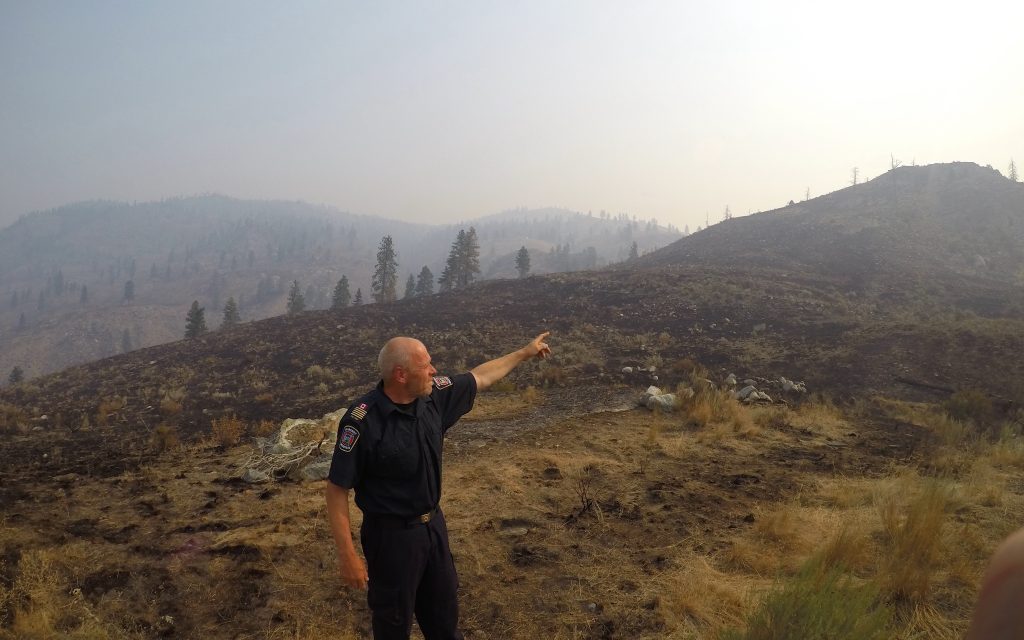
“It’s pretty quiet right now, the fire is somewhere in there,” says Urs Grob, fire chief of Anarchist Mountain Fire Department as he gesticulates to the plateau that stretches beyond the peaks of Anarchist where the Nk’Mip Creek fire continues to rage.
Speaking to Grob last Thursday (Aug 5) the Nk’Mip Creek wildfire was (and currently is) still out of control which means there’s no guard all the way around it, he adds. “On our side, they’ve put a lot of guards in and if the weather plays nice and we don’t have the big wind storms we’re pretty safe.”
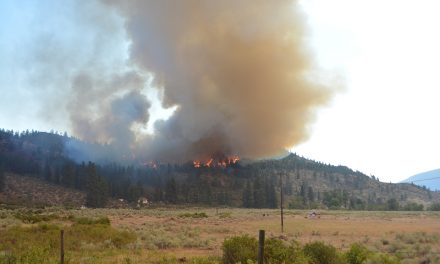
The wildfire on Anarchist Mountain was essentially the offspring of the original Nk’Mip Creek wildfire which turned up the mountain after it moved first to Spirit Ridge on the first Tuesday morning back on July 20.
On this particular day, I’m up on Anarchist getting a first-hand look and explanation as to what went down over the preceding two-plus weeks.
The fire that was fought on these hillsides was essentially the offspring of the original Nk’Mip Creek wildfire. It likely came off the fire that edged down to Spirit Ridge on that first Tuesday morning back on July 20, and started moving up Anarchist Mountain on Tuesday night and early Wednesday morning.
One of the nasty vagaries of this fire was the wind as it proved to be a hugely disruptive factor in predicting the fire’s growth and direction.
Grob references the preceding Saturday (July 31) when the wind kicked up and changed direction with the fall of night as it had done nearly every night for the previous dozen days. Except for this time the wind was coming directly from the fire front.
While this meant uncomfortable smoke for Osoyoos, worse still it held the potential for red hot embers to be blown back behind the fire front, potentially starting new fires pushed in the direction of Anarchist and Osoyoos.
“It always starts with a small fire,” Grob says. “That’s one of the reasons they kept the evacuation orders still on because if you’re down here you don’t see flames and fire it can catch you by surprise.”
Driving through the byways of Anarchist we pass areas where the Ponderosa Pine have been blackened four or five metres up their trunks, stark reminders of the area’s last major wildfire in 2003.
That fire, not dissimilar to this one according to Grob, saw 1,230 hectares scorched and two structures lost. It also proved to be the clarion call for the creation of the volunteer fire department sometime after.
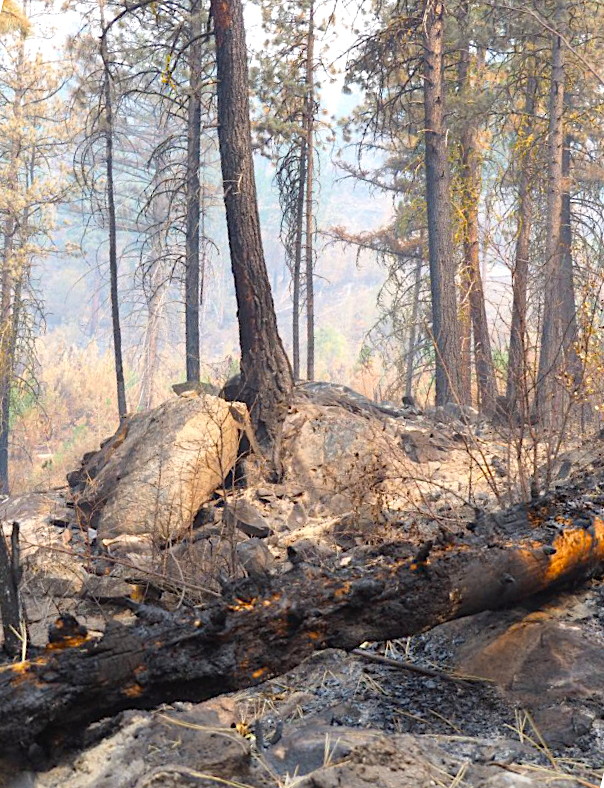 As we drive, I pepper the chief with questions on what’s going on in our forests. Why do the wildfires seem to be getting worse year by year? Is it climate change, human activity, what about the pine beetles, and aren’t we defying nature by doing all we can to stop fires?
The fire chief is sensibly cautious on this topic because of the ‘politics’ that inevitably taints discussions around such issues. Nonetheless, Grob does venture that, “in the extreme situation we’re in right now I personally believe it has to do with climate change.”
This would seem to suggest wildfire strategies need to be adapted. One such strategy already employed in a limited manner is that of prescribed burns to remove unspent ‘fuel’ on the ground, something Indigenous Peoples have long practised.
The problem is that there is a very small window in the spring and fall for this. Grob notes this creates a situation where the community is ‘in the smoke’ when the air is normally clear. “You really don’t want three seasons a year of smoke,” he adds, not to mention the push-back from segments of the community.
Another key strategy will be to continue pushing the FireSmart program, something the Anarchist community has been recognized for eight or nine consecutive years in a row.
“We got a lot of compliments from the structure protection guys about how well FireSmarted the buildings are.” A FireSmart house might need only three sprinklers whereas a non-FireSmart house would need something like 10 sprinklers, he adds. The sprinklers create much-needed humidity to help counter blowing embers that pose a grave threat to structures.
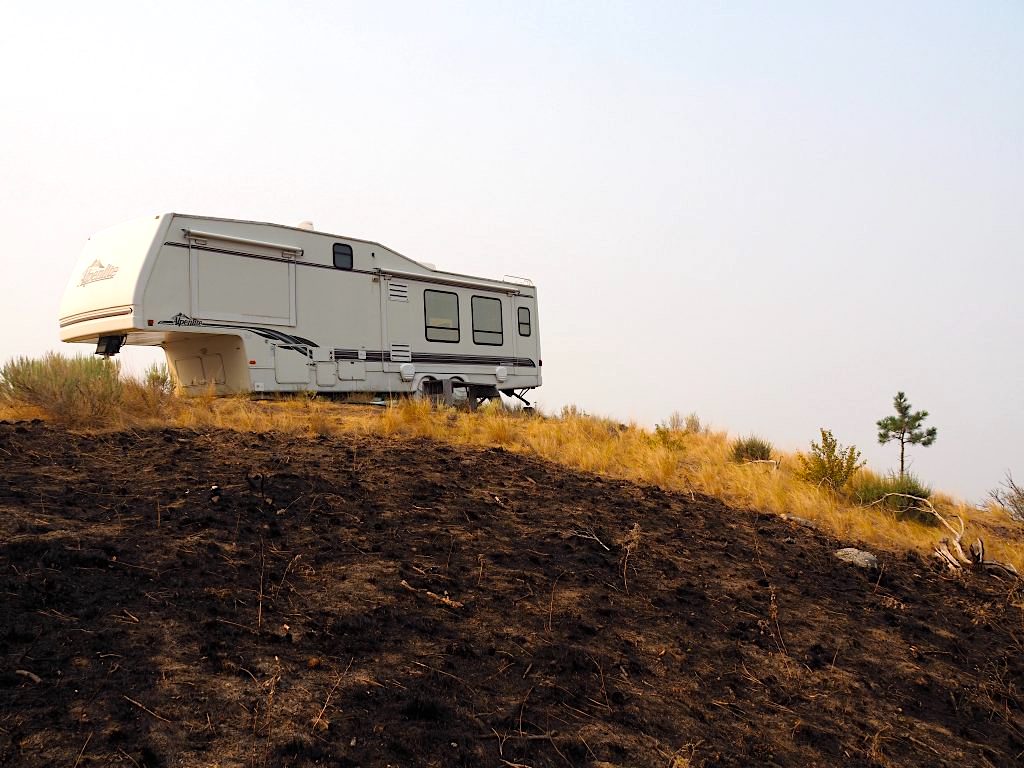
The wildfire came within metres of an RV parked on a hillside of Anarchist Mountain where a strategic line of control was heavily defended.
“If you have 10 houses FireSmarted and one where nothing is done and you have one crew to do the job, you’ll let them do the nine houses and forget the one house that’s not prepared. If I can say out of 10 houses we saved nine that’s better than saying out of 10 houses we saved one.”
Grob feels an appropriate amount of resources was deployed, from substantial initial help from the neighbouring fire departments in Osoyoos and Oliver to the contracted structure protection units that came in from Alberta to up to 50 firefighters from around B.C. and Alberta, BC Wildfire contractors, to air support . . . the list goes on.
“I really want to thank the OFC, the Office of the Fire Commissioner from the BC Wildfire Service; there was a lot of support, we had not too many people but we had enough,” he says. “Everybody that was here worked their butt off. Sometimes you’re working in the smoke and you know the fire is close, there’s a lot of pressure.”
The Anarchist firefighters covered the night shift on the ground and logistics support in the day. He adds that the BC Wildfire team and contractors were on call if things “went sideways,” during the night.
The firefighters were provided three meals a day courtesy of volunteers from the community who organized and prepared the meals at the Firehall from donated money and supplies. The setup was so good it became known as the ‘bistro,’ laughs Grob.
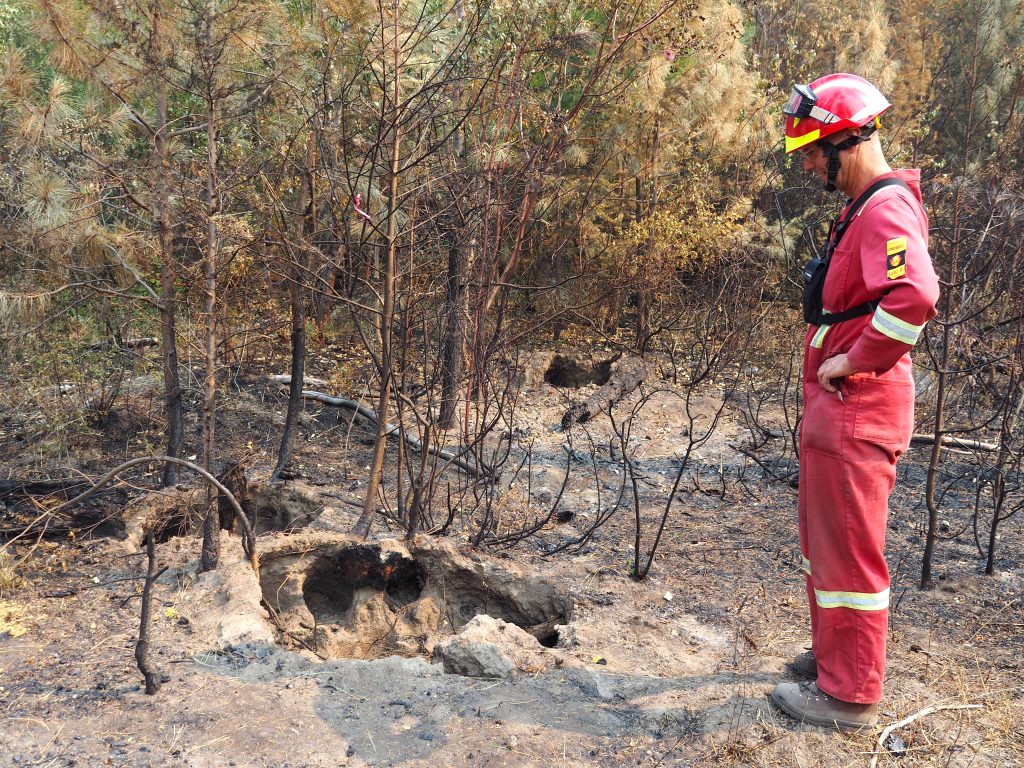
Mike Arychuk, a lieutenant with AMFD and medical first responder surveys the legion of holes that have been dug by firefighters attempting to put out smouldering roots.
One aspect of Anarchist that works in favour of fighting wildfires is the substantial access via countless roads and trails. Standing on one of those access roads next to a solitary RV perched on the hillside, the chief and I take in the vista of the scorched ravine by which the fire ascended the mountain.
He relates the incident involving this RV as we walk across the charred earth, crunching with every step as if we’re walking on Kellog’s Corn Flakes.
“At 5 a.m. one day I got a call from a crew that was out here for night duty that the fire was just below them and whether they should do anything as there was no power, no water, nothing.” Grob says they found a weed whacker in the camper and with the flames licking their way up the hillside from the ravine, “they did the maximum they could with the weed whacker to FireSmart the trailer.”
“The next thing I heard a helicopter had dumped water, the reason being that this trailer was actually on the line of defence. We didn’t want the fire to come any further so that’s why there was a big effort. We fought the fire out here for days. It was more a tactical decision not to let the fire come in here.”
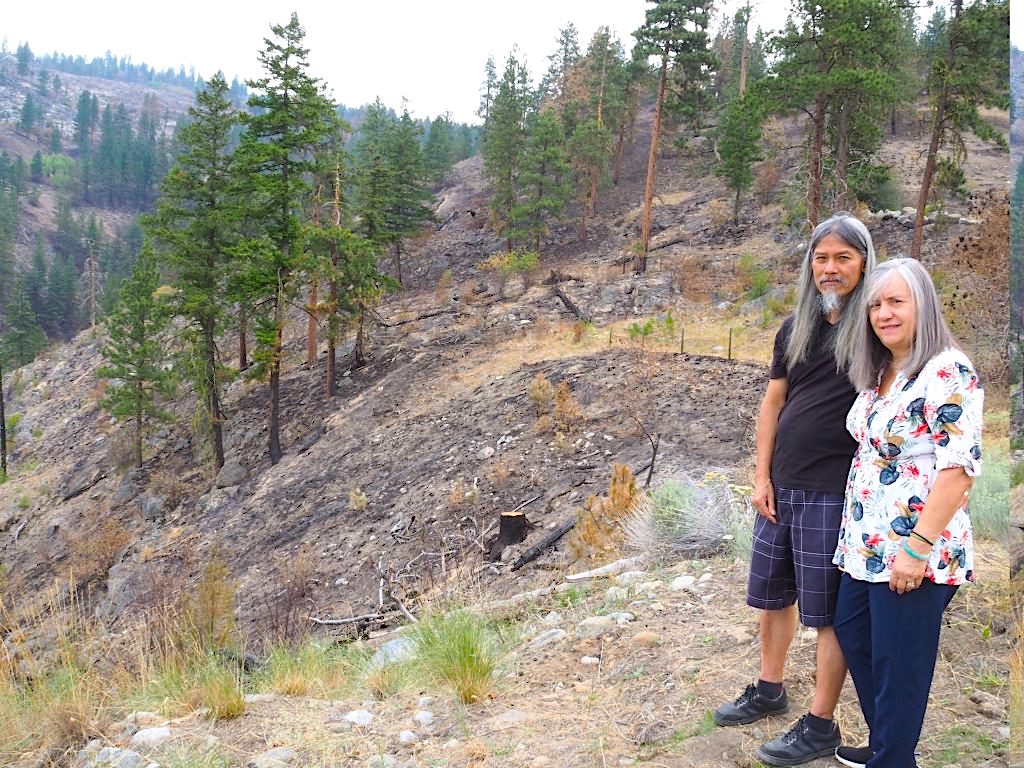
Rose and Wayne Chee were evacuated early on from their home, with a large flat portion of their property becoming a staging point for firefighters and helicopters as the wildfire crept within metres of their property.
Quite a bit further up the slope is a house owned by Rose and Wayne Chee who were evacuated early on and have nothing but praise for the work of firefighters in saving not simply their house but all of the houses up on the mountain.
Blessed with a large flat cleared area, the property became a staging site for helicopter and ground operations trying to hold the defensive line that extended up from the RV below and continuing up through their property. If it crossed over this line there was nothing to keep it from spreading over the hilltop and through the larger group of homes there.
“The fire came up the other side of the valley and we watched it burn on the left-hand side of the valley,” Grob says. They watched as trees and logs at the top burned and then at a certain stage rolled down the hill throwing up embers as they went, spreading fire to their side of the ravine.
“At one point there was fire all around this house one night but we had a bladder there and about 10 sprinklers running. It’s not all about protecting one structure, you also try to keep the fire from sneaking into the area.”
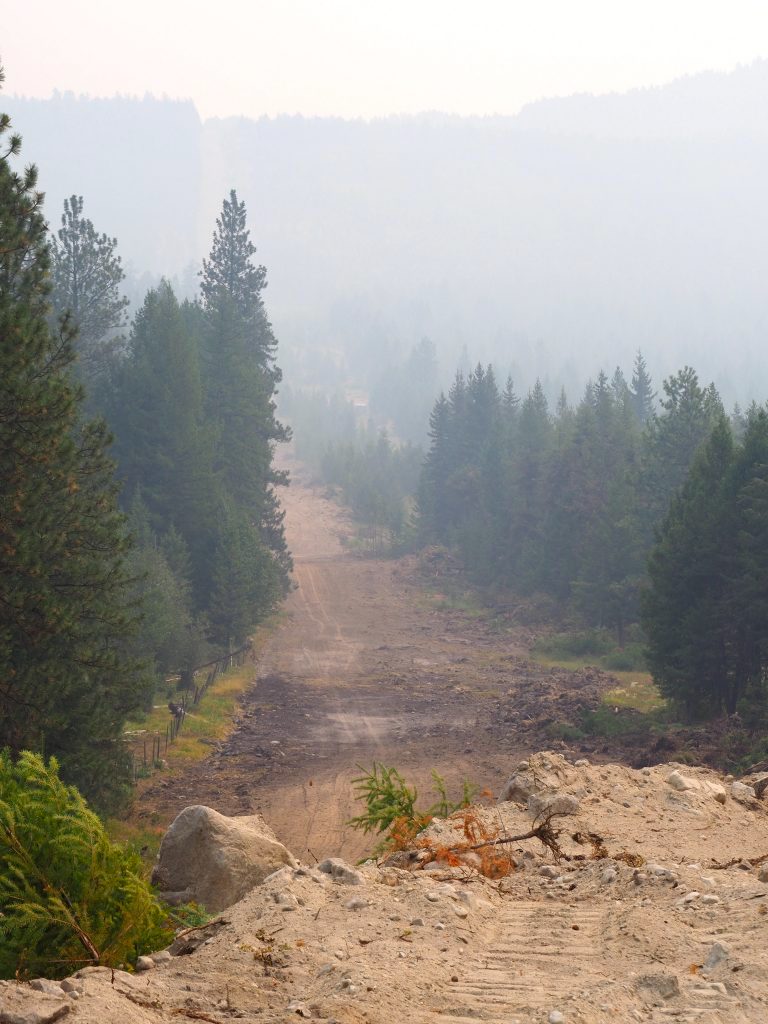
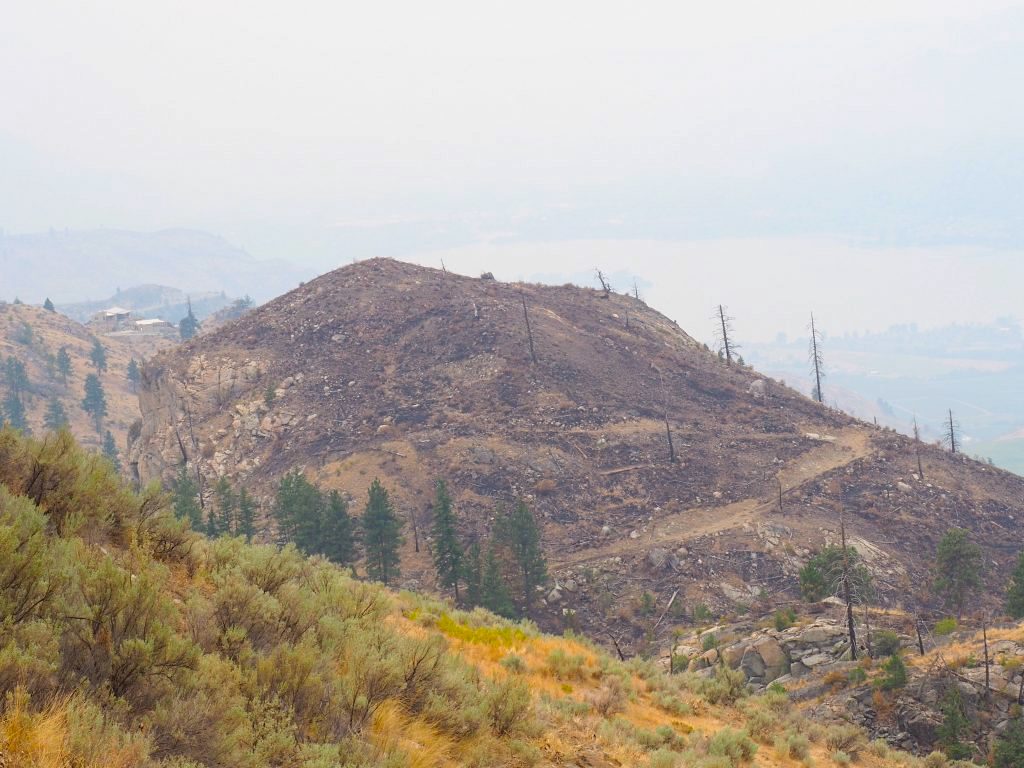
A 20 metre wide ‘cat guard’ fire break constructed by heavy equipment stretches over the hill in the distance.
Crews remained in this area of the mountain doing cold mop up, days after the fire front was defeated here. “It was a big effort. That kind of stuff you don’t see it, it’s not the action part of a fire, it’s not glamorous,” Grob notes. It is, however, absolutely crucial to ensure the fire does not reignite.
“You really touch the ground to find these hotspots,” he says. To put them out requires digging a hand guard around them, sometimes digging around the roots and spraying water if available. In many cases, this means carrying water up the mountainside in heavy backpack canisters, known as “piss tanks.”
To get an even closer view of what transpired I pile into an ATV vehicle with Mike Arychuk, a lieutenant with AMFD and medical first responder along with Jim Gray, a firefighter with AMFD. They take me to a spot that Arychuk estimates tens of thousands of gallons of water and over 700 man-hours went into mopping up hot spots.
Everywhere I look on the ash-laden ground are holes. It looks as if an army of gophers has been on a tear. The heat of the fire was so intense that it caused roots to smoulder underground. Without being fully exposed to oxygen they will continue to smoulder for days, weeks and even months and could eventually start a new fire.
“They did all this work digging it out and we still had to come in with water on it,” Arychuk says.
Up ahead we spot a small column of smoke rising from a spot some 20 metres into the tangle of both charred and green brush. My two chaperones are casual about it. This is simply one of the hundreds of hotspots still burning. But since the ATV is equipped with water and hose the decision is made to deal with it right away.
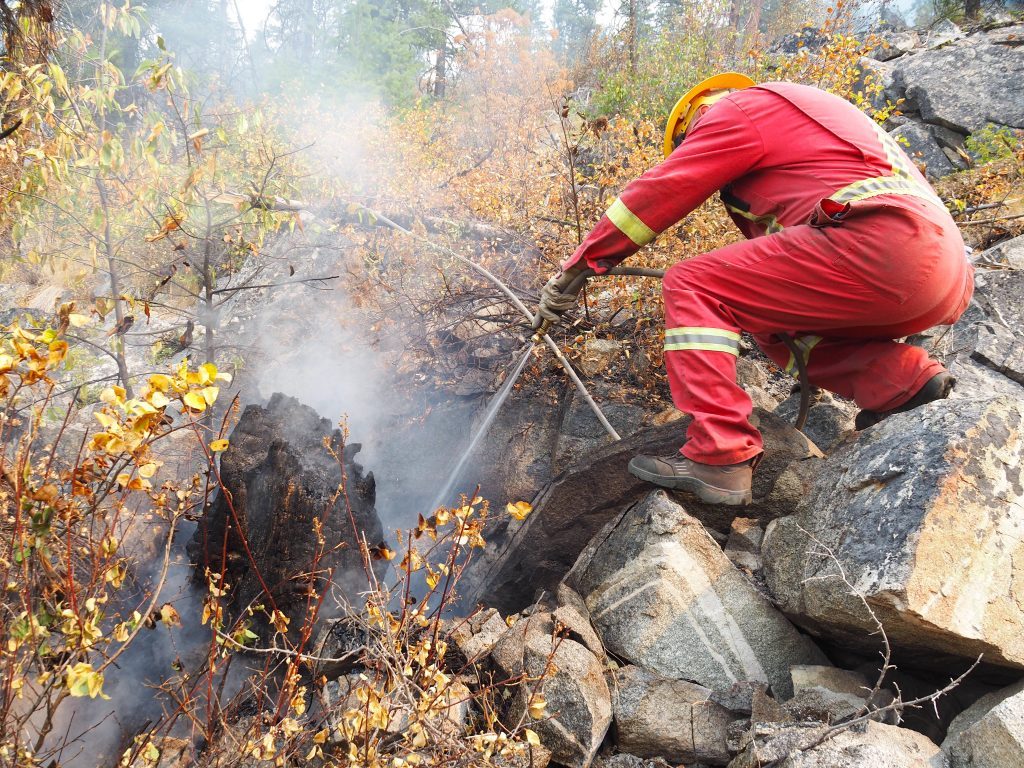
A burning stump is sprayed with water by Jim Gray, a firefighter with AMFD, just one of many spot fires that must be mopped up after the fire front has passed through an area.
What looked like a simple exercise proved more challenging. Through tangled brush, up and over a tumble of rocks slick with a layer of ash I quickly end up on my backside. This is all part of the challenge, hard to reach places, slow movement through the bush, sometimes in the dark of night which when faced with an unpredictable fire makes for very dangerous work.
We reach the source of the smoke – a smouldering stump that looks nothing more than a big hunk of smoking charcoal, belying its true menace. As Gray starts to spray water on it, it hisses and spits, the water boiling on the granite rocks around it.
With the tank now drained, the stump remains stubbornly hot and requiring further action. As a postscript, I find out later that AMFD crews took two more days to finally put it out. Magnify that by the hundreds of similar situations and the amount of work involved is clear.