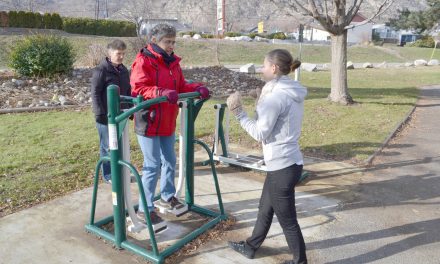

Child care supervisor Tracy Hunt has noticed an increase in clients in the after-school program at Tuc-el-Nuit due to the teachers’ strike. Education Minister Peter Fassbender said the strike could drag on through the summer and into the fall. Photo by Lyonel Doherty
Legislating teachers back to work is not the answer to resolving the strike, said Education Minister Peter Fassbender.
“We are not prepared to force a settlement,” the minister pointed out in a news conference today (June 19).
But if the strike drags on through the summer and into the fall, the government will have to look at other options to end it, the minister noted.
“We are not even close to where we need to be to get an agreement,” he told the media.
Fassbender said teachers’ wage and benefit demands are more than twice what other unions have settled for. On top of that, they are pushing for hundreds of millions of dollars more each year in other contract demands, he stated.
“We want to give teachers a raise, but the BC Teachers’ Federation leadership is making that virtually impossible.”
According to Fassbender, the government has tabled an improved wage offer, guaranteed
funding for class composition, and a $1,200 signing bonus (if a deal is reached by June 30). Teachers have countered, asking for a $5,000 signing bonus.
Fassbender acknowledged that the strike could go on for quite a while. The minister said it only took five days to reach a negotiated settlement with CUPE support workers.
“It’s clear to me that the BCTF wants to stay in their own orbit.”
Fassbender said they respect the role that teachers play, but not at the expense of the budget and everything else the government has to do.
In the meantime, BC teachers are calling for mediation to end the dispute.
“At this point, the best way to get that deal that works for BC’s public education system is through mediation,” said BCTF president Jim Iker.
“BC teachers have moved significantly at the bargaining table to bring the two sides closer together, but we have not seen similar efforts from Christy Clark’s government,” said Iker.
The BCTF’s framework for settlement that is currently on the table is based on five key points: a five-year term; a reasonable eight per cent salary increase plus signing bonus; no concessions; a $225 million annual workload fund to address issues of class size, class composition, and staffing ratios; a $225 million retroactive grievances fund, over the life of the collective agreement, as a resolution to Justice Griffin’s BC Supreme Court decision that retroactively restored the stripped language from 2002. This fund would be used to address other working conditions like preparation time and improvements to health benefits.
“Our proposals are fair,” said Iker.
He pointed to evidence that shows the government has stripped $275 million per year from BC’s public education system. Iker said that means that an entire generation of BC kids have been short-changed.
“There is no reason BC’s education system should be funded $1,000 per student below the national average. This government built in a series of surpluses and a sizeable contingency fund in their fiscal plan over the next several years. They have the money. It’s time to reinvest in BC’s students.”