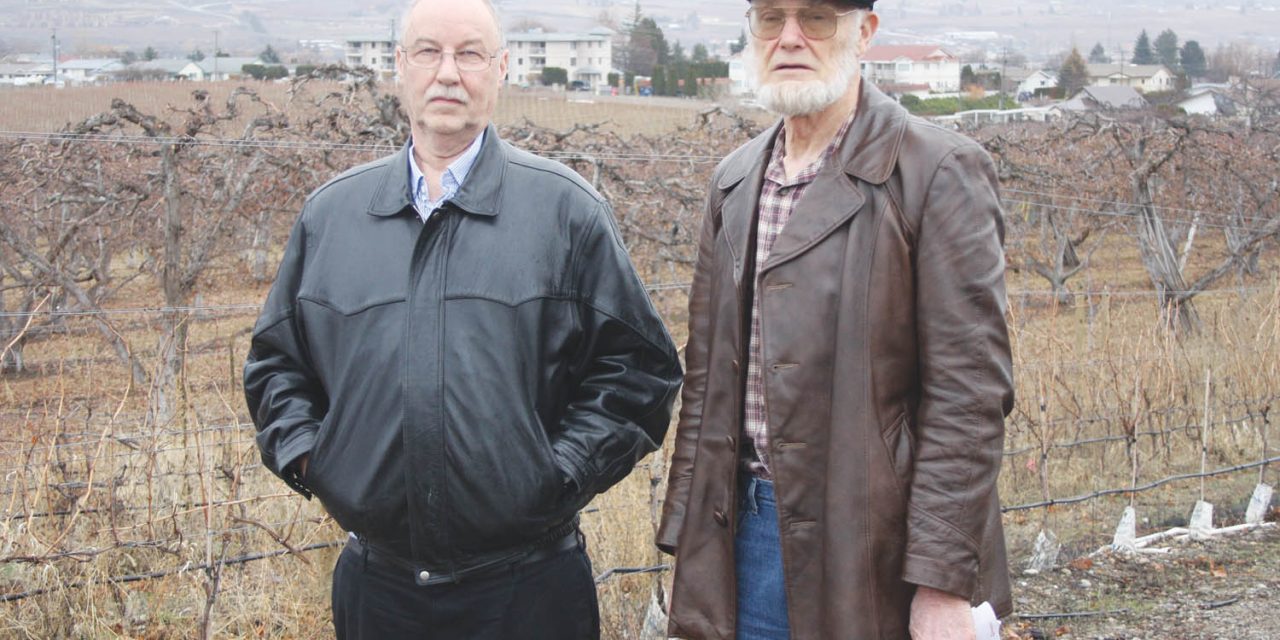
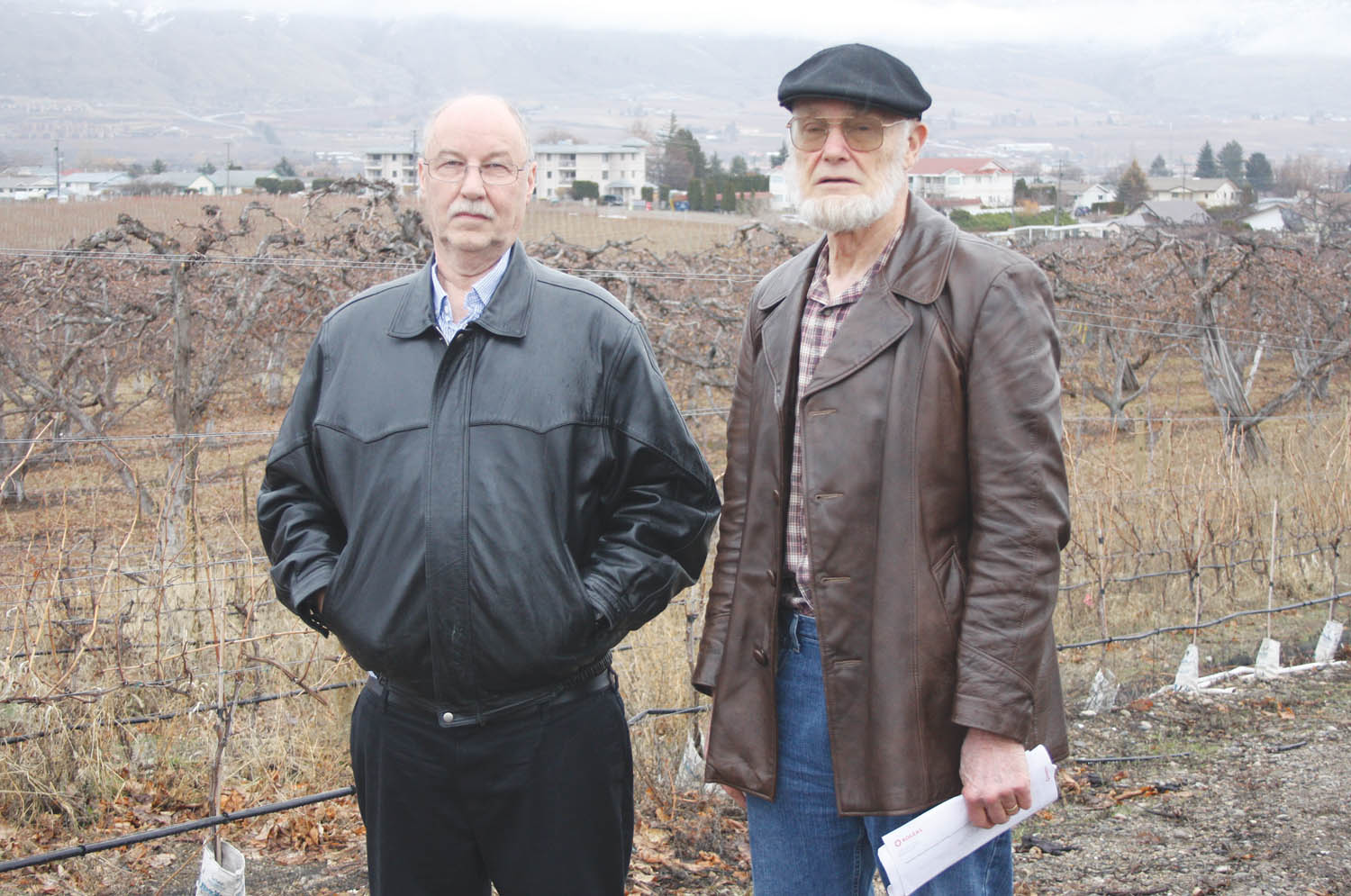
Martin Sadd (left) and Jacob de Raadt went public in February voicing their opposition to a plan by Rogers to erect a 150-foot cellphone tower near their homes just outside Osoyoos. (Keith Lacey photo)
Having the Osoyoos Indian Band (OIB) take over as the managers of the popular Haynes Point Provincial Park and controversy over a proposed large cellphone tower near Osoyoos made headlines last February.
Osoyoos Indian Band (OIB) Chief Clarence Louie confirmed in early February that he and his band council were the new managers of Haynes Point Provincial Park and had every intention of keeping the site as one of British Columbia’s most popular campgrounds.
“We don’t own it … we’re the new managers,” said Louie, minutes after the provincial government’s BC Parks department issued a press release stating the OIB would now be in charge of running and operating Haynes Point and Okanagan Falls provincial parks, effective immediately.
Louie confirmed the names of both parks would be changed to more accurately reflect the history of this area.
The deal with the provincial government came following the discovery in the spring of 2013 of First Nations archeological relics at Haynes Point Provincial Park.
Human remains were found and confirmed First Nation people were living at this site dating back as far as 10,000 years, said Louie.
Both Haynes Point and Okanagan Falls provincial parks would continue to be operated as campgrounds, said Louie.
“We realize the importance of tourism and camping to the South Okanagan and we’re going to continue operating them as campgrounds,” said Louie, who has played a key role in turning the OIB into one of Canada’s most economically diverse and successful First Nation bands.
Osoyoos and area residents would continue to be able to walk their dogs and walk the nature trails at Haynes Point as they have been able to do for several decades, said Louie.
The OIB already owns and operates Nk’Mip RV Campground on the east shore of Osoyoos Lake and won’t have any trouble taking over management duties at Haynes Point, said Louie.
“We already run one of the most successful campgrounds in the entire province,” he said. “We know how to run a campground … as a successful business.”
It still upsets him that several local citizens claimed that the human remains found last year weren’t authentic and could have been brought to the area from other parts of the South Okanagan, said Louie.
“Haynes Point is an ancient burial ground that dates back 10,000 years,” he said. “We have aboriginal title and rights, but we’re willing to work within the park system so tourism can continue to succeed in this part of the province.”
Meanwhile, a small group of neighbours were livid that multimedia giant Rogers was moving ahead with plans to erect a huge cellphone tower in the middle of pristine winery property.
Jacob de Raadt lives on 122nd Avenue in Osoyoos, not far from Martin Sadd and his wife Trisha Salter, who live on 92nd Avenue.
When all three of them found out about the plans by Rogers to build the 115-foot cell tower through an advertisement in the Osoyoos Times, they talked it over and decided to start a petition protesting the application.
The petition garnered more than 100 signatures in less than 10 days.
The application indicated the cellphone tower would be located just north of the Shell gas station in the middle of beautiful winery property, said de Raadt.
Andrew Garas, corporate communications spokesperson for Rogers, said the board with the Regional District of Okanagan-Similkameen (RDOS) was informed several months ago that Rogers was interested in building a cellphone tower in Osoyoos in an attempt to improve coverage and attract more customers.
All property owners who live within 115 metres of the proposed tower site had been contacted to inform them about this project, said Garas.
“The reason why is because service currently being provided to Rogers customers isn’t adequate,” he said.
In this instance, the company is convinced this location is the best to “dramatically improve services, while having as little impact on the community as possible,” he said.
The tallest building in Osoyoos is only four storeys high (about 15 metres) and this tower would be seven times that high, said de Raadt.
“If you are not concerned about this eyesore right at the edge of our town, perhaps the dangers of their emissions to your health should be of concern,” said de Raadt. “There are currently many unanswered questions regarding the negative effects of cellphone radiation to your health.
“Imagine the damage a massive cellphone tower spewing huge amounts of radiation into our homes 24 hours a day, seven days a week, can do to your health.
“Increased risk of cancer, migraines, heart palpitations and depression, to name a few of the serious side effects linked to cellphone towers being so close to human habitation.”
There is currently excellent cellphone service in Osoyoos and there’s simply no need for another tower, but if a tower is going to be allowed it should be away from residential neighbourhoods and located in the town’s industrial park, said Sadd.
Town of Osoyoos Mayor Sue McKortoff has confirmed management from Rogers Communications has agreed to host a public hearing in Osoyoos after several residents launched complaints about the proposed installation of a 35-metre cellphone tower in the heart of local vineyards.
The date and location of the public hearing hasn’t been confirmed, but it’s likely to take place before the end of March, said McKortoff.
Even though the proposed tower would be located on land located in the Regional District of Okanagan-Similkameen (RDOS) near 122nd Avenue not far from the Shell gas station on Hwy. 97 on the north edge of town limits, McKortoff said she and members of town council had heard enough complaints to get involved.
She placed a call to Rogers management and a manager confirmed that the company would be “more than willing” to hold a public hearing in Osoyoos, said McKortoff.
That public meeting has yet to be organized by Rogers’ management.
Martin Sadd and Jacob de Raadt, who live close to each other near the proposed cellphone tower, started a petition three weeks ago stating their opposition to the proposal. They generated more than 300 signatures withint three weeks, said Sadd. McKortoff said she hadn’t received a single phone call, email or inquiry that was in favour of the proposed location by Rogers within a two-week period after Rogers sent out letters.
KEITH LACEY
Osoyoos Times