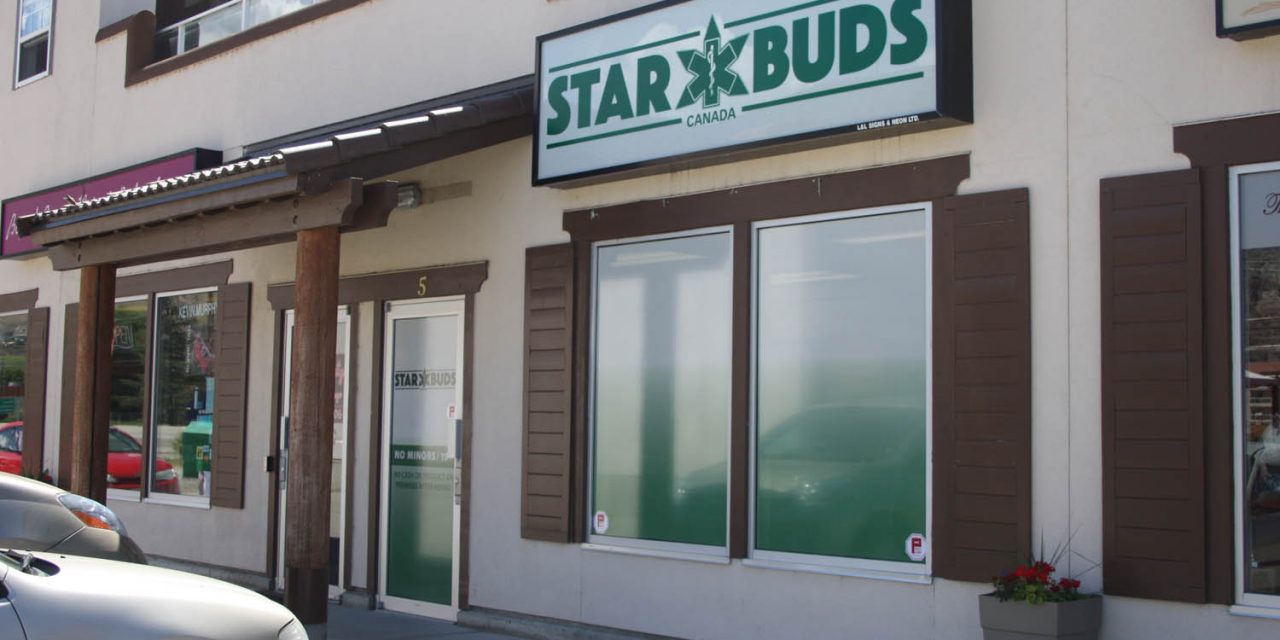
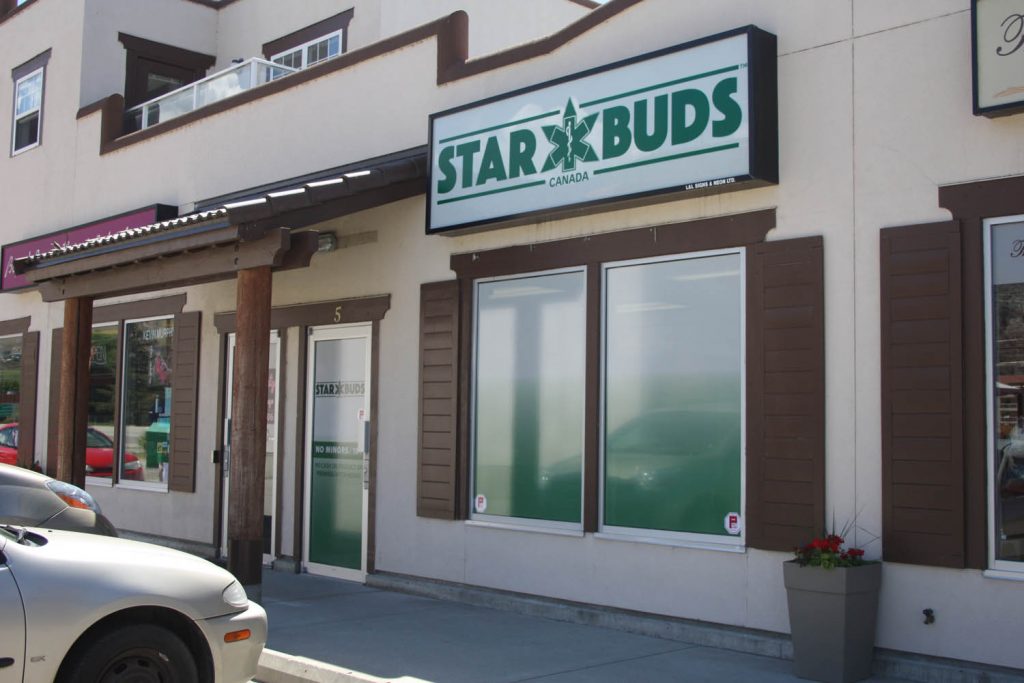
The Star Buds medical marijuana dispensary at Cottonwood Plaza was closed in June two days after it opened. (Keith Lacey photo)
When Mayor Sue McKortoff opened a public hearing Monday on a bylaw about medical marijuana businesses in Osoyoos, she told speakers to restrict their comments to what was contained in the bylaw.
Few heeded her request and instead most remarks addressed the pros and cons of medical marijuana dispensaries in general.
Comments covered the gamut from the argument that medical marijuana patients’ Charter rights are being violated to the suggestion that dispensaries give illegal drug dealers the façade of being businessmen.
The bylaw is a stopgap measure that effectively prohibits any marijuana operation in Osoyoos except for medical marijuana grow operations, which are already allowed at council’s discretion in general industrial zoned areas.
Alain Cunningham, director of planning and development services, recommended the bylaw after the town obtained a legal opinion.
Cunningham’s concern is that the federal government will bring in liberalized medical marijuana regulations, possibly in August that could legalize dispensaries.
He expressed concern that when council does bring in new zoning rules, it could face court challenges from marijuana outlets claiming to be legal, non-conforming uses.
“Such challenges could gain credence, for instance, if the town’s current position on retail outlets is seen as uncertain and possibly granting tacit approval,” Cunningham wrote in his recommendation to council.
He also advised that clear town messaging would help businesses with short- and long-range planning.
Although the bylaw is seen as a temporary measure until the federal government clarifies the new rules, councillors are already looking ahead at next steps when council establishes the zoning rules for such businesses in a future, long-term bylaw.
Coun. C.J. Rhodes asked several speakers where they thought it would be appropriate to locate marijuana dispensaries if they are allowed.
First to speak was Grant Bruce, former owner of the Osoyoos Star Buds franchise that was shut down in June after two days of operation at Cottonwood Plaza. Bruce said he has since distanced himself from Star Buds, but still supports dispensaries.
“I’ve been using medical marijuana since I was 15,” he told council. “I have epilepsy and I use it on a daily basis in order for me to live my life.”
Bruce said 90 per cent of Star Buds members are over the age of 50 and there are very few between the ages of 19 and 25. To be accepted, a patient has to have a diagnosis of an ailment that can be treated with marijuana.
He said he would be fine with a bylaw that established rules such as those existing in some other communities requiring a $5,000 annual business license, a criminal record check, a wall separating people coming into the business from products, and a 300-metre distance from another outlet or a school.
He suggested the Cottonwood Plaza location was ideal because it is away from the downtown Main Street, far from schools, but not hidden on a back street.
Mark Conlin, from West Kelowna, an organizer for Sensible B.C., a pro-marijuana advocacy group, described himself as a typical dispensary patient. He’s a 60-year-old retired letter carrier who developed degenerative arthritis to his neck and spine after 33 years of delivering mail.
Conlin argued that the present federal regulations, which only allow the sale of medical marijuana through the mail, don’t allow patients to have interaction with a professional to discuss symptoms or the efficacy of specific marijuana strains.
“These are things that any other Canadian with a recognized medical requirement has a legal right to expect,” he said, pointing out that successive court decisions have ruled in favour of increased access to patients based on the Charter of Rights and Freedoms.
“The dispensary closure, rather than reducing cannabis access, just puts it back on the street and into schools,” he said, adding that dispensaries funnel marijuana away from the black market.
Council also heard from several people opposed to dispensaries.
David Fahlman, of Osoyoos, said he supported the proposed bylaw.
“I believe that it is the correct way to go to keep illegal dealers out of this (town) and not give them the façade of being businessmen until such time as the laws are changed by the federal government,” he said.
Allowing dealers to come in pretending to be business people creates a huge problem for council and law enforcement, he added.
Sylvia Treptow, another Osoyoos resident, said in a letter that she moved to Osoyoos from Grand Forks “because Osoyoos’ elected council and mayor seem to have their heads screwed on right and you listen to the wishes of the city’s citizens.”
She contrasted this with former Grand Forks Mayor Brian Taylor, a marijuana advocate, who she said imposed “marijuana culture whether the citizens like it or not.”
Janis St. Louis, took a more nuanced position, saying she supports the bylaw as long as there is enforcement, but she is open to the use of medical marijuana products once the law is clarified.
Pointing to the experience of an ailing relative, who has been on a mix of controlled substances for many years, she noted that it takes an educated pharmacist to understand drug interactions and side effects.
Speaking in support of dispensaries was Nixon Zaye, who talked about her experiences with running the Numbered Club, a compassion club that was based at Altered Faith for six months until it was shut down after an attempted break-in in March.
Zaye said she personally doesn’t use any marijuana products. In the six months of operation, she said the club had more than 100 members, the majority local residents over age 60.
About half of what the club sold, she said, was cannabidiol or CBD, one of the compounds contained in marijuana that doesn’t make users high, unlike tetrahydrocannabinol or THC, but has a number of claimed medical uses.
“We’re not drug dealers and we’re not in it to make a buck,” said Zaye. “We were a compassion club. The majority of the products we gave for free because people couldn’t afford them.”
She added that she worked with doctors in the community.
Brynn Jones, chief operating officer of J/W Mariceuticals Inc., said he represents some companies that would like to operate dispensaries if they are allowed.
“Not all businesses are the same,” he said. “Do not let news reports of shady business practices fog your opinion.”
He pointed out that recently street drugs sold in Osoyoos, including marijuana, were found to be laced with fentanyl, a powerful and addictive opioid that has caused numerous overdoses elsewhere.
“With a regulated system, any outlet that sold unsafe or tainted product would be accountable and possibly criminally prosecuted,” he said.
Council is expected to give third reading of the bylaw at a special meeting on Aug. 8 with final adoption at its Aug. 15 regular meeting.
RICHARD McGUIRE
Osoyoos Times