By Sebastian Kanally, Times Chronicle
A local Oliver business will receive a Temporary Use Permit (TUP) to go ahead with a personal service hair salon, despite concerning actions such as building the business in a restricted zone and developing the space without a permit.
Hair by Cari made town staff and council uncomfortable with their actions in attempting to acquire a TUP on the second floor of Sunrise Restorations at 5883 Hemlock Street in Oliver,
“I want to see businesses succeed in our community, but what kind of precedent does this set if we say, we told you not to do it, you did it anyways, but go ahead,” Councillor Aimee Grice who was particularly torn about the application said.
Despite completing work without a building permit, and the business not being an approved one inside the industrial area, town staff looked past this and still recommended the application be approved subject to certain conditions.
“I am really struggling with this to be honest. We have an Official Community Plan. We have specific business types in specific zones for a reason. We have a downtown core that is struggling that could use public facing businesses that aren’t prescribed to be in the industrial area.
“And then to have a business owner being told that this is not an approved type of business in the area, and then to go ahead anyway and have us issue them a permit just seems to go against all of these bylaws and zoning we have in place,” Grice continued.
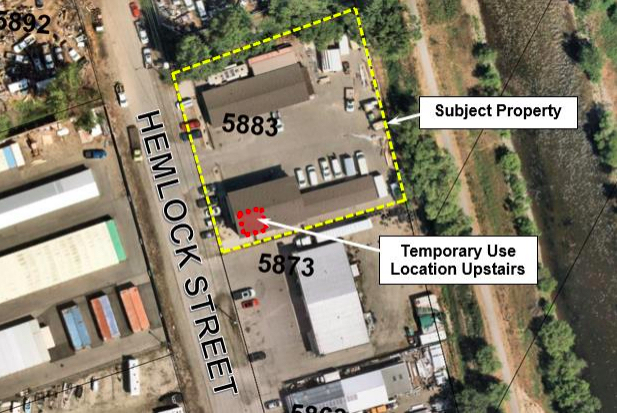
The property in question at 5883 Hemlock street and the small red area is subject to the TUP.
Town of Oliver photo
Mayor Martin Johansen expressed his unease as he said: “I will support this; I am not happy with the process of how we got here. There is a process there that is quite easy to work through. I think council is very reasonable and I don’t think we have ever denied a temporary use permit that has come to this table looking at flexibility and trying to support business.”
He continued to explain that a wider issue that may be in place is within the Official Community Plan (OCP) and how the town regulates the industrial area.
He noted that a small town is different from a large city industrial area, and they should be open to discussions around changes in how they perceive and regulate what kind of businesses ought to be there.
The TUP will have conditions on it. The following requirements will be in place:
- A building permit must be obtained for all the salon renovations that have been carried out to date or may still be required;
- As work was started without a permit, the Building Permit fees will be doubled;
- All work needed to meet BC Building Code requirements must be completed and approved by the Building Official;
- A Business Licence shall not be issued until the Building Permit has received final approval and approval is received from the Interior Health Authority;
- No business shall be operated under this Temporary Use Permit before a Business License is issued.
The fees will be doubled because in the town’s Building Bylaw 1404, it specifies in section 10.16 that “the building permit or other permit fee is doubled for every permit application if construction commenced before the building official issued a permit, to a maximum of $10,000.00.”
The vote passed unanimously despite reservations.
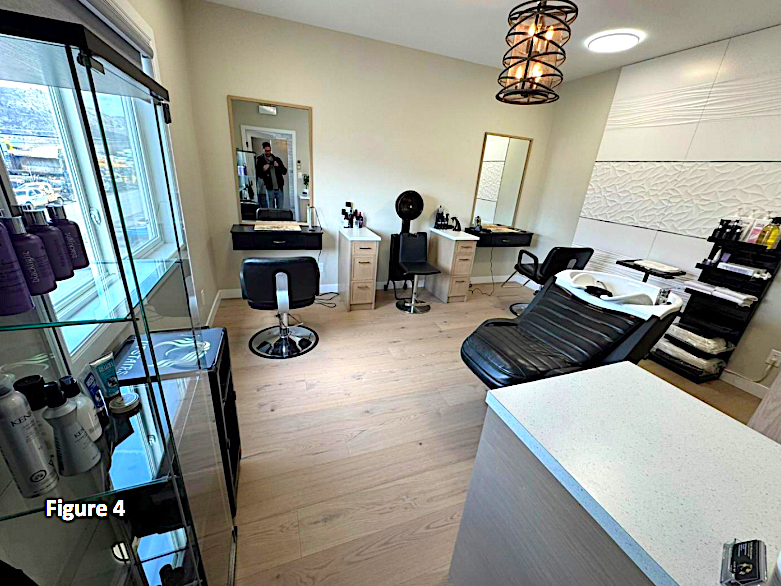
“Clearly the business is there already anyway, it’s beautiful from the photos. It’s unfortunate they have gone about it the way that they have, and I really do have concerns about what kind of precedent we are setting, if we are telling other businesses to open up wherever you want, act first and ask for forgiveness later,” Grice noted.
Councillor David Mattes chimed in saying that the application mentions that it fits within the general conditions of the OCP.
“It does meet the goals you are talking about. I understand where you are coming from . . . for me to expand the uses down there is a positive for the community, not a negative,” Mattes responded to Grice.
Councillor Petra Veintimilla noted that the business can only apply for a TUP at the same location twice. So that gives them around four or five years to relocate.
The business “is making use of an under-utilized space potentially providing a smaller location for someone to build up a business and ideally move down the road to one of the areas where this business should exist.”