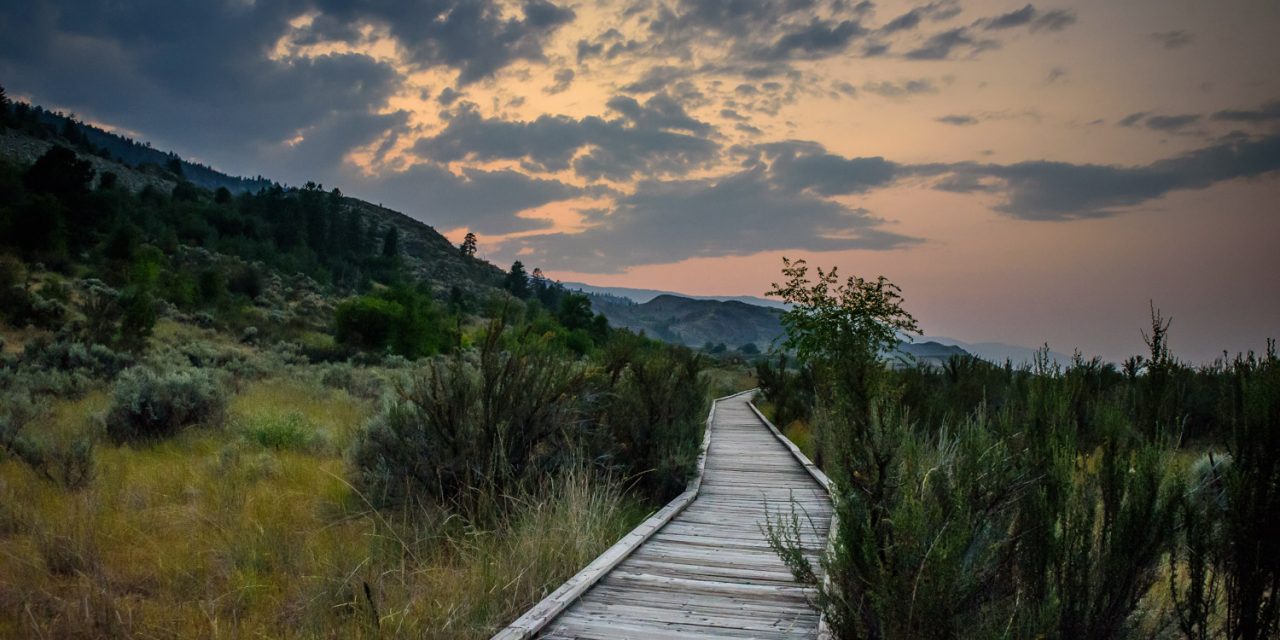

The vegetation next to the boardwalk takes a different tone after sunset at the Osoyoos Desert Centre. (© Richard McGuire photo)
As the days get shorter again, visitors on the Osoyoos Desert Centre’s night tours have a better chance to experience the arrival of nightfall.
The tours have been running every Tuesday evening at 7 p.m. through July, but there will be two more opportunities to experience this magic time of day on Aug. 7 and 14.
“It’s a lot cooler at night, so the animals are often a lot more active,” said Valerie Blow, the Desert Centre’s restoration coordinator, who conducts most of the evening tours.
“That being said, they are all wild animals,” she adds, suggesting that appearances of animals are unpredictable.
Sunset in Osoyoos these days is just after 8:30 p.m. officially, but the sun actually disappears behind the mountain ridges about an hour earlier. And, because the days are shorter, visitors in August will experience more twilight than those who come in early July when the sun after 7 p.m. is still quite high in the sky.
The chances of seeing deer from the boardwalk in the evening are quite high, said Blow. And very often visitors will see a Nuttall’s cottontail, though it may be too camouflaged to notice unless a guide points it out.
These little rabbits, Blow suggests, “look like a Disney-designed bunny because they’re just so cute.”
The noise of tour groups can scare away some animals and this is especially true for snakes. If a snake is spotted, it’s much more likely to be a yellow-bellied racer than a rattlesnake, which prefers a more rocky terrain.
“Snakes don’t really like commotion, so feet on the boardwalk usually scares them away,” said Blow. “For some people that’s a good thing and for some people that’s a bad thing,” she added, alluding to the fear of snakes that many people have.
If a snake is there, it’s more likely to be slithering in the opposite direction or hiding from the tour group under the boardwalk that circles the 67-acre property.
Birds are far more active as it cools down, so for birdwatchers the night tours are at a good time, said Blow, adding that it’s too early to see owls, which are more nocturnal.
There are also lots of hidden eyes out among the antelope brush and sagebrush of the Desert Centre. They see us, but we don’t see them.
“I can guarantee you that coyotes are watching us go around the boardwalk, but we don’t ever see them,” said Blow. “Same with bobcats. We catch those on game cameras, but never actually see them.”
The coyotes hear us coming and silently slink away. They have absolutely no desire to meet people.
Very infrequently, if an emergency vehicle passes on the highway with its siren blaring, the coyotes will call back in response. But that’s the only time they tip visitors off – other than when they leave behind scat, footprints or remnants of an animal they’ve eaten.
The tours also look at plants, though in this area there is no unusual nocturnal behaviour with plants as there might be in some other environments.
“People are usually shocked by how much you can’t see just by looking,” said Blow. “Then when you’re told about it, this whole new world opens up. All these plants have so many limitations put on them by the environment. They all look the same, but then you get in there and there are actually dozens and dozens of different plants.”
People ask questions about many things, but Blow said there are no stupid questions, because the guides have heard them all.
Every day, guides are asked where the sand dunes are, she said, because many people have never been to a desert and their image of a desert comes from movies.
“A lot of people don’t realize that there are lots of kinds of desert in the world, and so they are usually really surprised by how much life there actually is here,” she said. “People often think of deserts as barren and lifeless moonscapes.”
The guides get lots of questions about rattlesnakes, like whether they will kill you, whether they’ll jump out at you and how dangerous they really are. Again, impressions shaped by movies.
Some people, without thinking, ask if snakes dig holes. Blow points out politely that it’s a lot easier to dig if you have arms. More likely, snakes take over abandoned burrows of other animals like rodents when they want to stay cool underground.
While there are some nocturnal animals like bobcats and pocket mice, more commonly animals are crepuscular, meaning they are active at dawn and dusk.
And that’s why the evening can be an interesting time to visit – along with cooler temperatures and often with beautiful light.
The remaining tours are Tuesday, Aug. 7 and 14 from 7 p.m. to 8:30 p.m. Advanced reservation is required and tickets are $10 per person. People are asked to show up around 6:45 p.m.
For more information, call 250-495-2470 or visit desert.org.
RICHARD McGUIRE
Osoyoos Times

As the sun lowers in the evening sky, it backlights some antelope brush at the Osoyoos Desert Centre. (© Richard McGuire photo)

The sun sets behind a ridge above Highway 3 and the Osoyoos Desert Centre. (© Richard McGuire photo)

The prickly pear cactus at the Osoyoos Desert Centre have long spines that could do damage to anyone who falls off the boardwalk. (© Richard McGuire photo)

The sky is still glowing after the sun sets behind a ridge above the Osoyoos Desert Centre. (© Richard McGuire photo)

The odds of seeing deer on a night tour at the Osoyoos Desert Centre are quite good. Getting a photo before they run off is another matter. (© Richard McGuire photo)

A Nuttall’s cottontail blends in with its surroundings next to the boardwalk. Guide Valerie Blow says, they “look like a Disney-designed bunny because they’re just so cute.” (© Richard McGuire photo)