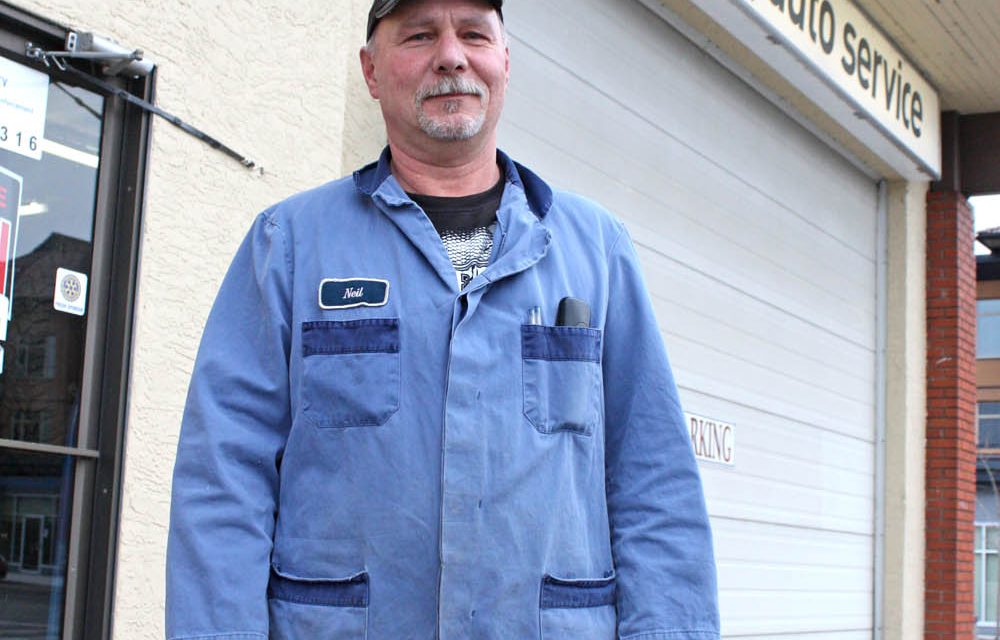
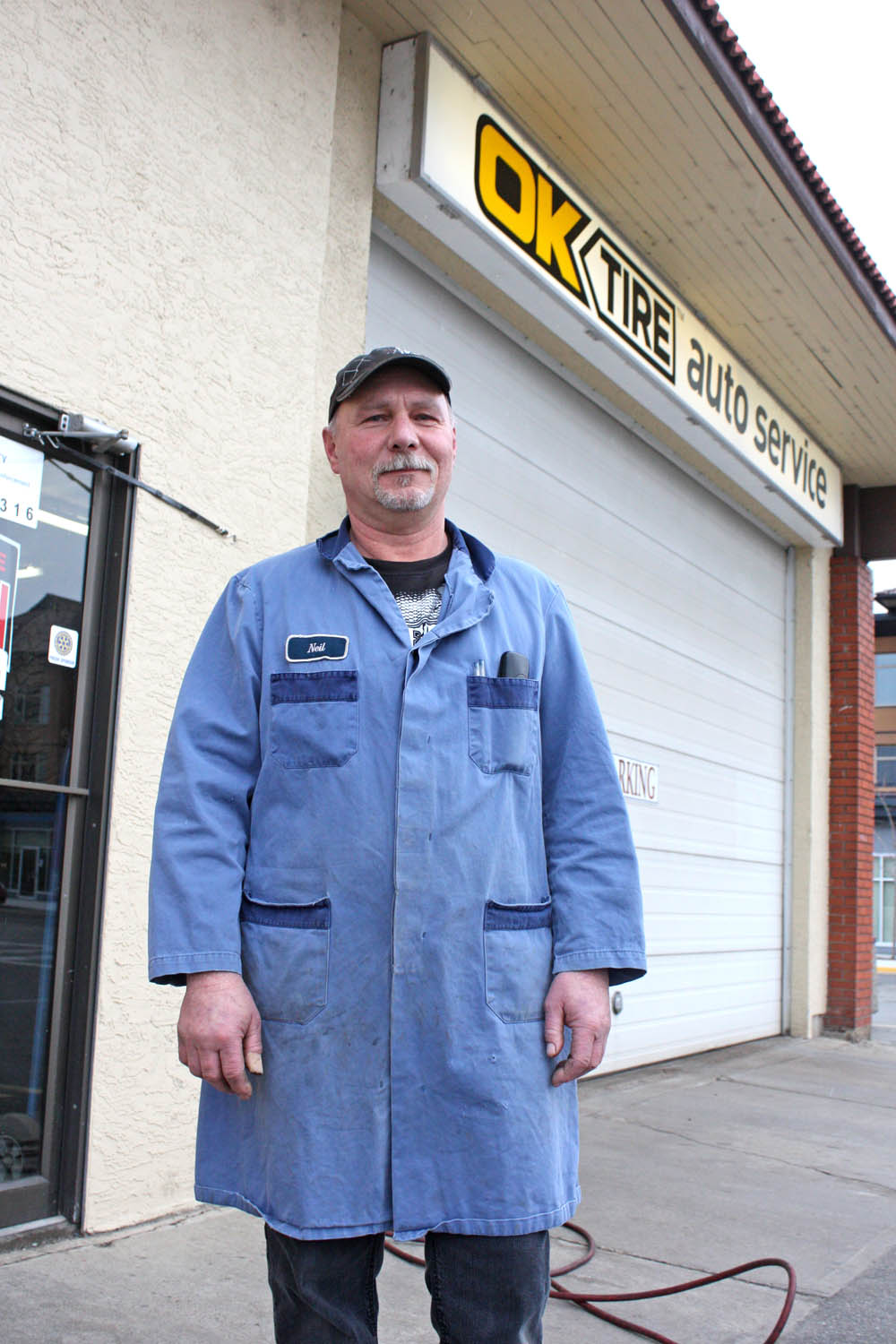
Neil Ericson, the owner of OK Tire in Osoyoos, recommends that regardless of B.C.’s new tire laws, anyone driving over mountain passes and in harsh conditions elsewhere should use proper winter tires with the mountain/snowflake logo. (Keith Lacey file photo)
“Winter tires” are now mandatory from October to March even on such valley roads as Hwy. 97 through Osoyoos.
But the provincial government’s definition of “winter tires” is so loose that most tires qualify, even if they aren’t considered by experts to be safe for extreme winter driving conditions.
The new rules took effect on October 1 and require tires designated with M+S (mud and snow) or with a mountain and snowflake symbol.
The requirement now runs to March 31 and rules are the same both for high mountain passes and in valleys on designated routes, including highways 97, 3 and 33.
Previously the rules were only sign posted for mountain passes and winter tires or chains were required until April 30.
In addition to requiring the right tires, tires must be in good condition with a minimum tread depth of 3.5 mm or about a seventh of an inch.
Despite allowing M+S tires, the B.C. Ministry of Transportation and Infrastructure advises motorists to use the best tires possible for winter conditions.
“Tires with the winter mountain/snowflake symbol provide the best level of traction and safety in severe show and ice conditions,” the ministry advises.
“An M+S tire is a viable and safe option for drivers that take care, adjust their speed and plan their trips to coincide with periods of better weather.”
Under the new rules, trucks are required to carry chains, however, passenger cars must have proper tires.
Those without proper tires are subject to a $121 fine.
The British Columbia Automobile Association (BCAA) declined to comment on the new government policy, saying its message instead is to educate drivers about road safety.
Nonetheless, Dave Weloy, associate manager at BCAA’s Road Assist, advises motorists to use the mountain/snowflake tire in severe winter conditions.
“If you’re going into the mountain passes, you want to have the best tires on the market, which really are the winter tire,” he said.
By “winter tire,” Weloy said he was referring to mountain/snowflake tires and added that motorists should put them on all four wheels.
Weloy explained that there are four main categories of tires: summer, all-season, all-weather and winter.
Only summer tires lack both the M+S and mountain/snowflake designations making them illegal from October to March. Most vehicles, however, have one of the other three types.
All-season tires have the M+S designation, while all-weather tires have both the M+S and mountain/snowflake designations, Weloy said.
Winter tires, on the other hand, have just the mountain/snowflake designation. They are made of a softer material that gives them better traction in severe road conditions.
Because this soft rubber compound wears down much faster, drivers are advised to remove them outside the winter season and use one of the other categories of tire made of a harder material.
Weloy said the difference between all-season and all-weather tires is both in the treads and the rubber compound. All-weather tires are not as good on winter roads as winter tires, but they are a step up from all-season.
Weloy advises that drivers going into severe winter conditions should have two sets of tires, switching them at the beginning and end of the winter season.
That’s the same advice given by Neil Ericson, owner of OK Tire in Osoyoos.
Ericson suggests that anyone planning to leave Osoyoos and go through either the Richter Pass or over Anarchist Summit should have mountain/snowflake winter tires when driving in snow.
Chains, he said, are helpful, but he questions how adept many drivers are at putting them on.
Despite coming from the Okanagan, Ericson said he has always used proper winter tires and switched them at the beginning and end of the winter season.
He doesn’t believe M+S tires are adequate in snow conditions, despite the fact that the provincial government allows them.
Ericson said the new rules haven’t led to an increase in business, but they may have led to the same customers coming in earlier.
He is frustrated that the provincial government didn’t adequately communicate the new rules to tire businesses.
The first province to pass legislation requiring winter tires was Quebec, which made them mandatory in 2008. In Quebec, they are only required from Dec. 15 to March 15, however unlike B.C., Quebec doesn’t consider M+S tires to be “winter tires.”
No other province or territory requires snow tires.
Studded tires, which help in icy conditions, are permitted in most provinces including B.C. during winter months, but are not required. Only in southern Ontario are studs banned outright.
The B.C. Ministry of Transportation and Infrastructure spokesperson said the date for winter tires was shortened to March 31 from April 30 because an extensive review of safety data found that crashes related to tires decreased dramatically after March 31.
The Oct. 1 start date reflects the fact that the Rural Highway Speed and Safety review found winter crashes begin to increase in frequency through October.
“Even valley bottom areas in the province are susceptible to early season frost and black ice,” said the ministry spokesperson.
RICHARD McGUIRE
Osoyoos Times