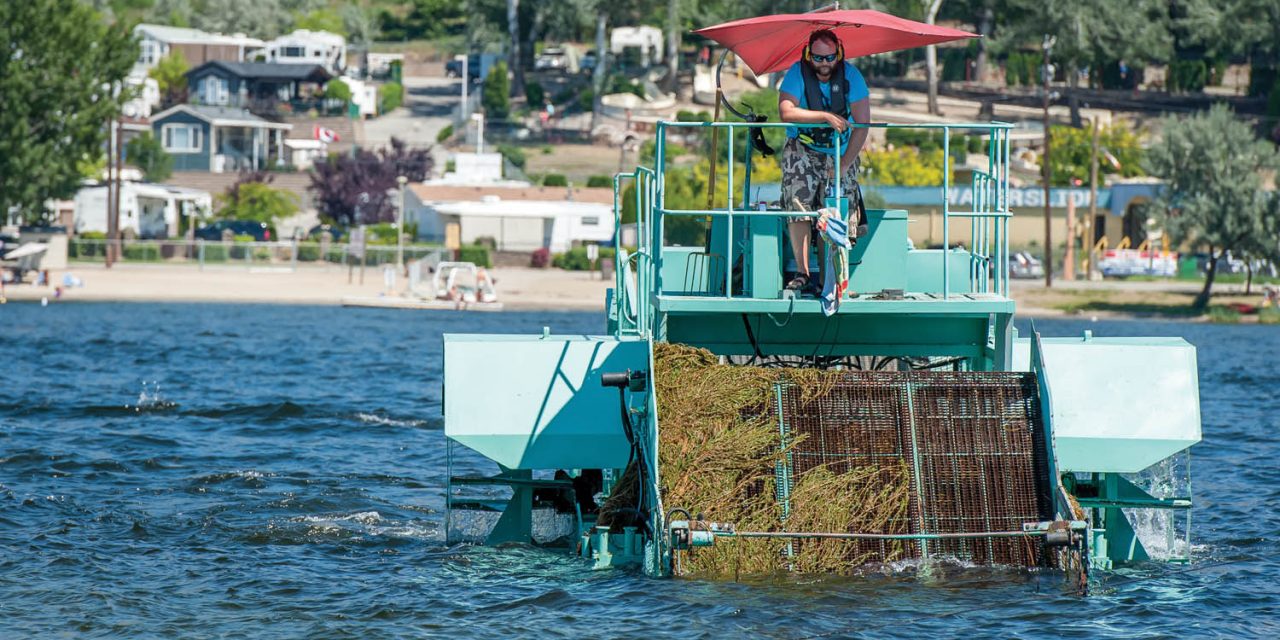
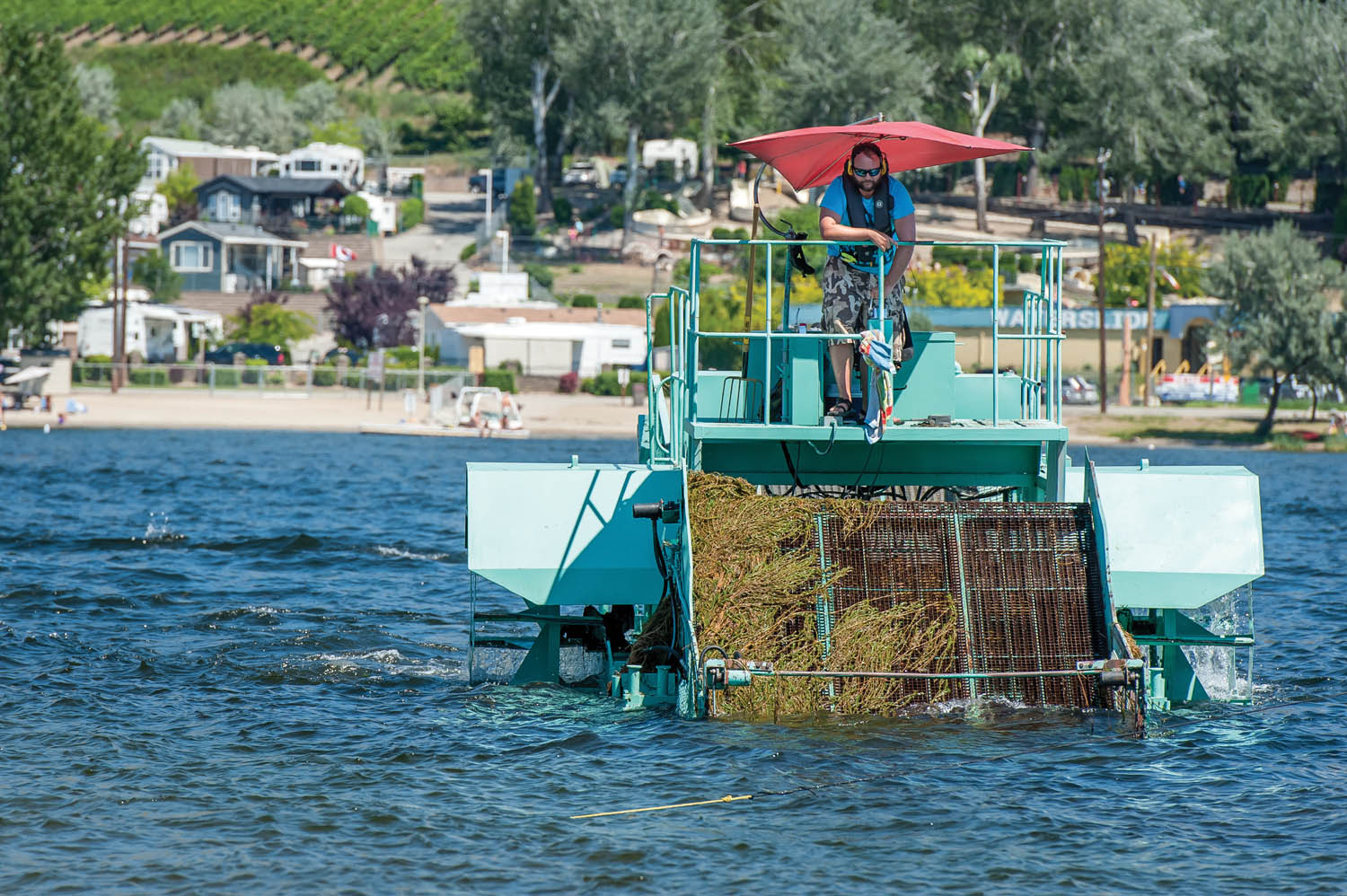
Dave Caswell of the Okanagan Basin Water Board shows how the rototiller he operates pulls Eurasian milfoil up by the roots in a file photo from last year. At these temperatures, the uprooted plants die. Eurasian milfoil is an invasive aquatic plant brought to the Okanagan in the 1970s. (Richard McGuire file photo)
The winter milfoil control program on Osoyoos Lake is well underway with work on the lake’s north basin about to start.
Work this year is more thorough because of a longer work window, said James Littley, office and project manager with the Okanagan Basin Water Board (OBWB), which conducts the program.
Littley said work on the portion of the lake below the Hwy. 3 bridge was wrapping up last week.
During the winter program, a rototiller machine pulls up Eurasian milfoil by the roots. This differs from the summer program when only the tops of the invasive aquatic weed are cut and harvested.
The work in the north basin will continue until the lake freezes up, Littley said, adding that it then resumes after the thaw. Unlike in the past, the work doesn’t have to conclude at the beginning of April.
“We’ve had a really successful first month,” said Littley. “I’ve been in contact with (rototiller operator) Dave (Caswell) every day and he’s been doing things really thoroughly, crossing all of the milfoil beds. He’ll go in one direction and then back in another direction.”
The longer work window results from the easing of environmental restrictions intended to prevent interference with spawning areas of smallmouth and largemouth bass.
Littley said the OBWB asked for the easing of the restrictions because the bass are an invasive species, even though they are fished commercially, and because the restrictions made it harder to control the spread of milfoil.
Just how long into the spring the program continues will depend on conditions and water temperatures, Littley said. If all areas are covered, the work will stop. An extra month should be more than enough, he said.
“Once the milfoil starts growing, which is usually June to July, then there’s no point in us rototilling because we’re just spreading it,” he said. “So we kind of look at that April and May window as being the latest.”
In cooler temperatures, the plant is dormant and when it’s pulled up, it floats ashore and dies. In warmer weather, pulling up the plants causes it to spread.
Eurasian milfoil is an invasive aquatic species that first spread into the Okanagan lakes in the 1970s.
The OBWB took over the control program from the province in the early 1980s.
RICHARD McGUIRE
Osoyoos Times