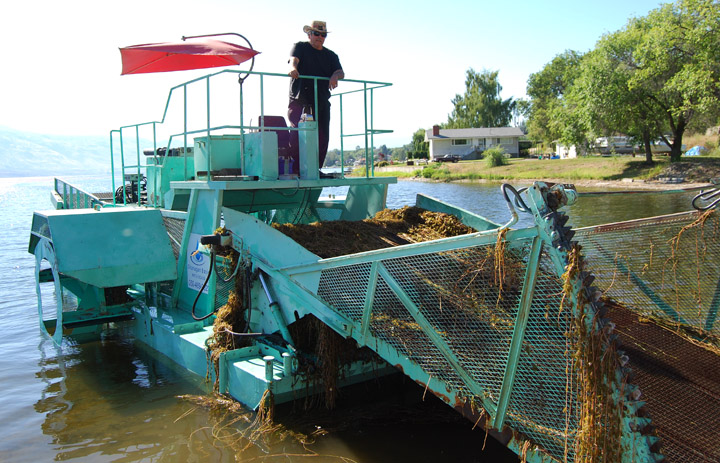
The Okanagan Basin Water Board's milfoil harvester was hard at work this summer dealing with a boom of milfoil growth in Osoyoos Lake. Photo by Osoyoos Times/File - Click on picture for larger image
OSOYOOS TIMES-November 10, 2010
By Paul Everest – Osoyoos Times
The Okanagan Basin Water Board may soon begin cooperating with organizations and governments in the U.S. on ways to battle milfoil in regional waterways including Osoyoos Lake.
A draft memorandum of understanding (MOU) focused on the “control of invasive aquatic vegetation” in the Upper Columbia River system has been prepared and Anna Warwick Sears, the board’s executive director, said the board is prepared to sign on.
The groups that intend to sign on to the MOU, including American agencies such as the U.S. Fish and Wildlife Service, the Washington state Department of Ecology and the National Park Service, will work to share information about techniques and processes to deal with invasive plants such as milfoil.
The water board has been responsible for the control of Eurasian watermilfoil in the Okanagan Valley since the 1970s and conducts regular milfoil rototilling and harvesting in Osoyoos Lake.
Eurasian watermilfoil is believed to have been introduced to North America in the 19th century and is a problem as it interferes with boating, swimming and fishing activities.
Warwick Sears said since invasive plant species such as milfoil are moving across the Canada-U.S. border, it’s good to have cooperation and collaboration with organizations in America that share similar invasive-plant-management goals.
She added that Washington state is interested in some of the mechanical harvesting techniques the board uses in the Okanagan basin.
At the same time, the board would like to learn more about biological methods of controlling invasive aquatic vegetation employed in the U.S. such as using weevils that eat Eurasian milfoil.
Warwick Sears said that it was the U.S. agencies that began looking at ways to work together to manage invasive aquatic vegetation and they decided to begin talking to like-minded groups in Canada.
The draft MOU states that Eurasian milfoil is an “imminent threat to native fish and plant species.”
It also states that the parties that sign the MOU recognize “the need to develop an integrated approach to invasive aquatic vegetation management through the development of scientific research, education, training and awareness raising at all levels, the development of appropriate coordinated policies and practices, the networking of scientists in the region, and the transfer of information and knowledge by establishing a region-wide Partnership.”
Through the MOU, the signatories intend to develop an “integrated weed management program” in the region that would allow for the coordination of weed control efforts and methods.
They also hope to design a system to allow each signatory to share information with the others.
Warwick Sears said she wasn’t sure when the MOU would be signed, but added that if the board is happy with the finalized document, it will sign on.
[email protected]