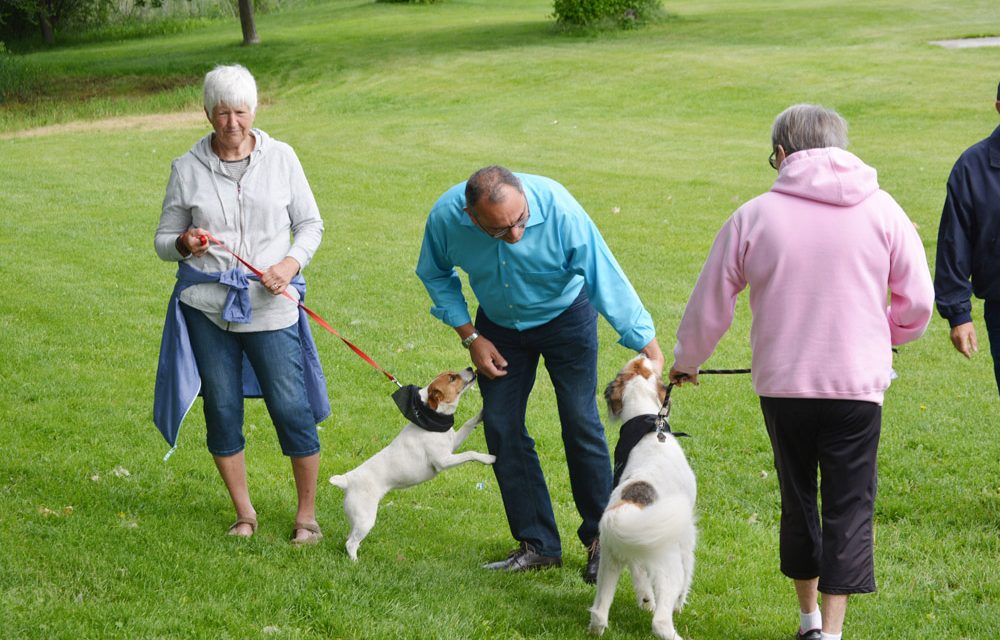

Mayor Ron Hovanes greets a couple of canines during the Walk for Dog Guides in Lion’s Park last weekend. Photo by Dan Walton
The steep costs of breeding and training a service dog prevents many Canadians from enjoying a higher quality of life, so each year in May, the Oliver Lions Club holds the Purina Walk for Dog Guides, raising money to ease the financial obstacles.
Two of the day’s participants were Bob and Karen Scott, who are in Oliver visiting from Ontario. Bob is a member of the Lions Club in his community, and there he organizes a similar event to raise money for dog guides. He said that aside from being 4,000 kilometres from home, the walk for dog guides wasn’t much different than what he’s used to in Ontario.
The Scotts were in town visiting their friends Bertie and Harry Barens, who took part in this year’s event for the first time with their dogs Jake and Aussie.
“Just by taking our dogs out for a walk, we’re doing something that some people can’t, so it’s a reminder that we’re healthy and functioning, and we’re happy to raise money to help out the people that can’t,” said Bertie. “We heard about it late but we’re really happy to be able to help support the Lions Club because of all the wonderful work they do.”
Mayor Ron Hovanes spoke at the event, emphesizing the amount of resources needed to enable such important relationships.
“Servies dogs are more than a companion,” he said. “I can’t image how much it would improve their lives.”
Joanne Bray, president of the Oliver Lions Club, explained how multi-faceted service dogs are able to be, offering assistance to people with disabilities involving mobility, hearing, vision, autism, epilepsy and diabetic alert.
“They cost about $30,000 and they’re give free to their owners,” she said. “The more money that’s raised, the more service dogs they can breed and train for Canadians in need.”
At last weekend’s event, $2,057 was raised, a number Bray had hoped would be higher.
“This is such a needy cause but we’re still only getting $2,000 which we did 10 years ago. It hasn’t really grown.”
Bray spoke about an instance where a service dog was able to help others in the community. A diabetic alert dog spending time at a park directed its owner over to an unknown child, prompting the woman to ask the child’s mother if he was diabetic. To the mother’s knowledge, her child was not diabetic. But sure enough, subsequent testing led to a positive diagnosis.
“The quality of life just goes up 100 per cent with these dogs,” Bray said.
By Dan Walton