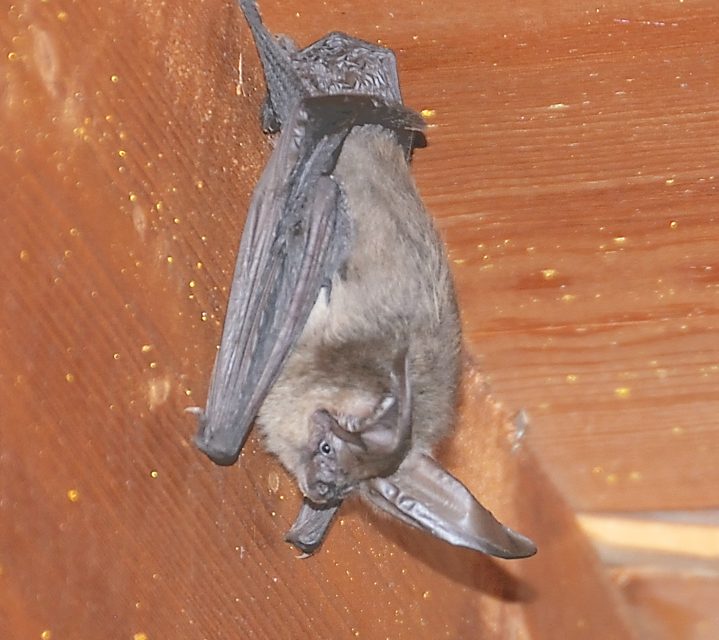

A Townsend’s big-eared bat hangs out on a beam. Researchers are anxious to do bat counts before White Nose Syndrome affects bat populations in B.C. (Sharon Laughlin)
The B.C. Community Bat Program Okanagan Region is seeking bat colonies and volunteers for the Annual Bat Count.
This citizen-science initiative encourages residents to count bats at local roost sites.
“Bat counts are a wonderful way for residents to get involved in collecting important scientific information,” says ecologist Paula Rodriguez de la Vega, Okanagan coordinator for the B.C. Community Bat Program. “No special skills are needed, you can be any age, and you can relax in a deck chair while counting.”
The Annual Bat Count will collect baseline data on bat populations before the devastating White Nose Syndrome fungal disease affects bats in the province.
“White Nose Syndrome is estimated to have killed more than seven million bats since it was first discovered in eastern North America a decade ago,” says Rodriguez de la Vega. “In March 2016, the disease was detected just east of Seattle, and has now spread within Washington State. This has greatly increased our urgency to understand bat populations in B.C. We need the public’s help to census local bat populations – we never know when it is our last year to obtain population estimates before White Nose Syndrome causes widespread declines in western North America.”
Counts are easy – volunteers wait outside a known roost site, such as a bat-house, barn, bridge or attic, and count bats as they fly out at twilight. They record the final number along with basic information on weather conditions.
Ideally, one to two counts are done between June 1 and 21 before pups are born, and one to two more between July 11 and August 5 when pups are flying.
“We know relatively little about bats in the Okanagan and Similkameen, including basic information on population numbers,” says Rodriguez de la Vega. “This information will be extremely valuable, particularly if it is collected annually. If people want to get involved but don’t have a roost site on their property, we will try to match them with a roost site nearby.”
Funded by the Habitat Conservation Trust Foundation, the Forest Enhancement Society of B.C., and the South Okanagan Conservation Fund, and with support of the B.C. Conservation Foundation, the Province of B.C., the Okanagan Similkameen Conservation Alliance, Okanagan Similkameen Stewardship Society, the Allan Brooks Nature Centre, the Osoyoos Desert Centre, and the Peachland Bat Education and Ecological Protection Society, the B.C. Community Bat Program provides information to people dealing with bat issues on their property or who have questions about how to attract bats.
To find out more about bat counts, or to get assistance dealing with bat issues, visit www.bcbats.ca or call 1-855-9BC-BATS, ext.13.
SPECIAL TO THE TIMES
Osoyoos Times