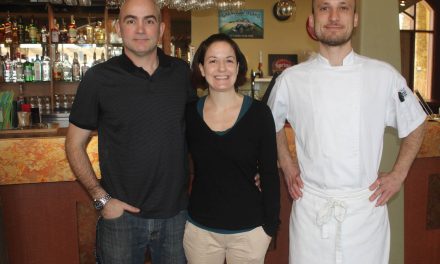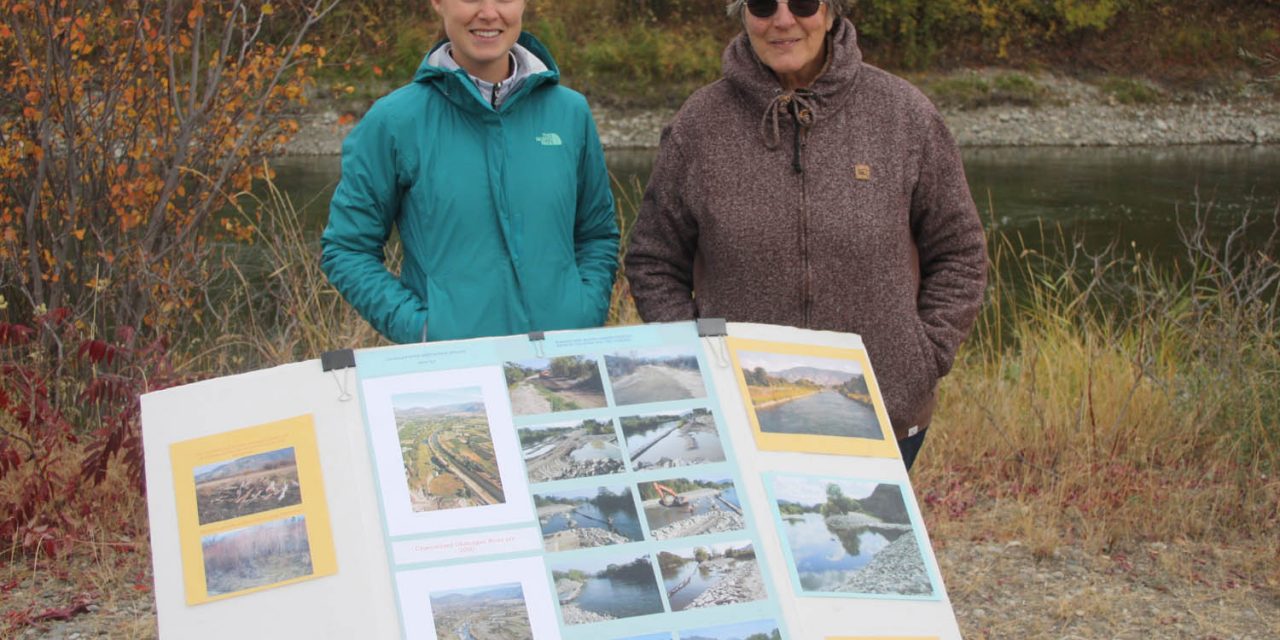
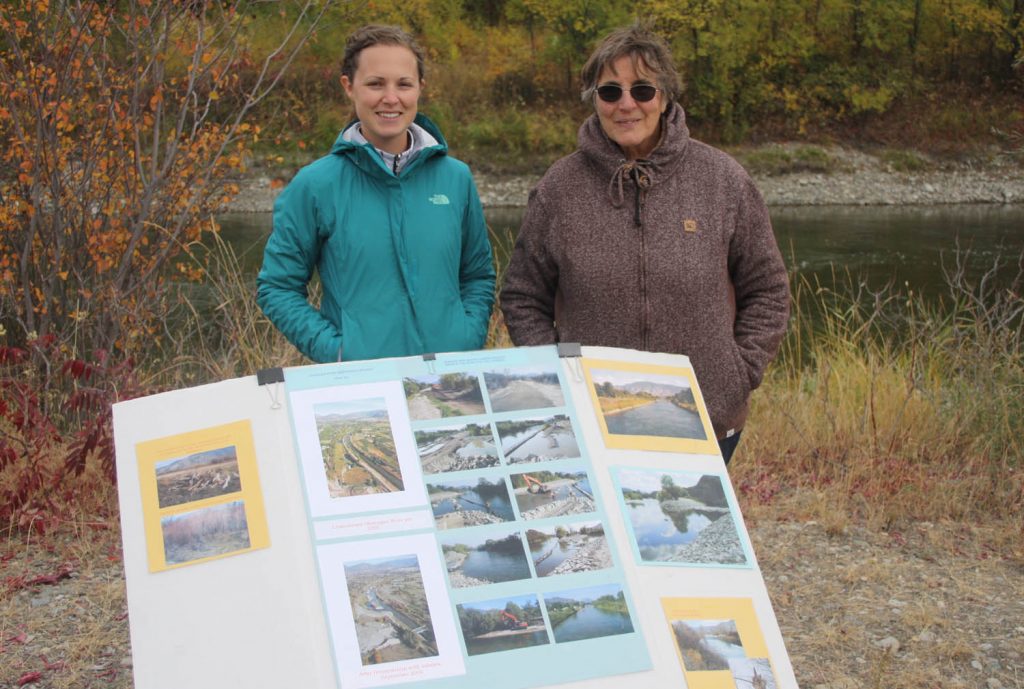
Biologist Valerie Blow (left) with the Okanagan Similkameen Conservation Authority, stands with Lee McFadyen of the Okanagan River Restoration Initiative during a recent open house in Oliver. The initiative began in 2000 to re-establish the natural aquatic and terrestrial habitat previously lost due to river channel alterations. (Keith Lacey photo)
The “channelization” of the Okanagan River almost destroyed its capacity to remain a vibrant breeding ground for sockeye salmon and other fish species, however, organizations like the Okanagan River Restoration Initiative (ORRI) are doing everything in their power to ensure a self-sustaining ecosystem remains in place.
For the fourth consecutive year, ORRI held an open house and information session recently near its main fish rearing station, located 1.5 kilometres from the Oliver Visitor’s Centre and 17 km upstream of Osoyoos Lake.
Lee McFadyen, the public relations co-ordinator for ORRI, was on hand to answer questions, hand out pamphlets and share information about the extensive work done by the organization since it was formed back in 2000.
Valerie Blow, a contract biologist with the Okanagan-Similkameen Conservation Authority (OSCA) was also on hand at Saturday’s open house.
Major flood control work that started in the 1950s resulted in the “channelization” of the Okanagan River, with 85 per cent of the river “straightened and diked” and 50 per cent of its length eliminated, said McFadyen.
More than 90 per cent of its riparian and wetland habitat was disappeared, several animal and plants species destroyed and connection to natural floodplains lost, she said.
ORRI was conceived in 2000 to re-establish some of the natural aquatic and terrestrial habitat features lost due to channel alterations, she said.
This has included re-activating and re-vegetating floodplains, re-establishing side channels to the river, increasing the region’s biodiversity which has resulted in the recovery of endangered species, and improving the water quality to moderate the effects of droughts, floods and climate changes, she said,
In the late 1990s, sockeye salmon stocks on the Okanagan River were as low as 2,000 and there were great concerns the entire commercial salmon industry would disappear for good, she said.
Organizations like ORRI, OSCA, the Okanagan Nation Alliance (ONA) and Penticton Indian Band have worked together since that time to ensure sockeye and other fish species can thrive and survive along the Okanagan River, she said.
“The Okanagan River is one of only three rivers in the vast Columbia River system where sockeye salmon still return to spawn,” she said. “Concerns for its health brought all of these organizations together.”
ORRI has been involved in several significant projects over the past several years that have dramatically improved the living conditions for sockeye salmon and other fish species and ensured the annual salmon run from Osoyoos Lake through the Okanagan River continuing north remains a success, she said.
In 2009, construction allowed the river to flow into its historic west side meander and to re-activate the connected floodplain at high flows, she said
Ongoing aquatic and terrestrial monitoring have shown many positive results over the past decade, she said.
Some of those benefits include the regrowth of riparian vegetation and in-river improvements have restored ecological functions; increased use of aquatic spawning and rearing habitat by salmon and trout; increased use of the floodplain by species at risk, such as the Great Basin Spadefoot Toad; reduction of invasive species such as Eurasian Milfoil; and overall improvement in water quality.
Phae II reconnected a historic river pathway of the Okanagan River immediately upstream of Phase I, said McFadyen.
The 2013 construction project allowed water to enter a 300-metre long natural side channel on the East side of the river.
The naturally vegetated side channel provides good quality fish rearing habitat with food, cover and a place to rest, especially for young rainbow trout, steelhead and chinook salmon, she said.
The rock riffle that has been built and fish spawning platforms provide desirable spawning habitat, especially for sockeye salmon, she said.
To help compensate for greater water velocity and to maintain river bed stability, 17 Vertical Drop Structures (VDS) have also been installed along the channelized sections, she said.
“Each VDS creates an upstream back-watering effect and fine sediments are retained upstream,” she said. “Consequently, spawning habitat upstream from each VDS is marginalized.”
These V-shaped concrete wedges on each pier don’t play a structural role in the VDS, but accentuate he upstream backwatering effect, she said.
ORRI has also assisted the ONA in its Providing Fish Passage at McIntyre Dam program, which will provide upstream adult salmon safe passage and improve downstream juvenile salmon migration.
McIntyre Dam is located between Oliver and Okanagan Falls and controls the water level of Vaseux Lake and the flows of the Okanagan River between Lake Vaseux and Osoyoos Lake.
The dam was constructed in the 1950s and since that time, upstream fish passage has been impeded as salmon can’t typically migrate past the undershot gates.
The project involves replacing the existing gates with overshot gates where water will flow over the gates.
A backwater riffle will also be built downstream from the dam and monitoring will take place to observe the effectiveness of the project on sockeye salmon migration.
A permanent screen will also be built in the Oliver irrigation canal by the Town of Oliver.
All of these projects have helped fish migration along the Okanagan River and ensured the sockeye salmon run will continue to thrive, said McFadyen.
“We know we’re making a difference and having a positive impact,” she said. “Organizations like ORRI, OSCA and the ONA will continue to work as partners to ensure all of the progress we’ve made over the past 20 years continues.”
KEITH LACEY
Osoyoos Times