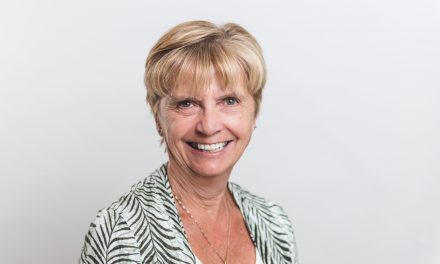
MLA Linda Larson had her own vote total increased in the final vote count, but the provincial outcome is likely to put her into the opposition if a deal reached Monday between the NDP and Green parties succeeds. (File photo)
This story has been updated to include developments occurring Tuesday.
MLA Linda Larson would find herself in opposition if the B.C. NDP becomes the new provincial government under an agreement between the NDP and B.C. Greens announced Monday.
Premier Christy Clark said Tuesday that she plans to reconvene the legislature in early June and will test whether she has the confidence of enough MLAs to continue to govern.
She acknowledged that her government is likely to fall, in which case she would become the leader of the opposition and NDP Leader John Horgan would become premier.
After final vote totals last week left the governing B.C. Liberals with a 43-seat minority, Horgan and Green Leader Andrew Weaver announced an agreement Monday that would allow the NDP to form the government.
That agreement was ratified by MLAs of the NDP and B.C. Greens on Tuesday.
As the incumbent, B.C. Liberal Leader Clark continues as premier, but if she loses a confidence or supply bill, the legislature would again be dissolved and Lieutenant Governor Judith Guichon would likely call on Horgan to form a government.
Clark said she would not ask Guichon to call another election.
Final numbers released by Elections BC last week confirmed Larson’s re-election with 9,513 votes, representing 42.8 per cent of the popular vote.
But the numbers, which included absentee ballots, also gave the NDP a 189-vote victory in the tight race in Courtenay-Comox, which the NDP was leading by a mere nine votes on election night, leaving the provincial outcome uncertain.
That means the NDP, with 41 seats, combined with the Greens’ three seats, together have 44 seats, the minimum needed for a majority in the legislature.
The four-year agreement between the two parties is not a formal coalition.
Rather, the NDP and Greens will operate as separate caucuses, with the Greens supporting the NDP on confidence votes.
The B.C. New Democrat Government has agreed to advance several legislative and policy initiatives identified as a condition of support by the B.C. Green Caucus, including:
- Reforming the electoral system, getting the influence of big money out of politics, and reforming lobbying rules;
- Recognizing that education is about lifelong learning and fast-tracking enhancement to K-12 education funding;
- Protecting and promoting public health care, creating a proposal for an essential drugs program, and giving families the security of quality, affordable child care;
- Getting people moving with better transit;
- Giving the opioid crisis the attention it deserves;
- Establishing an Emerging Economy Task Force and an Innovation Commission;
- Eliminating Medical Services Premiums;
- Implementing a basic income pilot project;
- Fighting climate change while creating good jobs and introducing rebate cheques that will mean most people pay less while increasing the carbon tax beginning in 2018;
- Sending the Site C project immediately to an independent review;
- Opposing the Kinder Morgan pipeline expansion project.
“We can have a stable minority government for four years with the support of B.C. Green MLAs on confidence and supply matters,” said Weaver on Monday.
“People voted overwhelmingly for change, and we are ready to give them that,” said Horgan. “A New Democrat government will deliver what people voted for on May 9: making life more affordable, fixing the services people count on, and building a sustainable economy that works for everyone.”
This is the first minority government in B.C. since 1952 and the first time since 2001 that the NDP has formed government.
Last week Clark said that with 43 Liberal candidates elected as MLAs, and a plurality in the legislature, “we have a responsibility to move forward and form a government.”
But without the support of a majority in the legislature, a B.C. Liberal government would not likely survive its first confidence vote.
“With this historic result, British Columbia can finally put the ineffective two-party system behind us,” said Weaver after the final vote totals were announced.
Weaver supports a proportional system of elections that would give smaller parties more power and Horgan said he does too.
“I look forward to working with both other parties so that we can finally get big money out of politics, move towards electoral reform and implement good public policy on a wide range of issues that puts people first,” said Weaver.
Larson’s final total of 9,513 votes is an increase of 339 votes from those announced on election night and a slight drop in percentage of about three tenths of one per cent.
Also in Boundary-Similkameen, NDP candidate Colleen Ross increased her total by 334 votes to 7,275. That gives her 32.73 per cent of the popular vote.
In third place, independent candidate Dr. Peter Entwistle added 137 votes bringing his total to 3,165 votes, and 14.24 per cent.
In fourth and last place was Vonnie Lavers of the B.C. Greens, who added 129 votes for a final total of 2,274 and 10.23 per cent.
RICHARD McGUIRE
Osoyoos Times
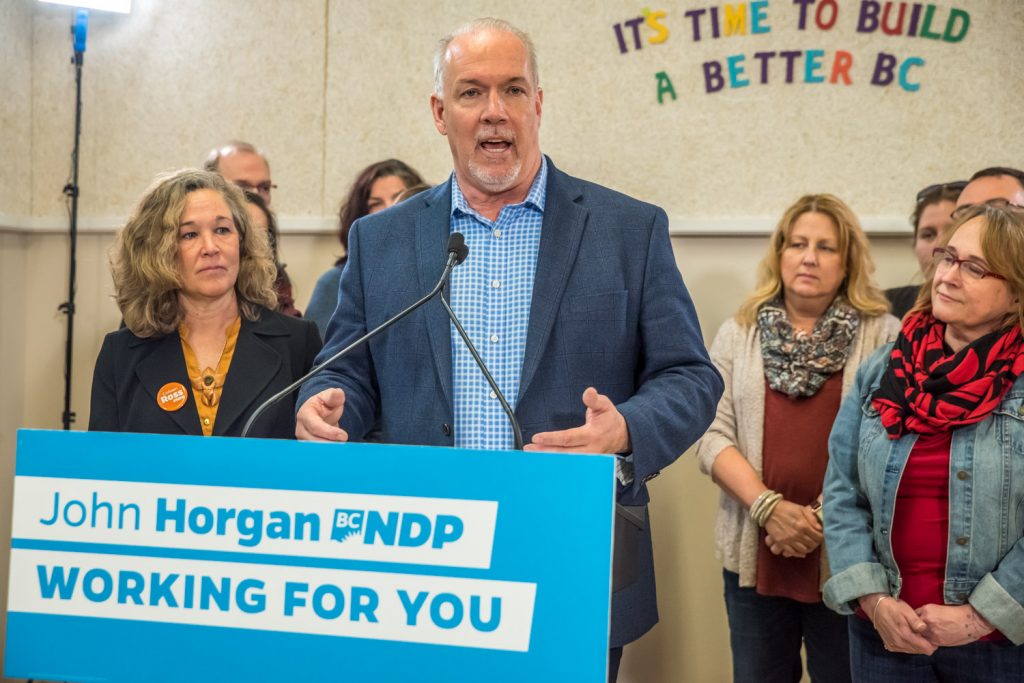
NDP Leader John Horgan, pictured in Osoyoos at the start of the election campaign, would become B.C.’s next premier under an agreement announced Monday between the NDP and the B.C. Greens. The governing B.C. Liberals won a 43-41 seat plurality, but they failed to achieve a majority when final vote counts were announced last week. (Richard McGuire file photo)