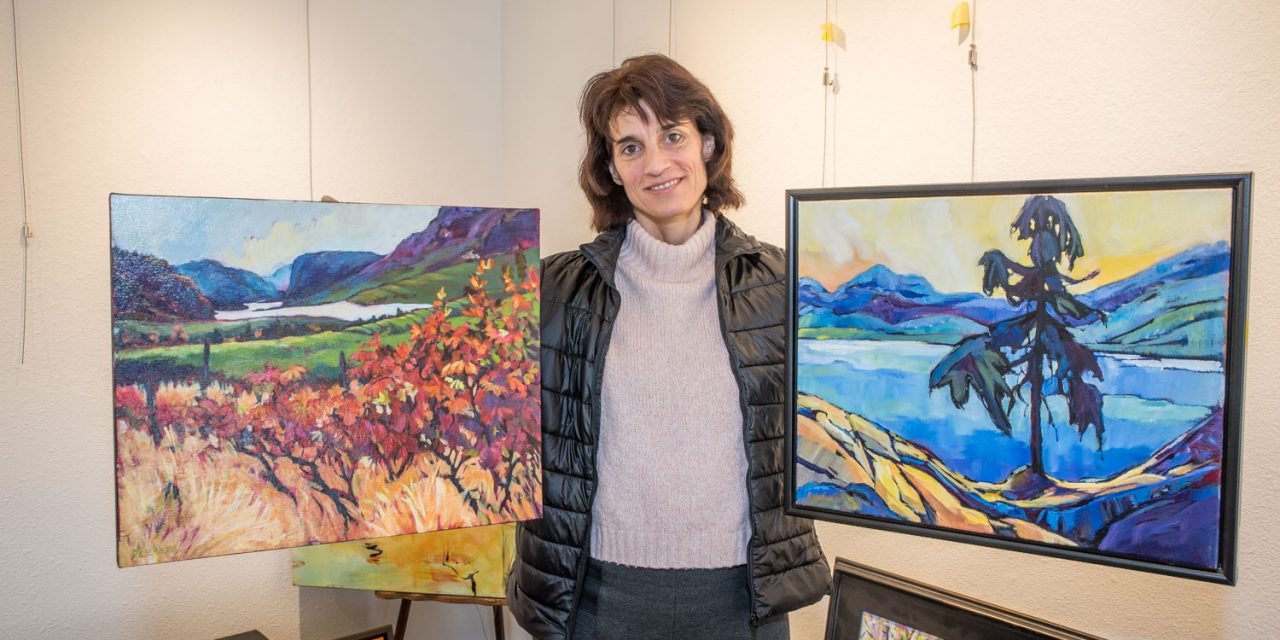
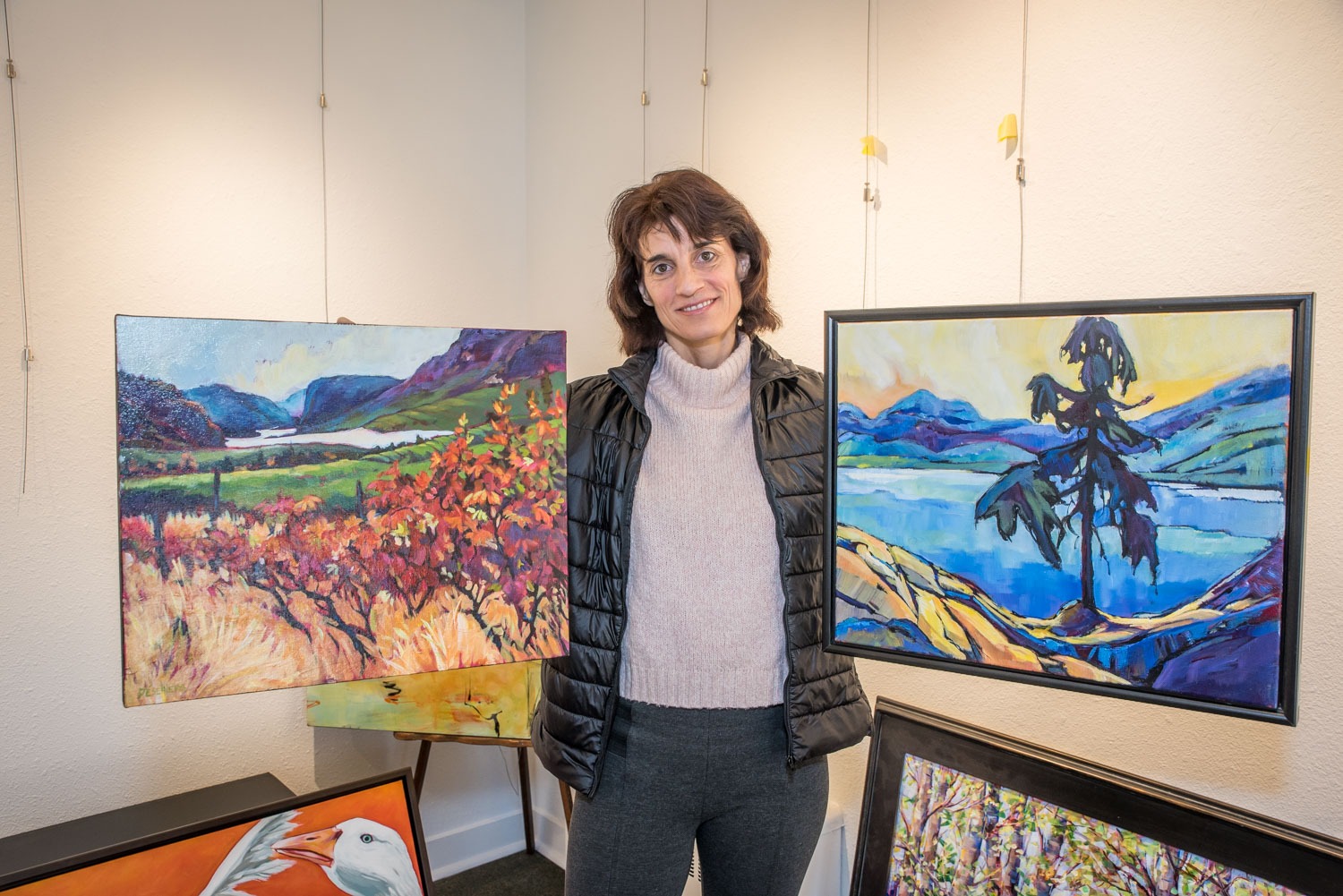
George L. Traicheff’s exhibition “Essence of the Animal” is now open at The Art Gallery Osoyoos. His work in a variety of media features formal and environmental portraits of animals, both wild and domestic. (Richard McGuire photo)
When George Traicheff sets out to capture the essence of an animal in a painting or lithograph, he brings a deep knowledge of that animal to his work.
Traicheff, whose exhibition, “Essence of the Animal,” officially opens Saturday, Oct. 14 at The Art Gallery Osoyoos, has been learning about animal behaviour since he was a child.
His grandfather, a hunter in Nova Scotia, taught him about animal tracking and instilled in him a love of wildlife and the woods.
He learned to tell the direction an animal was travelling from the colour tone of the grass in the animal’s path. Or how recently the animal came by from traces of dampness on overturned stones.
His work includes a mix of more formal portraits of animals, both wild and domestic, and environmental portraits showing the animal where it lives.
Traicheff, who now lives in Okanagan Falls, once went on a workshop in Ontario’s Algonquin Park with famous naturalist and painter Robert Bateman. They travelled by canoe in a small group, and Bateman shared his knowledge of conservation, animals and how to represent them.
The two have remained friends.
“Observation is nine tenths of art,” said Traicheff, citing some of the knowledge he acquired from Bateman and now passes on to his own students. “It’s not just putting to pencil. It’s looking and learning. You don’t want to put a moose in sage country, because it would never live there. You see a lot of artists do that.”
Bateman taught him about the anatomy of different animals.
“The way the hair flows on a cat is different than the way hair flows on a dog,” said Traicheff. “When you paint, light would strike that differently. So learning those little nuances helps give you accuracy in your animals.”
So how would the “essence” of wild and domestic animals be different?
“Domestic animals don’t have the fear of being eaten every day or being hunted, whereas your wild ones do,” said Traicheff. “They’re always a little more skittish and in your paintings, you try to give that essence of always being on alert, always being ready to move. With the domestic animals, you give a little more character of laziness, of being more relaxed.”
In his piece “After the Siesta,” a donkey looks like it’s just been snoozing. In contrast, a giraffe in another piece has its head turned to look for any approaching predators.
There’s a painting of two geese in the water that looks calm, but even here, the male’s head is looking back over his shoulder.
“Even though it’s a serene scene, there’s still that little bit of tension that’s there,” Traicheff said.
The show includes almost as wide a range of artistic media as the range of animals. There are watercolours, acrylic paintings, stone lithographs, pen and ink drawings and a number of limited-edition prints.
Not included in this show is Traicheff’s photography, which was shown at the Osoyoos Art Gallery when he did an exhibition a number of years ago.
Traicheff’s subject matter is by no means limited to animals, although they are the focus of this show.
One image, called “In the Beginning,” stands out because it is the only piece that includes a human subject, an 1886-era North-West Mounted Policeman riding through the sagebrush.
“Don’t forget that people are animals,” says Traicheff.
He included this image as a way of incorporating a bit of his own past into the show. Traicheff served with the RCMP throughout B.C. before he retired to the Okanagan.
He was a police artist, drawing pictures of bad guys based on the recollections of witnesses.
Sue Whittaker, curator of the gallery, said she’s glad to welcome Traicheff back. She notes that the gallery has now switched to new LED lighting that has a more neutral colour temperature.
“The light is just stunning in there now,” she said.
Whittaker thinks the subject matter of animals will draw considerable interest, and will be more accessible to children.
“Besides that, he’s just a wonderful artist,” she said. “He has so many skills.”
Traicheff will be giving a presentation on his art at noon at the reception on Saturday and he will be painting at the gallery every Saturday throughout the show.
He’ll also be present most Wednesdays to meet visitors.
The Art Gallery Osoyoos is located at 8713 Main Street and is open Tuesday to Saturday from noon to 4 p.m.
RICHARD McGUIRE
Osoyoos Times