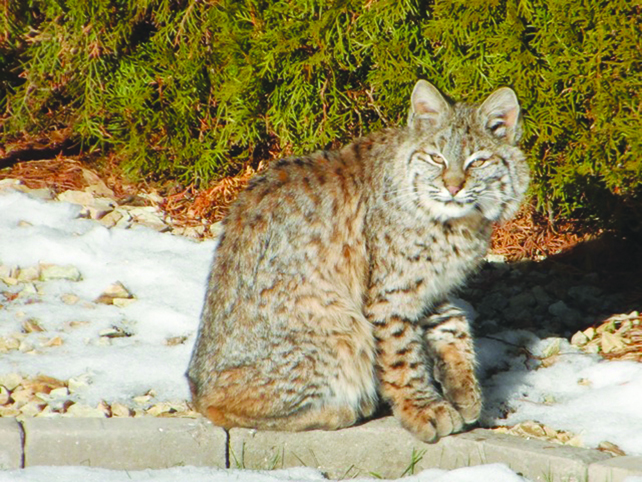

A UBC student is asking citizens to send in their photos of bobcats or lynx in order to help him with his study.
A University of British Columbia Okanagan (UBCO) student is completing his Masters degree studying the effects of climate change on lynx and bobcats across the province and he’s asking for assistance from local residents – and people across the province.
T. J. Gooliaff, 24, is in the first year of his two-year Masters program in biology at UBCO and is working on this thesis that centers around the concept that lynx and bobcats in B.C. are being adversely affected by climate change.
He’s asking members of the public who take photographs of either species of cat to send him those digital photographs, including date and location, so he can put together a comprehensive map of both species across the province.
“I am using photos of bobcats and lynx submitted by the public to help map the current provincial distribution of both species to determine if their ranges have shifted in response to climate change,” said Gooliaff, who is originally from Agassiz, B.C. and completed his undergraduate studies and received a Bachelor of Science degree in biology from the University of the Fraser Valley in Abbotsford in the spring of 2015.
“I hypothesize that bobcats have moved northwards and into higher elevations as a direct result of climate change.”
Historically, bobcats and lynx have been typically separated by snow depth, said Gooliaff.
Lynx have extremely long legs and large snowshoe-like paws, making them well adapted to travelling across deep snow.
Both species are found in the boreal forests across Canada and Alaska, as well as the mountain ranges extending south into Washington, Idaho, Montana, Wyoming and Colorado, he said.
In contrast, bobcats are heavier, have small feet and sink into the snow, meaning they are susceptible to being targeted by other predators when they have trouble moving around in the snow, he said.
Bobcats are found throughout the deserts and grasslands of the contiguous United States, as well as southern Canada, he said.
“However, climate change has led to earlier springs and lower snow levels in western North America. As a result, suitable bobcat habitat may now be present in new areas in British Columbia.”
Response from members of the public over the past several months has been outstanding as he’s received more than 1,900 photos from strangers since starting his research back in September, said Gooliaff.
“I’m almost overwhelmed at the positive response,” he said. “But I do need more photos as I’m trying to map both species across the entire province.”
The photographs members of the public submit to him don’t have to be award winning.
“The photos don’t have to be great photography … they just have to show a bobcat or lynx or even just a part of either,” he said. “The photos can be blurry or dark and don’t even have to clearly show which cat species is present
“When sending me photos, please include both the date and location of each photo. Location should be as specific as possible and the most preferred would have latitude and longitude co-ordinates. If that information is not available, then please provide the name of the nearest road or landmark (including the distance from the road or landmark) or nearest town or watershed or Wildlife Management Unit.”
None of the photos submitted as part of this project will be published or shared with anyone without permission and photographers will retain full ownership of their photos, he said.
“The results of my study will be gladly shared with those who are interested.”
For decades, lynx and bobcats seldom shared the same habitat in B.C., but climate change has changed that and there are many areas where both species can be found in abundance, said Gooliaff.
“Due to climate change, bobcats have moved to higher elevations and the effect that has had on the lynx population remains unknown,” he said.
From the latest data, Gooliaff said there are healthy populations of lynx and bobcats in B.C. and they are both found across the Okanagan Valley.
The lynx population remains strong across North America, but there are signs of dwindling populations of bobcats in Washington State, Idaho and Montana, he said.
“My goal is to prove climate change has been the biggest reason why this species is in trouble in areas where they used to thrive,” he said.
Gooliaff said his final Masters paper should be completed “in about a year” and it’s his hope to graduate and land a job as a wildlife biologist with the Ministry of Environment.
Those who would like to submit photos can do so by email to [email protected] or Dr. Karen Hodges at [email protected].
By Keith Lacey