By Times Chronicle Staff
Researchers at the University of British Columbia (UBC) have discovered a universal ‘weak spot’ in the COVID-19 virus that could be a potential game changer in fighting the virus.
This breakthrough could spell a new wave of treatments across all COVID-19 (SARS-CoV-2) variants, according to the study’s senior author who detailed the findings last week in the scientific journal Nature Communications published online.
“This study reveals a weak spot that is largely unchanged across variants and can be neutralized by an antibody fragment. It could set the stage for the design of pan-variant treatments that could potentially help a lot of vulnerable people,” said Dr. Sriram Subramaniam, a professor at UBC’s faculty of medicine.
Up until now, antibodies developed in a lab have been used to treat the COVID-19 virus. However, these treatments have proven less effective as the virus evolved.
“This is a highly adaptable virus that has evolved to evade most existing antibody treatments as well as much of the immunity conferred by vaccines and natural infection,” Subramaniam said.
“Antibodies attach to a virus in a very specific manner, like a key going into a lock,” he explained, “but as the virus mutates, the key no longer fits.”

UBC’s Dr. Sriram Subramaniam. UBC Faculty of Medicine photo.
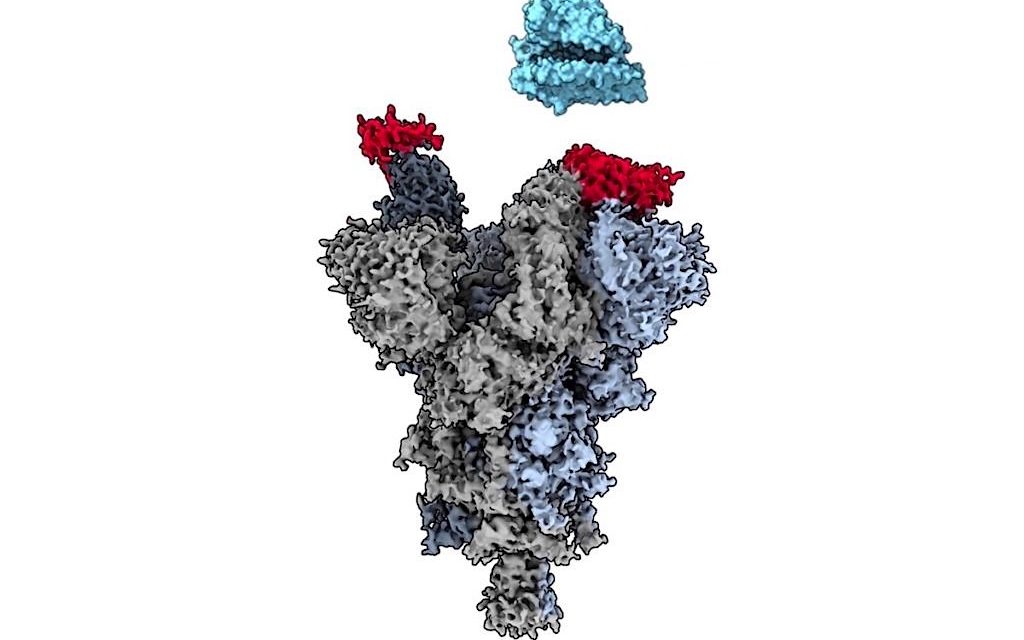
By using cyro-electron microscopy to reveal the atomic-level structure of the vulnerable spot on the virus’ spike protein, known as an epitope. Spike proteins enable the virus to penetrate host cells and cause infection.
Researchers were also able to locate an antibody fragment VhAb6, which is able to latch onto and neutralize the virus’ weak spot – the epitope – on the spike protein across all variants. The fragment attaches to the spike protein head, blocking the virus from entering all human cells.
“We’ve been looking for master keys – antibodies that continue to neutralize the virus even after extensive mutations,” says Subramaniam.
The discovery is just the latest collaboration between researchers at UBC and the University of Pittsburgh. UBC has been using cyro-em technology to study the molecular structure and characteristics of the spike protein, while the Pittsburgh team, headed by Dr. Mitko Dimitriov and Dr, Wei Li, has been screening extensive antibody libraries and testing their effectiveness against COVID-19.
Earlier this year, the tandem of Universities north and south of the border were the first to report of the structure of the contact zone between the Omnicron spike variant and the human receptor ACE2, in a paper published in Science magazine.
In mapping the molecular structure of each individual spike protein, the search of potential vulnerability across all variants opened the door to new treatments.
“Now that we discovered the structure of this virus in detail, it unlocks a whole realm of treatment possibilities,” said Subramaniam.
The vulnerability can now be used – and exploited – by drug makers. Because this vulnerability is at a mutation-free location on the COVID-19 virus, the potential treatment should be equally effective against existing – and potential future – variants.
“We now have a clear picture of this vulnerable spot on the virus. We know every interaction the spike protein makes with the antibody [at this site],” says Subramaniam.
“We can work backwards from this, using intelligent design, to develop a slew of antibody treatments. Having broadly effective, variant-resistant treatments would be a game changer in the ongoing fight against COVID-19.”