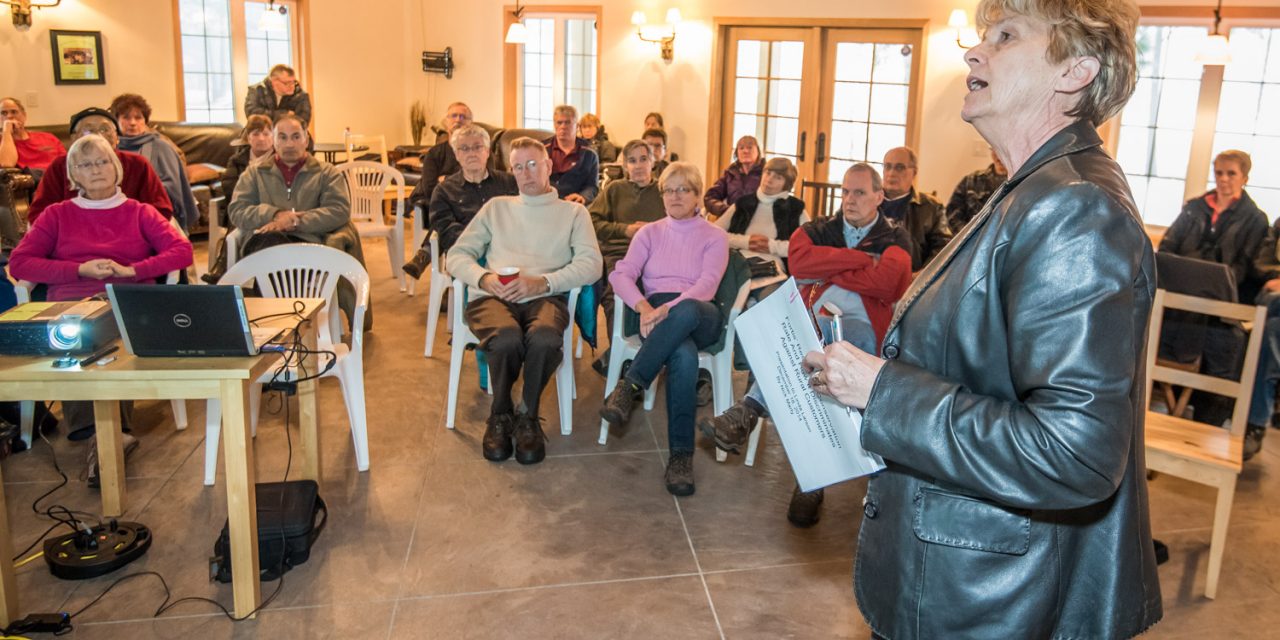
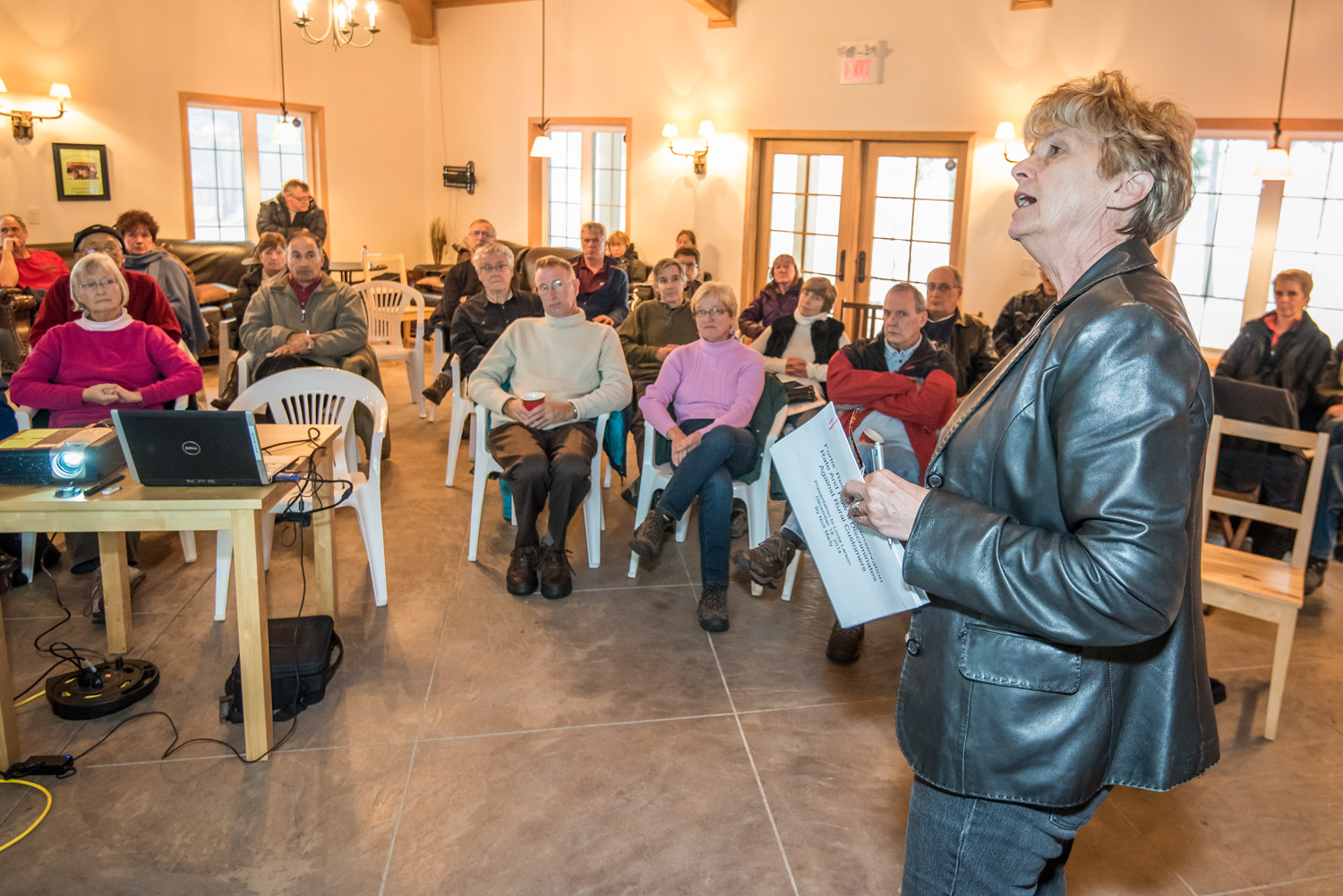
MLA Linda Larson spoke to residents of Anarchist Mountain last Thursday after hearing their concerns about two-tier electricity prices. (Richard McGuire photo)
The two-tier electricity rate charged by FortisBC is a case of misguided policy that discriminates against rural residents without access to natural gas.
That’s the view of Anarchist Mountain resident Nick Marty, who was the main speaker at a meeting on Thursday at the Summit Centre to bring the mountain community’s concerns to Boundary-Similkameen MLA Linda Larson.
When Marty speaks of a “seriously flawed design” of the policy, he has the background to back up his opinion.
As a federal official who retired in 2007, he worked extensively for several decades in energy conservation policy design and energy regulation at senior levels with Natural Resources Canada and the National Energy Board.
The problem, said Marty, is that the two-tier rate structure is intended to fulfill the B.C. government’s 2007 BC Energy Plan goal of encouraging electricity conservation.
In fact, he said, for most customers it has the opposite effect, actually encouraging consumption.
And the minority, about eight per cent of customers with no access to natural gas, end up paying much higher bills to subsidize rate cuts to the majority.
Using a PowerPoint presentation with charts and graphs, Marty explained that the B.C. Utilities Commission (BCUC) ordered FortisBC to implement two-tier pricing for electricity known as the Residential Conservation Rate (RCR).
Instead of the flat rate of 9.447 cents per kilowatt/hour (kWh) that existed before July 1, 2012, the utility introduced a lower rate for the first 1,600 kWh used and a higher rate for any electricity used above the 1,600 kWh threshold.
Those rates have since been raised and are now 9.093 cents per kWh for the lower tier, Block 1, while the higher tier is now charged at 13.543 cents per kWh.
In theory, this should encourage customers to reduce their consumption of higher-tier electricity in order to have all their electricity billed at the lower rate.
The problem, as Marty pointed out, is that B.C. is divided into a majority residents, mostly urban, who have access to natural gas, and a minority, mostly rural, who rely on electricity for space and water heating.
A typical rural customer therefore uses about four times as much electricity as a typical urban customer who has access to gas.
In fact, he argued, about 77 per cent of energy used in B.C. homes is for space and water heating.
As a result of this policy, 68.5 per cent of FortisBC electricity customers actually were billed less under RCR than they would have been under the old flat rate.
And close to a third of customers saw their bills reduced by more than 10 per cent.
Even FortisBC acknowledged in a report to BCUC that these bill reductions were achieved by electricity consumers “without having made any efforts towards conservation behaviour.”
Worse, as Marty argued, the lower rate actually encourages consumption.
“The basic law of economics is that if you want people to conserve, you don’t lower the price,” Marty told the meeting. “If you lower the price, and they consume more, it’s a given.”
Those bill reductions are largely subsidized by the 8.4 per cent of customers experiencing an increase of more than 10 per cent of their bills because they rely on electricity to heat their homes and water in the winter, Marty said.
His own bill increased by about 20 per cent, he said, noting that his consumption actually went down and that he uses an environmentally friendly geothermal heat pump.
The effect of the misguided policy, Marty said, will be to encourage rural residents to rely increasingly on burning wood for heat, which produces more emissions.
Even more frustrating for Marty and other Anarchist Mountain residents at the meeting is they have been unable to get FortisBC, the BCUC or the provincial government to take their concerns seriously.
FortisBC argued in the company’s submission to the BCUC that any move away from the current policy would only benefit “a relatively small percentage of customers at the upper end of the consumption spectrum.”
The BCUC issued an assessment of the RCR saying “preliminary evidence demonstrates that the RCR is achieving its intended results.”
Marty emailed B.C. Premier Christy Clark in March 2014 asking how the RCR could be consistent with the government’s policy that aimed to have “all” British Columbians take steps “for conservation, energy efficiency and clean energy.”
Despite the email being copied to media, opposition party critics and Larson, the premier’s office ignored the email until Larson’s office intervened to ask the premier’s office to respond.
When the response finally came in September, it put the onus on the BCUC telling Marty: “We would encourage you to continue working with the BCUC and FortisBC to address your immediate concerns about the rates you’re being charged.”
Similar advice was given to Marty by Energy Minister Bill Bennett.
Mark McKenney, president of the Anarchist Mountain Community Society, told the meeting these responses from the provincial government are “blow-off letters,” like the letters that Anarchist Mountain residents have received from the BCUC.
“I know the template that’s used for this,” said McKenney, adding that he has worked in government. “It’s ‘go away.’ We’re not going to go away.”
When Larson addressed the meeting, she encouraged residents to keep writing letters.
“Every letter that comes to our office, we make sure that it goes to the right entity, if we take them ourselves to the BCUC,” Larson told the residents.
In the end, Larson pledged to bring the residents’ concerns to Bennett and said she would ask Bennett to meet with them.
“I know what your issues are and you’ve got some fairly large homes here and they’ve only got electricity,” Larson told the residents. “Why don’t you take a look at the town of Hedley? If you think people are suffering, that’s where they’re suffering. Hedley’s local houses have no insulation to speak of. They’re 100 per cent electricity and they are also the lowest income you could find anywhere.”
Larson acknowledged Marty had “a couple of good ideas” in his presentation though she dismissed the notion there is a deliberate plan to make rural residents subsidize urban electricity consumers.
“I don’t believe that it was a conspiracy to take money from the few rural areas, so that part (of Marty’s presentation) I can’t agree with,” Larson told the residents. “But I do believe that this was not done in a way that they thought about the impacts that would happen.”
The BCUC, she said, was charged by the province to come up with ways to conserve electricity and the two-tier approach was the one they chose.
“Fortis didn’t ask for a two-tiered rate,” Larson said. “They were given it by the BCUC as a way to do conservation. So I don’t agree with it, I never have, and I can say we have fought steady. The minister Bill Bennett has also stood alongside us, intervening with the BCUC to try to get them to change their minds.”
Larson noted that the BCUC is an arms’ length agency so the government can’t tell it what to do.
This suggestion prompted skepticism from McKenney.
“I’ve worked in governments at quite senior levels and I find it very difficult to believe that the Minister of Energy couldn’t have lunch with the chairman of the BCUC and say ‘fix this’,” said McKenney. “And it would be fixed.”
Larson also said Boundary-Similkameen is an exception and she is just one voice.
“This riding is really the only one in the province that is affected to the degree that Nick has pointed out here,” Larson said, later explaining that other parts of the province have better access to natural gas.
RICHARD McGUIRE
Osoyoos Times
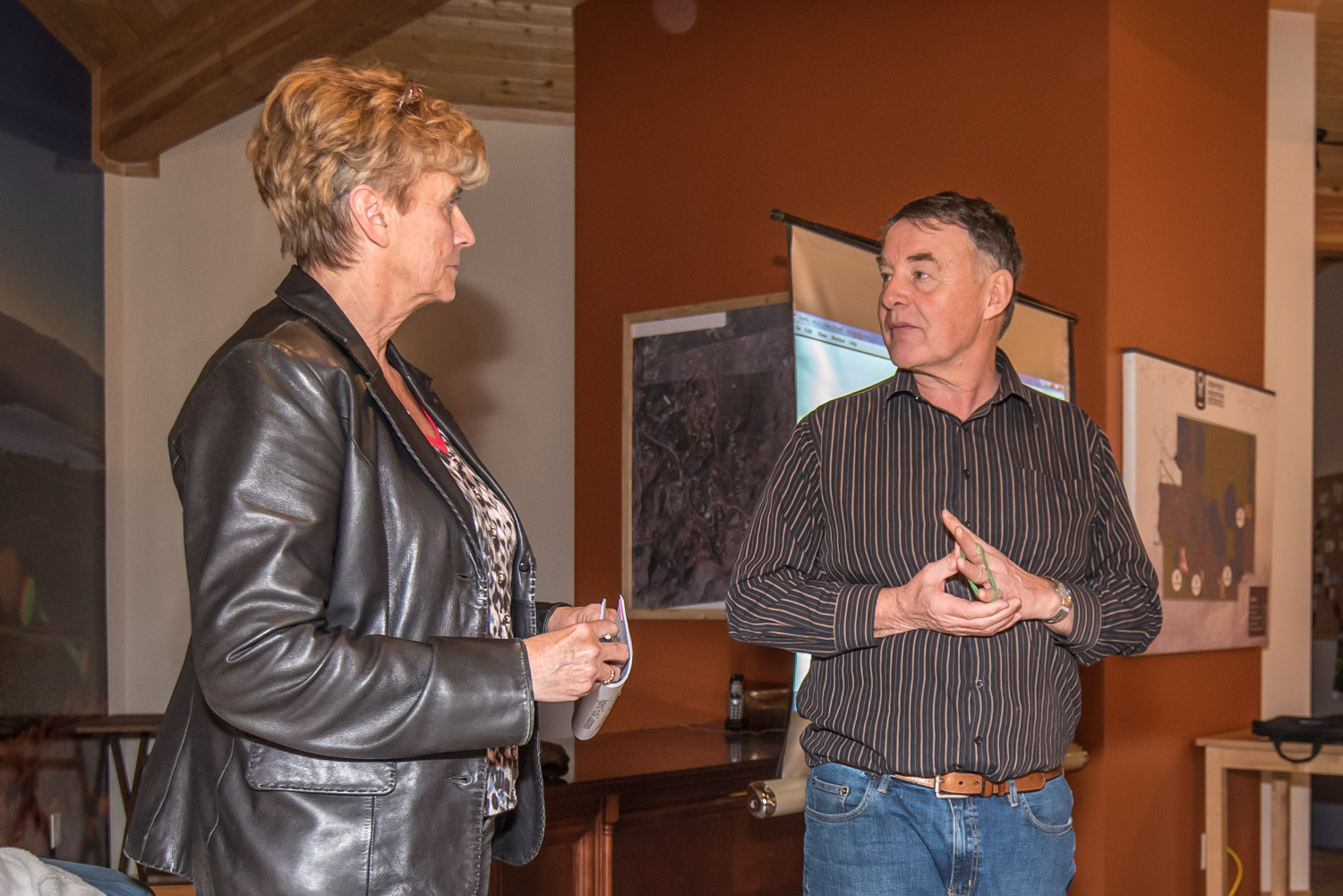
MLA Linda Larson speaks with Mark McKenney, president of the Anarchist Mountain Community Society, after hearing community concerns about two-tier electricity rates. (Richard McGuire photo)