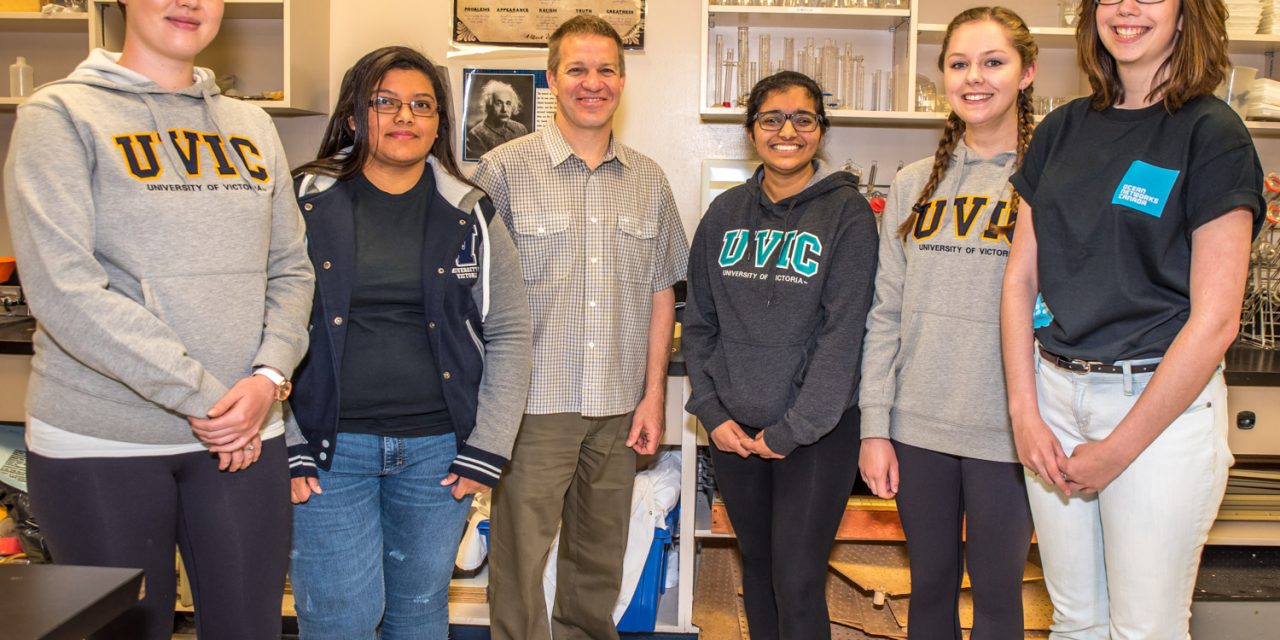

Five of teacher Peter Gajda’s students have returned from a two-day symposium at the University of Victoria about oceans and marine biology. From left are: Sara Smiley, Flor Ribas, Gajda, Jasdeep Sandhu, Hannah Shiels and Julia Mocci. (Richard McGuire photo)
When Sara Smiley, a student at Osoyoos Secondary School (OSS), mentioned to her teacher in late February that she was interested in a career in marine biology, she had no idea where the conversation would lead.
Fortunately for her and four other OSS students, her teacher was Peter Gajda, who believes the classroom doesn’t end at four walls.
And, coincidentally, he had just learned that the Fourth Annual Ocean Science Symposium was taking place at the end of April at the University of Victoria.
Gajda applied and five students were accepted for this two-day event geared to high school students and educators with an interest in marine science and technology.
“The timing was perfect, so I contacted Ocean Networks Canada and said, ‘Hey, I can bring some students if you can help me out,’” Gajda said.
The school received funding from the university to bring five students and that funding was topped up by OSS and the parent advisory council, with the students themselves paying a small amount.
“It was actually over their allotment, but they really were looking for an inland school, away from the ocean, that would be interested,” said Gajda.
In addition to Smiley, the other four students travelling to Victoria were Flor Ribas, Jasdeep Sandhu, Hannah Shiels and Julia Mocci.
For anyone interested in oceans, this event fit the bill. There were activities touching on the disciplines of biology, chemistry, physics, engineering, geology and social science.
The high school students met grad students and expert oceanographers.
“Honestly, I recommend it to anybody,” said Sandhu. “You might not even be interested in the ocean, but if you go you will see other people at U Vic who are so passionate about the ocean, it actually increases your own interest.”
Those living on land don’t often think about the oceans and human impact on them, she said.
Smiley said she developed her passion for the ocean when she lived on the coast for six months as a five-year-old.
“I really love animals, especially marine animals,” she said. “I’ve always gone to the aquariums and I’ve always loved the ocean.”
Her early memories were of Gabriola Island where she got exposure to the ocean and started loving it, she said.
“I have a lot of good memories of being on the coast with my grandparents.”
Among the many guest speakers at the event was Sarika Cullis-Suzuki, a marine biologist and daughter of environmentalist David Suzuki. She talked about her research, obtaining her PhD and about the current threatened state of the oceans.
On the first day, the students rotated through stations where they learned about such topics as hydrothermal vents and the impact these have on ocean life.
They also covered such topics as Arctic ice and even learned about the design of autonomous underwater vehicles (AUVs) which they employed their engineering skills to try to design.
“We created little AUVs ourselves out of little materials and rated them and had a little competition on who could make the best AUV,” said Sandhu.
Gajda explained that many of the topics the students covered tied into their curriculum. For example, the AUV exercise fitted in with course content on buoyancy.
“In the curriculum, there’s a lot of talk about density and buoyancy,” Gajda explained. “So it’s a great lab where you can tie it to real-world applications. Here’s how they build a rover that can go down underneath and collect data. So it’s quite exciting.”
The information the students learned about hydrothermal vents, geothermally heated water typically in areas of volcanic activity, which are rich in life, tied in with topics covered in Biology 11, Shiels said.
Also linked to their biology course was information about the food chain and what would happen if an organism was taken out of the chain and how that would affect other organisms, she added.
“Going there is just a huge eye opener on the damage we are doing to our planet and the oceans especially,” said Sandhu.
Smiley may be the only one of the girls currently looking at a career in marine biology, but it’s safe to say this lesson in the classroom beyond the school’s walls also planted a seed of interest for the other students.
RICHARD McGUIRE
Osoyoos Times