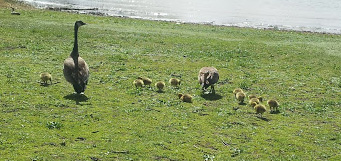
 It may have ruffled a few feathers but Town officials say their unorthodox method of goose population control is working.
In accordance with the Okanagan Valley Goose Management program, the Town issues a temporary bylaw exemption to six local hunters specifically for the purpose of hunting Canada Geese.
These exemptions allow the permit holders to discharge firearms on specific areas of public land during the provincially-established hunting seasons. The holders must also follow all provincial and federal hunting regulations and receive permission from affected land owners before discharging a firearm.
The geese hunting seasons run from September 20 to November 28, December 20 to January 5 and February 22 to March 10.
Municipal manager Tom Szalay said the Town initiated the bylaw exemption six years ago because the number of resident geese had started to inhabit the valley year-round.
Szalay said the excessive number of geese, or rather their droppings, which had begun to blanket local parks, beaches and sports fields, had caused serious health concerns within the community.
According to the Internet Centre for Wildlife Damage Management, a single goose can defecate up to 1.5 pounds of feces each day and research has shown that the excrement of geese contains a wide variety of pathogens capable of infecting humans. Geese can also be a means of transmitting diseases in ways unrelated to their defecation.
Research conducted by the ICFWD also indicates that a large number of geese concentrated in one area for an extended period can also have a negative impact on water quality.
However, the Centre’s research also shows that only a handful of these pathogens are significant to humans. These pathogens can include parasites, bacteria, viruses and fungus.
But Szalay noted the Town’s priority is the safety of its residents.
“It got to the point where we had to issue warnings because people couldn’t use the beach,” he explained.
Szalay said the Town has been able to pinpoint problem areas and focus efforts. Since they launched the program, he added, the number of non-migratory geese has decreased exponentially.
Szalay noted the Town also uses another, more conventional method known as “addling,” and is one of several communities within the valley to resort to it to prevent geese from “overwintering” in public spaces.
Egg addling involves shaking eggs or coating them with non-toxic biodegradable food-grade corn oil within 14 days of incubation to make them non-viable.
Once addled, eggs are returned to the nest. Geese continue to incubate until they realize the eggs will not hatch. At this point, it is generally too late in the year to produce more eggs. Adults are not harmed and will continue with their regular life cycle.
Kate Hagmeier, program coordinator of the Okanagan Goose Management Program said this is a minimally invasive approach to solving the goose problem.
Hagmeier noted that the birds are largely descendants of young geese and eggs that were brought into the Valley in the 1960’s and 70’s to encourage the creation of an Okanagan goose population. What was not foreseen at the time, she explained, was the inability of these geese to migrate because they had no natural parents to teach them. Instead, they adapted to the Okanagan climate and were inadvertently to remain.
Hagmeier said since the program began in 2007, approximately 7,700 eggs have been prevented from hatching. Taking into account the natural mortality of young through predation or nest failure, that is equivalent to about 5,800 fewer geese in the valley.
“It’s a broad approach to dealing with this,” she said.
“We’re not looking to wipe out a population of geese. We’re trying to restore balance.”
A statement issued on behalf of the BC SPCA indicates the organization supports this technique and is recommending it be used as an alternative to lethal measures.
Erin Christie
Oliver Chronicle