Sophie Gray
Local Journalism Initiative
B.C. Minister for Health Adrian Dix told British Columbians that this summer is going to be different than any we have seen before as the province enters into the warmer months of the year under continued COVID-19 restrictions.
“This will be a different summer than any of us has ever known,” Dix said during the April 4 update from Victoria. “But it can be a summer of renewal if we hold fast to the rules and guidelines Dr. Bonnie has set for us.”
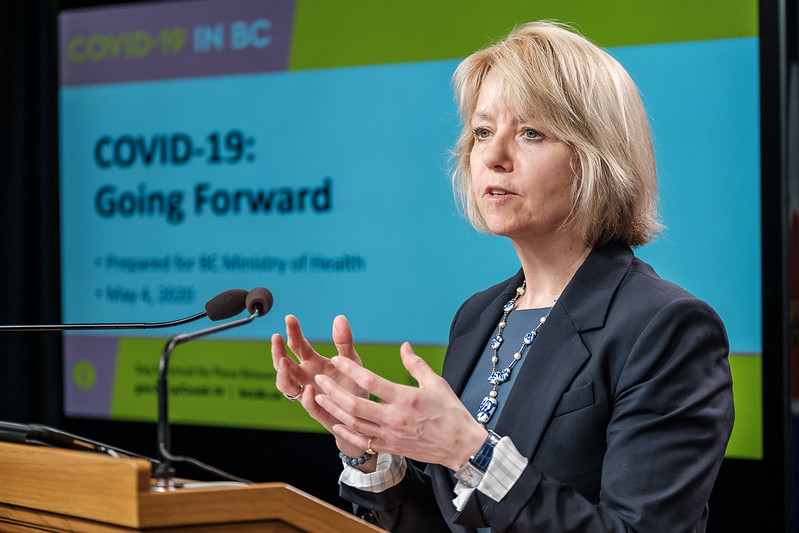
The impact of those rules was outlined during today’s update, which included a lengthy presentation on modelling and statistics around the impact of COVID-19 in B.C.
• Read more : B.C. Modelling – COVID-19 Going Forward
According to provincial health officer Dr. Bonnie Henry, the largest number of COVID-19 cases are in people between the ages of 30 and 60, but COVID-19 appears to be of the biggest risk to men, who account for 72 percent of deaths. The majority of those deaths are in men over the age of 60.
This statistic shows that men are disproportionately affected by the COVID-19 virus. Although they are less likely than women to get the virus, men are much more likely to need hospitalization or critical care and are also dying at a much higher rate than women.
“This is a phenomenon that we’re seeing around the world, that men are more likely to have more severe illness, to require hospitalization and to die from COVID-19,” said Dr. Henry. “And we really don’t understand why. There’s a lot of work going into trying to understand that phenomenon.”
In B.C., healthcare workers account for 428 reported cases of COVID-19, or 21 percent of cases. Most of these, said Dr. Henry, were in young, healthy women, with a recovery rate of 85 per cent. Only 11 per cent of healthcare workers who tested positive for COVID-19 were hospitalized or need critical care and only one has died.
The modelling continued to reinforce how much age, gender and chronic conditions increase the chance of catching this virus, with 1,373 of the confirmed cases in B.C. having at least one underlying risk factor.
Further data demonstrated that the province is continuing to flatten the curve. B.C. is seeing a continued decrease of people in critical care, with a substantial number of critical care beds and ventilators available even while new cases continue to come in.
Dr. Henry said that this statistic and the steady number of case increases per day without large spikes are good news. We will not wipe out the virus, she said, but we are at “the end of the beginning” of the pandemic.
“We haven’t stopped the car and it’s very unlikely that we’re going to be able to do that in the coming months,” she said.
What that looks like going forward, said the doctor, is continuing to maintain physical distancing, using engineering controls like plexiglass in grocery stores as a physical barrier to virus spread, and wearing personal protective equipment when physical distancing can’t be maintained.
But expanding our social interactions might be possible.
Dr. Henry used a series of graphs to show the predicted rise in cases by the amount we increase our social interactions. Right now, she explained, with current restrictions and physical distancing measures in place, B.C. residents are at roughly 30 per cent of the interactions people were having back in December. The predictions shown during today’s presentation say that it may be possible to increase those interactions up to 60 per cent of normal without a large spike in case numbers.
Dr. Henry is hopeful that B.C. will be able to slowly get to that 60 per cent mark, but only if people are safe and diligent.
“We need to do that now in a controlled way and a managed way and a safe way,” said Dr. Henry. “Until we have a vaccine, we know it’s going to be here in some way and our job, our role, our goals in the next months is to ensure that we learn how to live with this virus in a safe way that protects people.”
On top of the modelling presentation, Dr. Henry and Dix announced 53 new test-positive cases and three deaths since Saturday’s briefing. There are now 177 cases in the Interior Health region, with 2,224 cases total in the province. To date, 1,417 people who had tested positive for COVID-19 have recovered.