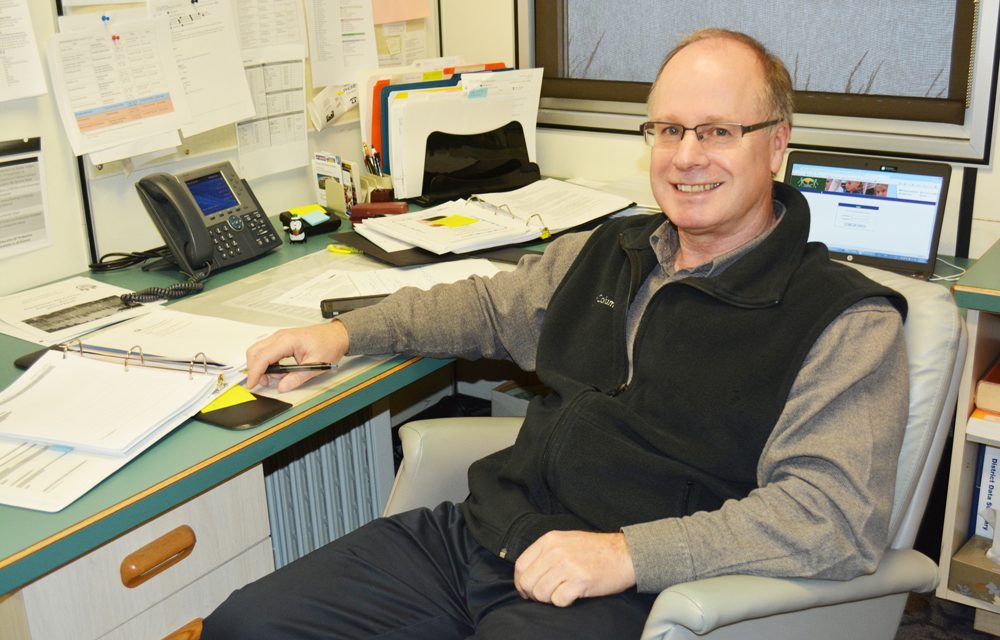

Assistant Superintendent Jim Insley is preparing to say farewell and enjoy his retirement from education.
Lyonel Doherty photo
(We asked Assistant Superintendent of Schools Jim Insley about his upcoming retirement and put the squeeze on him. But we didn’t have to squeeze very hard.)
Q: How does it feel to retire?
A: I think it’s feeling good, but it’s been so busy, I haven’t had much time to think about it. I believe I’m ready and am looking forward to the future and freer use of time.
Q: How long have you worked in education?
A: Thirty-six years. Began as a substitute teacher in Courtney-Comox district in January 1979.
Q: What accomplishments are you proud of in this district?
A: So many! I came here as the principal of Tuc-el-Nuit 23 years ago and was really proud of what we as a staff accomplished there. Had a very talented group of teachers and support staff who were willing to work together there to develop a collaborative school plan through a process that included participation of parents and all staff members, CUPE and teachers. I went to Osoyoos for one fabulous year, where staff really wanted to move the culture and educational agendas forward.
I realized early in my career that buy-in and commitment are gained when the people for implementing a decision are involved in making it. Many of the great ideas have come from the field in what I once called “forums of dialogue.” It’s amazing what can be accomplished when people work together in an open process to solve a problem or improve a situation. If I am to take some credit, it should be for staying current and recognizing when an idea fits with good practice and the goals of the district, as well as being willing to change my thinking around a problem, concern or initiative. I always look for initiatives that are going to positively affect the learning of students.
I am very proud of the work Helen Gallagher and our aboriginal support workers have done in aboriginal education under the guidance of the Aboriginal Education Advisory Council. We are doing some wonderful work in social emotional learning and our career programs are second to none.
Q: What challenges do you see for the board?
A: Funding is always a challenge. There is never too much! I think the challenge for any district is to find a balance in the use of available funds. We tend to get hung up around class size due to the union rhetoric and forget that there are other critical parts of the system. For example, good management and leadership practice demands that administrators have the necessary time to supervise and lead. Our goals should always be directed towards good learning experiences for our students, so no matter what, we need to invest in the growth of our teachers and support staff to build on their knowledge, skills and repertoire in facilitating the learning of students. The “Team Inquiry Model” is a great example of how we can invest in better learning without it costing money.
Q: If you were given $10 million to spend in this district, where would you put the money?
A: That’s a lot of money! To make the biggest impact I would invest it in a strong staff development strategy with a strong focus on classroom instruction. Part of this would be to use some of our strong teachers as coordinators in specific areas (literacy, numeracy, assessment, technology, etc.) and to set up a mentor program for new teachers with less than five years experience. Just think of the impact this would have for generations of students.
Q: What is your best advice to students?
A: Everyone of you has a gift and you need to work hard to find what makes you happy and provides you with a meaningful life. When you are knocked down or haven’t been successful, just pick yourself up and try again. Believe in yourself!