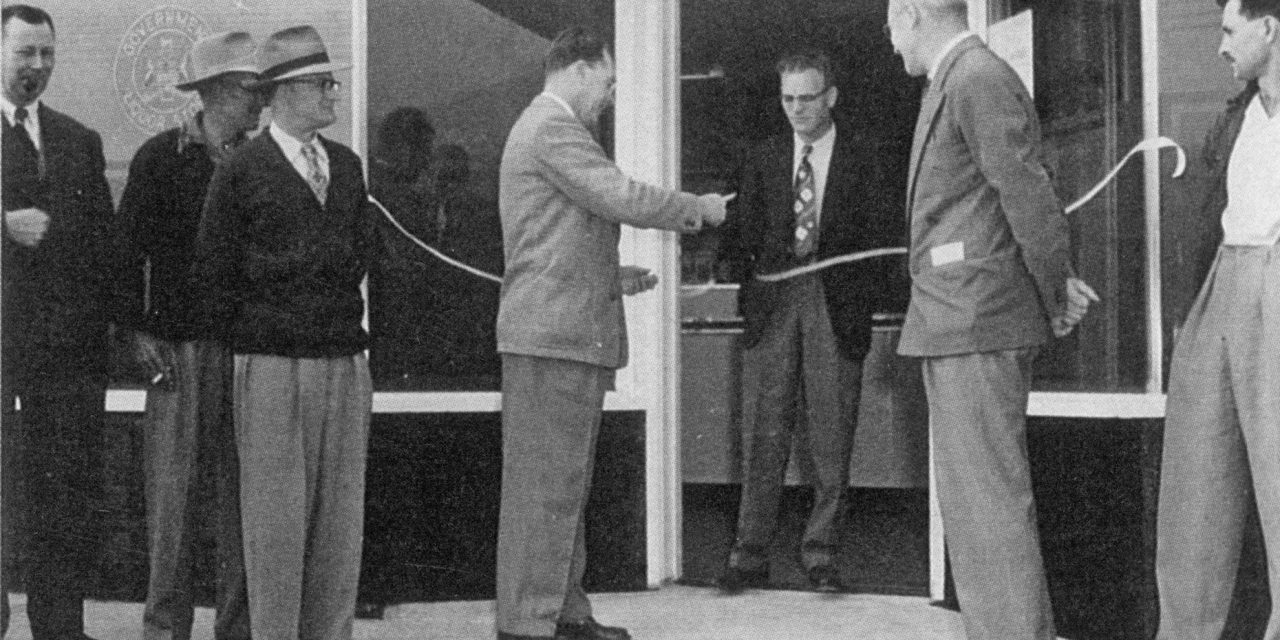

After many years of having to travel to Oliver to buy liquor, Osoyoos finally got its own liquor store in 1954. The store was located where Advanced Fitness is now. Attending the ribbon cutting ceremony were (from left) Roy MacDonald, Harry Hesketh, John Wargosivik, Chuck Emery (chairman), Johnny Martin (LCB), unknown and Stan Stodola, then publisher of the Osoyoos Times. (Osoyoos and District Museum and Archives)
Rivalries between neighbouring towns or cities are common around the world. But usually they revolve around trivial matters such as competing sports teams.
The depth of animosity between Osoyoos and Oliver, however, has deep historic roots and it can surprise those of us who came here more recently.
Not until Osoyoos Secondary School was threatened with closure in 2016, along with plans to once again ship Osoyoos students to Oliver, did I understand the bitterness.
When I sat down recently with a group of Osoyoos old-timers at the home of Ruth Schiller, the word “hate” came up quite a few times when I asked about their school days in Oliver.
That sentiment continued into adulthood.
“Were the Oliver kids friendly to you?” I asked when they talked about riding the bus each day to school in Oliver.
“No! No!” they responded in unison.
“They didn’t want you going to their school, their scout hall,” said one. “There was a lot of friction.”
There were battles at recess between students of the two communities. The Osoyoos kids often got along better with kids from Okanagan Falls, one told me.
That animosity continued into adulthood with the perception that Oliver got everything and Osoyoos got nothing.
“They had the liquor store. We had no liquor store. They had a government office. We never had a government office. If you wanted your license for your car or your truck, you had to drive to Oliver and get license plates,” said Don Brunner, 80.
When Osoyoos finally got its own liquor store in 1954, and got the ability to obtain license plates here, that attitude toward Oliver became, “That’s all we need. To hell with you.”
The bitterness peaked in the early 1970s when Oliver got the South Okanagan General Hospital to replace the old St. Martin’s Hospital.
The old-timers recall a tense meeting in Oliver about the hospital in which people from the two communities lined up on opposite sides of a football field and the anger boiled over. It came close to violence.
“It was like the Hatfields and the McCoys,” said Brunner. “I will never go to another meeting like that again.”
Brunner concedes that because Osoyoos “was at the end of the line,” he understands why the government would locate the hospital in Oliver, especially since St. Martin’s was already there.
The Osoyoos students rode the bus each day to Oliver, and George Fraser, 82, recalls one bus having bench seats that ran from back to front along the sides.
The grade 12 students were seated at the back and the grade 7s at the front. When the driver hit the brakes, the older students slid forward into the younger students.
Having to ride home on the bus after school put the Osoyoos kids at a disadvantage when it came to looking after plants the students grew in a greenhouse.
As the Osoyoos students took the bus home, Oliver students could stay after school to tend their plants and then walk home. The Oliver kids’ plants thrived, while the Osoyoos kids’ plants withered and died.
Gerald Pendergraft, 82, recalls that he and another Osoyoos student decided to get revenge.
“We stayed after school one day,” he said. “We took a pencil and went down by each root of the tomato plants and then poured fertilizer down and sealed it off. A couple of days later, all their plants died too.”
Ruth Schiller, 93, said she’s tired of trying to explain the animosity between Osoyoos and Oliver.
“We just don’t like each other,” she said. “That’s been going on forever… It’s not going to change.”
RICHARD McGUIRE
Osoyoos Times