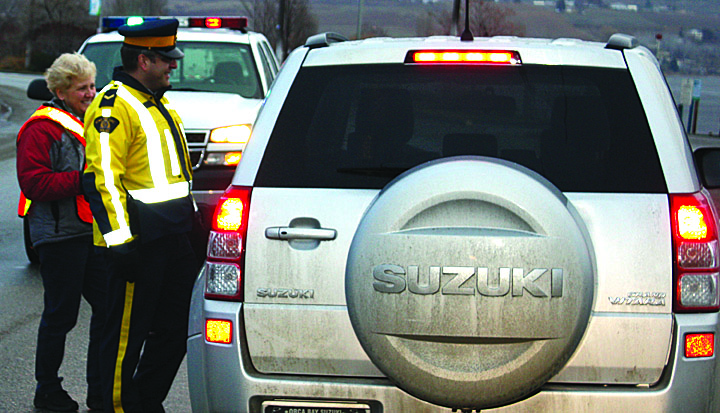
The holiday CounterAttack campaign began on Dec. 4 and on Dec. 21 Cpl. Jason Bayda of the Osoyoos RCMP set up a roadblock with ICBC’s road safety coordinator, Christine Silver. The pair was checking to find out if anyone had been drinking and also to warn drivers that the RCMP will be out over the holidays looking for anyone driving under the influence. Photo by Laurena Weninger - Click on picture for larger image
OSOYOOS TIMES-December 23, 2009
By Paul Everest – Osoyoos Times
Local police want you to arrive home safely this holiday season, so they are letting the community know they’ll have their eyes open for impaired driving during the period around Christmas and New Year’s Day.
“This time of the year, certainly with all the office parties and the celebrations, we usually gear up that there is significantly more impaired driving cases in December and January,” said Staff Sgt. Kurt Lozinski, commander of the Osoyoos RCMP detachment.
Someone who has been drinking and has ended up behind the wheel could face a number of penalties if caught by police, including charges of impaired driving or a 24-hour driving prohibition.
Lozinski said an RCMP member could lay charges based on several factors.
If an officer is following a vehicle and it is all over the road, he or she can lay an impaired driving charge straight away.
A member can also decide to issue a charge or charges based on physical descriptors that someone is impaired.
“Their motor skills, their red, blood-shot eyes, there’d be an overwhelming odour of liquor on them,” Lozinski said. “Slurred speech, they’re high-handed trying to get their licence out of their wallet and it falls.”
He acknowledges that some of these characteristics can be attributed to nervousness associated with getting pulled over by a police officer.
“That’s why our members are trained to look past that.”
Lozinski said there are other factors that could raise an officer’s suspicion.
“As in somebody lighting up a cigarette as soon as they pull over. Chewing fresh gum. Some people wonder why we sit and talk to people for a duration and we try to get up close. There’s not many things that can mask all the symptoms of impaired driving.”
Should a member require more proof of impairment, he or she can escort a driver to the detachment office where a technician would analyze breath samples.
When an impaired driving charge is issued, the driver cannot operate a vehicle for 24 hours.
Impaired driving charges can mean a penalty of $1,000 for the first offence, 30 days in jail for a second offence and 120 days in jail for a third offence.
Anyone caught driving under the influence of alcohol or drugs faces a maximum life sentence if they cause death when their blood-alcohol concentration exceeds 80 milligrams.
The difference between charges and a 24-hour suspension comes down to whether a person is impaired and has a blood-alcohol level over the limit (80 milligrams of alcohol per 100 millilitres of blood) or whether a person has had something to drink, is under that limit, but should not be driving.
While the Criminal Code sets a blood-alcohol concentration threshold of 80, the Motor Vehicle Act sets a threshold of 50.
Therefore, if a police officer determines that a driver has a concentration above 50 but under 80 using a test such as a “roadside screening device,” a 24-hour prohibition can be issued.
Such a device registers a “pass,” “warning” or “fail” based on a person’s blood-alcohol content and is different from a breathalyser.
“If you blow and you’re under the (80 milligrams) legal limit then you’d be given a warning, a 24-hour (prohibition from driving) all based on your driver’s licence,” Lozinski said. “If it shows a fail, then you’d be escorted back to the detachment.”
A 24-hour suspension can also apply to someone driving under the influence of drugs.
Charges or a prohibition would mean the driver would have to walk home or call a friend or taxi.
The vehicle could be left where it is if it’s legally parked, Lozinski said.
If not, the vehicle can be towed or the police can take it off the road.
“If we feel, and this can be according to a member, that the person may return to get the vehicle once we leave, we certainly have the authority to seize it and impound it.”
Having to walk home or not being able to drive for 24 hours might be the least of a person’s worries when a prohibition is issued.
According to the provincial Superintendent of Motor Vehicles’ website, the prohibition will stay on a person’s record and could be considered by the superintendent in a review of a person’s driving record.
“Drivers who receive two such prohibitions in a two-year period may be prohibited for an additional two months or more by the Superintendent if they have a previous history of impaired driving or driver penalty points in the past five years,” the website states. “Drivers who get a third 24-hour prohibition can be prohibited for three months or more.”
And earlier this year, ICBC introduced a new Driver Risk Premium.
A person would have to pay the premium if they have one or more driving-related Criminal Code convictions including an impaired driving charge or one or more 10-point Motor Vehicle Act convictions.
Lozinski said people should also be aware that they could be charged even if they are in the driver’s seat and the vehicle is only running.
He added that there have been cases where people are passed out behind the wheel while the car is stationary with the keys in their pocket and that person has been charged.
Such a situation could suggest to police that the person could drive at some point while still impaired.
So, he said, anyone who has had a few drinks and maybe wants to sleep it off in the car should sit in the backseat or passenger seat.
“If people are going to be in their vehicle, do not be in the driver’s seat.”
[email protected]