By Sherani Theophilus, Times Chronicle
The Town of Osoyoos is finally nearing completion of the water meter installation project which began back in July 2024. While there are many benefits to conserving water in an area routinely affected by drought, it has taken the town a long time to implement meters.
Neptune Technology Group, contracted for the installation of the fairly simple indoor water meters, has made the town aware that there were delays due to a difficulty reaching snowbirds, and non resident homeowners. There were also delays with some residents not complying with the project.
Rod Risling, CAO Town of Osoyoos felt positive overall, “we’re really pleased with the water metering project. We do have a lot of snowbirds, which has caused a couple wrinkles in the process, but for the most part, it’s been a good project and we’re nearing completion.”
Risling identified the inherent value of meters when asking for any money from the provincial government, “We appreciate everyone’s cooperation in meeting this important objective, which will enable us to be in a better position for grants. For most grants now they want to see that municipalities have asset management plans.”
Water metering is widely deemed essential in areas affected by drought and water quality. Grants from the province have been announced as far back as 2019, however former Osoyoos councils did not agree to go forward with meters.
On May 6, 2025 the Province announced that nineteen very small, rural and First Nations communities will benefit from nearly 15,000 new automated water meters that will be installed. Provincial funding will cover up to 100 per cent of eligible costs.
“Drinking water is an incredibly precious resource,” said Brittny Anderson, Minister of State for Local Governments and Rural Communities regarding the announcement.
“Small and rural communities in BC face higher financial and management capacity challenges, and water metering helps communities identify leaks, conserve drinking water, and keep costs down for businesses and residents.”
Osoyoos did apply for this recent water meter grant but was unsuccessful.
Risling said that every avenue for funding is always explored. He also noted that the $9 million grant for a water treatment plant was given without a conservation and asset management plan in place due to the urgent nature of the crisis. Now those plans are being implemented.
“We were able to demonstrate that there was a strong commitment to these initiatives, and as a result, we were very fortunate to receive the $9 million”.
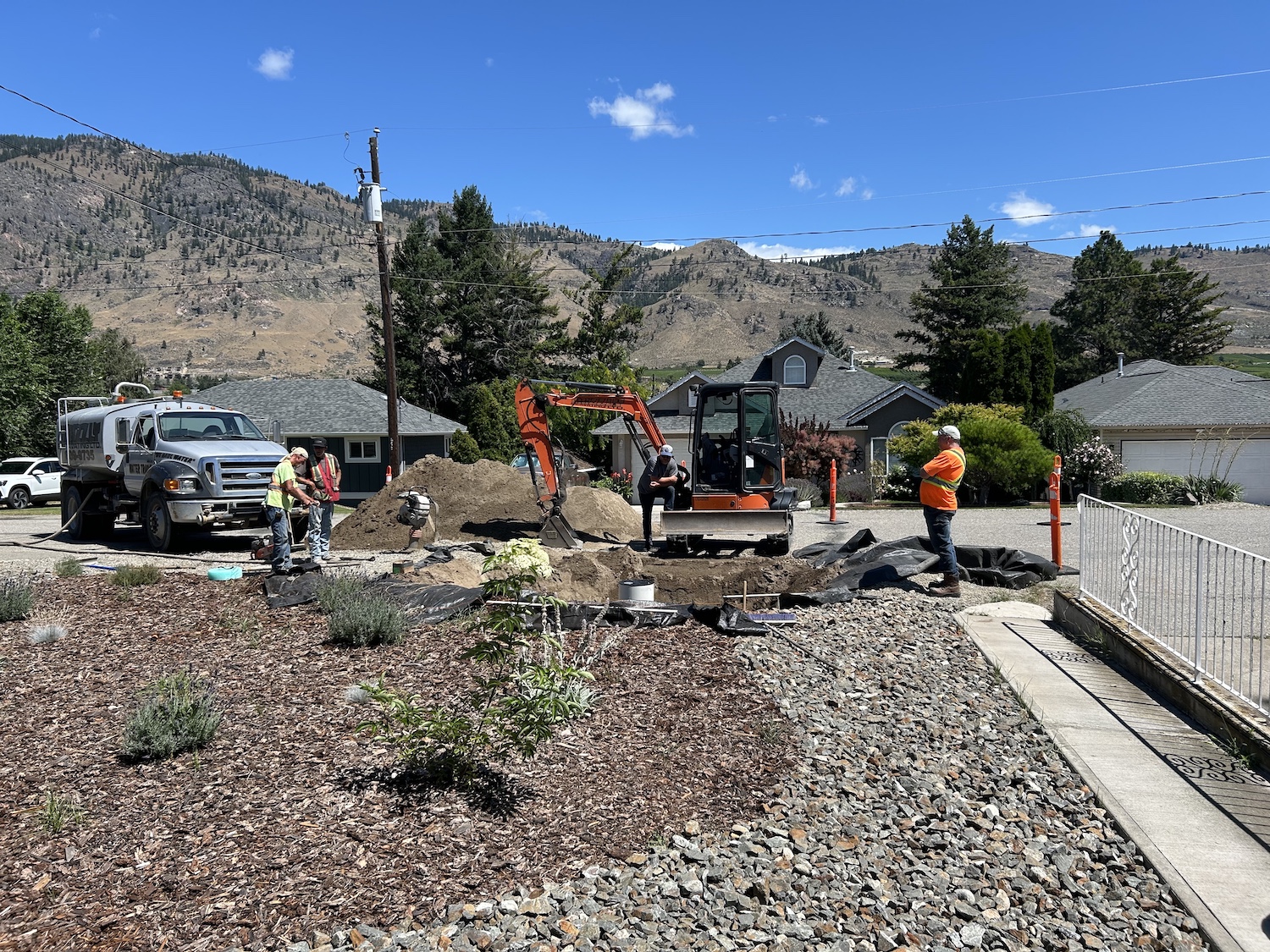
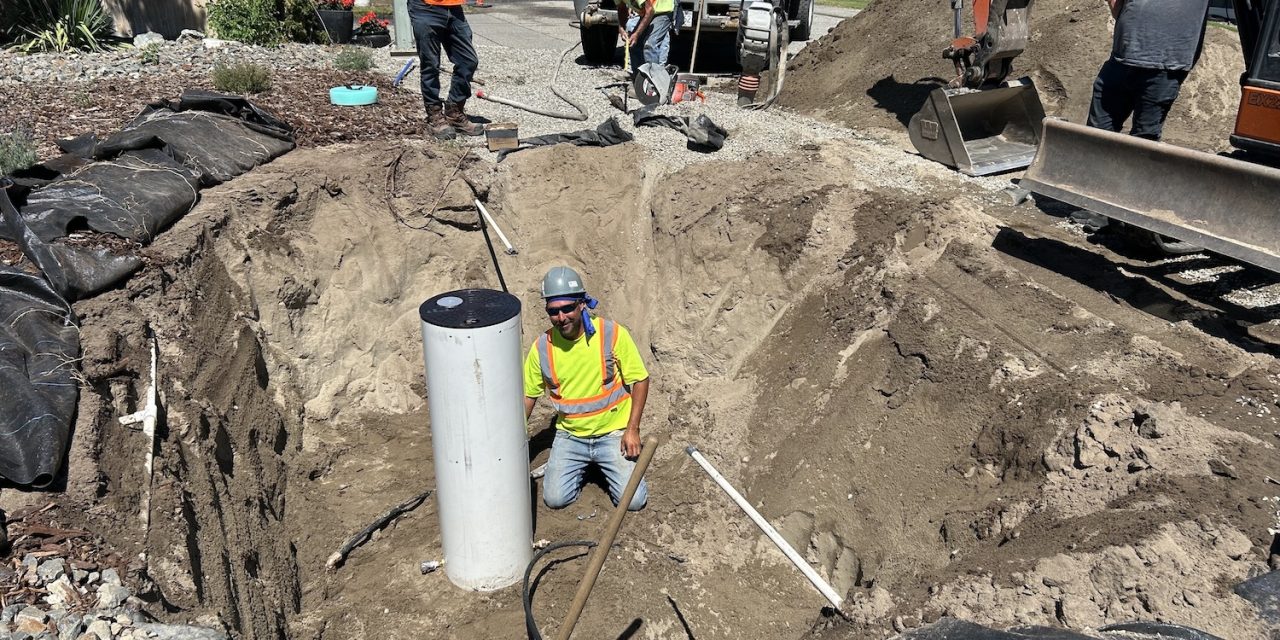
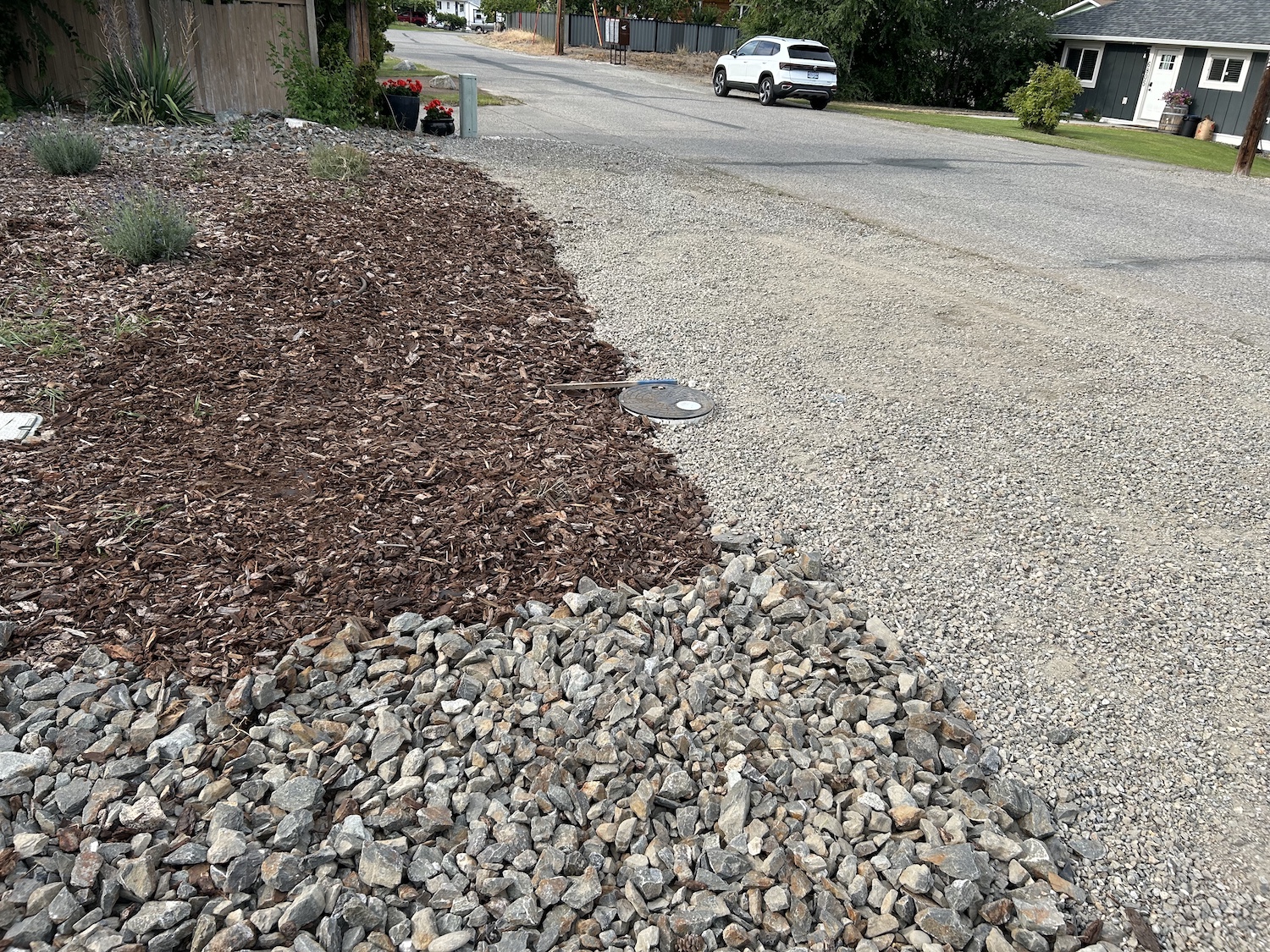
Grizzly has been contracted by the Town of Osoyoos to install pit meters and they have been operating quickly and leaving hardly a trace.
Sherani Theophilus photos
Not every resident is pleased with the installation project. Brian Sorensen contacted the Times Chronicle after over seven months of questioning the validity of the meters being placed in two properties, owned by his parents – one in Osoyoos and one just outside the town in RDOS. He spoke of over 400 emails going to the town staff, town administration, town council, RDOS, BC Construction Standards and Digital Solutions Branch, the home insurer, and Neptune Technology Group.
Speaking to the Times Chronicle, Sorensen said the main issue is that Neptune was subcontracting out of province installers after not being able to find local workers. Installers are certified for this specific installation work but may not be certified journeymen in BC.
Sorensen takes issue with the fact that they are not known to him as sub contractors and also that the BC building code 1.2.3.1 states that
1) Personnel performing the installation, extension, alteration, renewal or repair of a plumbing system shall:
- a) possess a Canadian tradesman’s qualification certification as a plumber,
- b) be an indentured apprentice supervised by a journeyman who meets the criteria set out in Clause (a), or
- c) be the registered owner and occupant or intended occupant of the single family dwelling in which plumbing work will occur.
Marg Coulson, Director of Corporate Services, Town of Osoyoos explained to Sorensen, “Authority to access private properties within a municipality to provide municipal services (e.g. water meters on the water system, whether by staff or contractor) is embedded in legislation, so some of the principles are a bit different than private contracting on a private property.”
It should be noted that Faisal Hasan, Project Supervisor from Neptune did tell Sorensen that, “for water meter installations on service lines less than two inches, a licensed plumber is not required under the Town of Osoyoos bylaw.”
That did not deter Sorensen who has been exhausting every avenue including complaining to the BC Ombudsman. Sorensen was also adamant that a building permit was required.
Stephen Watt, Senior Codes Administrator, Building and Safety Standards Branch responsible for the BC Building Code responded to Sorensen: “The Province doesn’t review plans or enforce the BC codes or provide opinions on the compliance of specific projects. For questions about permits, compliance or enforcement on a specific project, contact your local authority having jurisdiction.”
In Osoyoos that local authority or AHJ (Authority Having Jurisdiction) is the building inspector. This position was vacant for several months and just recently has been filled.
For the RDOS, Mark Petry, Building and Enforcement Services Manager, responded to our question regarding the validity of Sorensen’s insistence that a building permit is necessary for a water meter installation inside a home.
“These installations are generally considered an extension of operational utility work which is consistent with how many jurisdictions manage similar system-wide service upgrades.
“We continue to survey other municipalities regarding their water meter replacement programs and continue to find that it is not common practice to require a formal building or plumbing permit for each installation when the work is being carried out by or on behalf of the utility provider as part of broader infrastructure improvements.”
Sorensen had refused to let anyone enter the homes for months to confirm that it required a standard meter and not a pit meter outside the home and on town property. He recently confirmed that the inspection has been made on the RDOS property and while it’s not deemed necessary to have a building permit for this work, one was being prepared for Sorensen’s parents.
Petry commented on the issuing of the permit, “If a homeowner prefers to obtain a building permit, we are generally willing to accommodate that request. While a permit is not technically required in most cases for this project, we are happy to offer this service upon request.”
Amy Robinson, Deputy Corporate Officer, Town of Osoyoos, has been tasked with contacting those residents who have not responded to the letters requesting access to homes. Many of these are secondary residences and the owners may simply not know.
When asked if anyone is not cooperating with the town for installation, Risling said, “I do know there are some people that are still not cooperating. However, it is important to note that there are very, very few.
“The vast majority have been cooperative, knowing that this is good for the environment, but also good for us to enable us to be able to get a grant. Plus, as everybody knows, we don’t have water and this will enable us to hopefully conserve a little bit more.
“It will be more transparent as to how much water people are using. Our next step is to actually incorporate bills showing people how much water they’re using, so hopefully there’s some motivating factor there for people to actually conserve even more,” Risling added.
So what’s going to happen with people that refuse to cooperate? “Ultimately, if people do refuse, we will be installing a pit meter at their cost. It’s just over $5,000.”