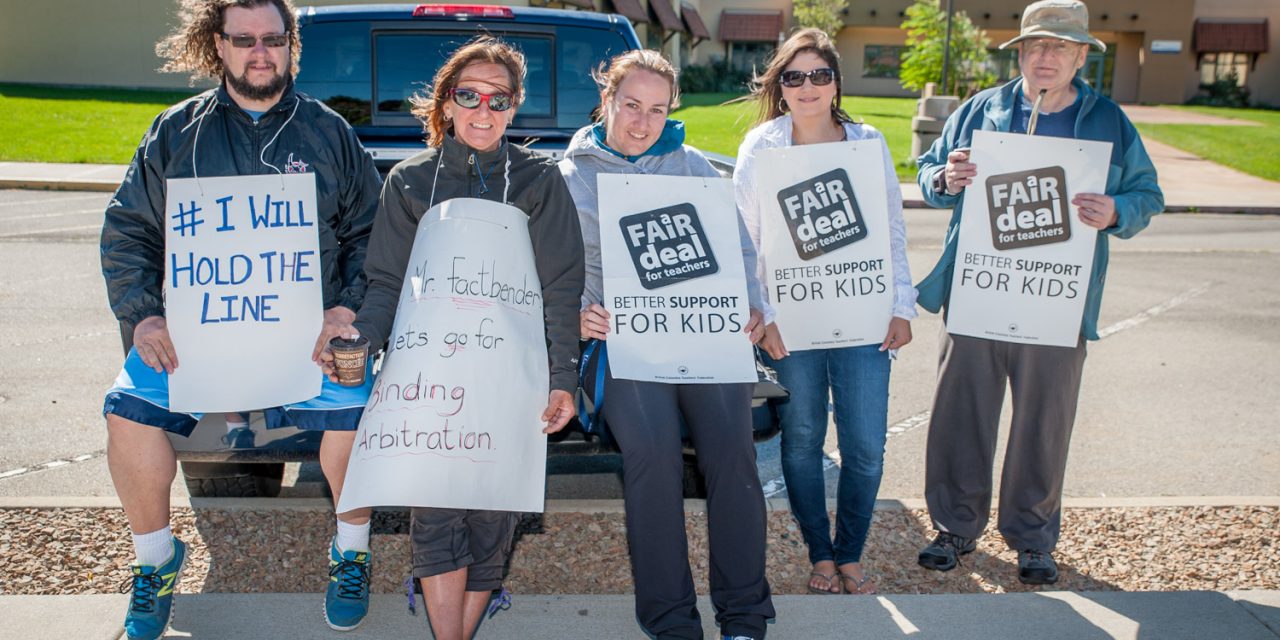
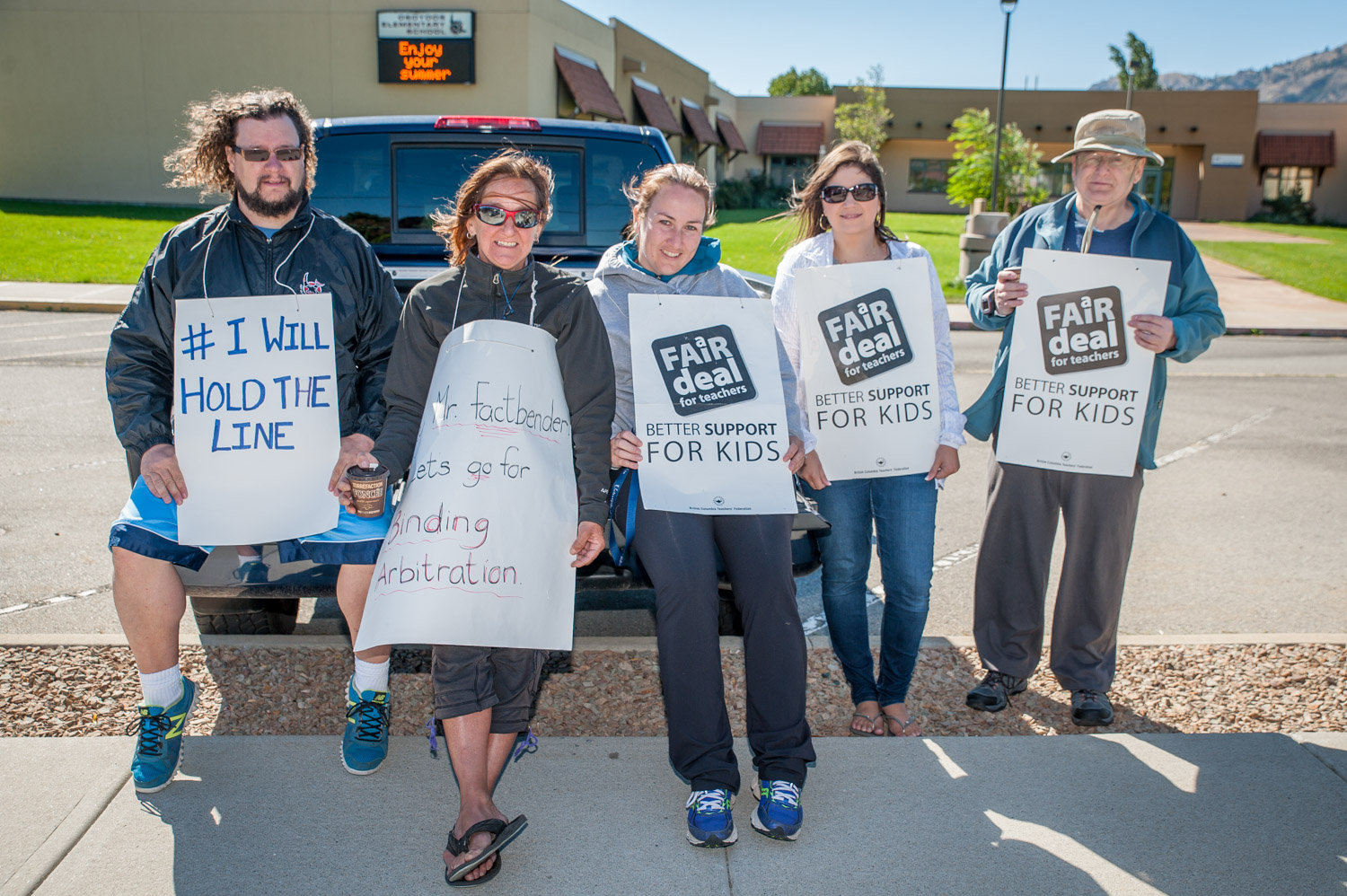
Teachers from Osoyoos Elementary School were on the picket line recently. From left are Richard Bayliss, Margi Chantler, Helen Wollf, Julie Dias and Richard Hoen. A tentative agreement to resolve the strike has now been reached. (Richard McGuire file photo)
Ecstatic.
That’s how School District 53 chair Marieze Tarr feels about the new tentative agreement between British Columbia Teachers Federation (BCTF) and the provincial government, which could see students back to school as early as next Monday.
Teachers are expected to vote on Thursday whether or not to ratify the deal.
“This is something everyone was wanting – a negotiated settlement as opposed to binding arbitration or legislation,” Tarr said on Tuesday. “I heard it will be a six-year contract, so we’ll have labour peace for six years.”
Tarr spoke to teachers on the picket line Tuesday and reported all of them are very happy.
“Everyone is excited to get back in the classroom,” the chair noted.
Tarr believes the relationship with teachers will still be a good one considering it’s a fresh start to the school year.
District 53 Superintendent of Schools Bev Young agreed that the announcement is wonderful news, adding she is relieved this long labour dispute appears close to ending.
Sylvia Slater, president of the South Okanagan Similkameen Teachers’ Union, said she is cautiously optimistic about the deal.
“I haven’t yet seen all of the language but I do know teachers, students and parents want schools open.”
Slater said even if there are significant improvements to the Learning Improvement Fund, complex class composition issues will remain.
“Public education is underfunded in many more areas than just class size and composition,” she said. “Money for supplies and resources including equipment, textbooks and software still remains too low and doesn’t even keep up with inflation.”
Slater said school shop classes are still working with equipment from the 1980s and earlier.
“Cars have changed dramatically since then.”
Slater noted an influx of money is needed as each change comes, but that just hasn’t been happening.
Teresa Rezansoff, president of the BC School Trustees Association, said the tentative deal is great news for students, parents, teachers, administrators, support staff and trustees.
“The immediate goal is to get students back in classes as quickly as possible. We must then focus on the critical work of strengthening our public education system and rebuilding trust,” Rezansoff said.
In a news conference on Tuesday, BC Premier Christy Clark said a negotiated settlement is a “remarkable achievement after 30 years of dysfunction.”
Clark confirmed the six-year proposed contract, which will give teachers and the government time to improve education for students.
“We can work together now rather than constant fighting.”
Clark thanked parents and students for their patience during this “painful” disruption.
The premier said the tentative deal gives teachers a fair wage increase and an investment in classroom composition and teacher support.
She stressed that all of this comes without raising taxes or putting the government in a deficit position.
Clark pointed out that students could be back in class by next Monday.
During question period, Clark was asked how much the deal would cost taxpayers.
Clark said she couldn’t disclose the details until teachers had a chance to review them.
“It is within our fiscal plan,” she said.
Responding to questions about outstanding legal issues, Clark said the agreement would allow the government to settle grievances. But she stated the existing court case (on bargaining rights) would continue.
Education Minister Peter Fassbender responded to a concern about how the government will make up for the five weeks that students have been out of school.
He said school district superintendents will be working on those plans and will be making announcements.
“We guarantee that students’ educational journeys will be kept whole,” Fassbender said.
The deal was reached following a marathon bargaining session that stretched over 13 hours on Monday and Tuesday.
It’s believed to be a six-year deal and was reached after respected mediator Vince Ready brought both sides together for the first time in months this past weekend.
Most observers believe the deal was reached after the BCTF agreed to reduce its demands for wages and benefits and the government offered up more money for class size and composition.
The deal is also believed to include a signing bonus for the more than 40,000 members of the BCTF.
Ready, who is recognized as Canada’s most respected mediator, said both sides worked hard to reach the tentative deal, but he refused to divulge details of the deal.
“After all these hours, I am very pleased to announce that the parties have reached a tentative agreement,” he told reporters. “I’m not at liberty to release any of the details, nor are the parties. The parties are going to meet later this morning and finalize a few of the outstanding details, but generally speaking, there has been a tentative agreement initialized by the parties and that’s really all I got to say at this point.”
Education Ministry spokesman Scott Sutherland said the tentative settlement was reached around 4 a.m. Tuesday.
The B.C. Teachers’ Federation thanked its members through social media for their “commitment, courage and strength” during their months-long strike.
The union’s Nancy Knickerbocker said in a tweet that teachers would read over details and vote on the agreement on Thursday.
She said support workers will also need to clean and prep schools that have been closed since mid-June.
Negotiations resumed last week under increasing pressure from the public and suggestions by the government that legislating an end to the dispute was an option.
Last Wednesday, the B.C. Teachers’ Federation voted overwhelmingly to end their dispute if the government agreed to binding arbitration – something the government firmly rejected.
Teachers launched full-scale job action two weeks before the summer break and students have missed more than two weeks of their new school year.
The federation and B.C. governments – no matter what political affiliation – have a decades-long history of animosity and difficult labour disputes.
More than 40,000 members of the BCTF have been without a contract since June 2013 and class size and composition have been major stumbling blocks in the dispute.
Last January, a B.C. Supreme Court judge ruled the provincial government violated teachers’ rights in 2002 when it declared they could no longer negotiate the size of classes or the number of support staff in classrooms. The province is appealing that decision.
But in an attempt to get movement at the bargaining table, the union began escalating stages of labour action in April.
About two weeks before the end of the last school year, teachers launched a full-scale walkout.
The teachers’ union and the government’s bargaining team barely spoke during the summer, and at the end of July, Finance Minister Mike de Jong announced the B.C. government would pay parents $40 a day for every child 13 and under if the teachers’ strike continued into the start of the school year.
Ready agreed to make himself available in mid-August, but he walked away from the bargaining table Aug. 30, saying the two sides were just too far apart.
Schools remained closed Sept. 2 for half a million B.C. students.
Iker called for binding arbitration almost two weeks ago, saying it was the only solution available to get the dispute settled.
Fassbender panned the idea hours later. He said the province had a bad experience with the process once before, referring to a costly dispute with B.C. doctors more than a decade ago.
The teachers’ union announced 99.4 per cent voted to end the strike through binding arbitration.
LYONEL DOHERTY
Special to the Times